Summary Completion: IELTS Listening Practice

IELTS Listening Summary Completion Exercise

Summary completion listening questions are similar to sentence completion questions. The difference is that the summary is in a paragraph form rather than disconnected, individual sentences. The difficulty level of this exercise is typical of IELTS Listening Section 4.

First read through the summary and predict the types of answers you need for each gap. You will always have time to review the questions before the recording starts. However, the time is brief so you will need good speed reading skills.

Listening Summary Completion for IELTS

The Terracotta Army

Questions 1-5: Complete the summary using no more than three words and /or a number.

The terracotta army was made in order to 1.  …………………… the emperor after this death in his afterlife. This funerary art has been estimated to be from the 2. ………………. and was discovered in 1974 by the 3. …………………… The majority of the sculptures were 4………….. and 5. ………….. sculptures of cavalry horses were also found.

Recording

.

Transcript, Answers and Vocabulary

Click below to show the transcript and answers:

Transcript
The Terracotta Army is a collection of terracotta sculptures depicting the armies the first Emperor of China. It is a form of funerary art buried with the emperor in 210–209 BC and whose purpose was to protect the emperor in his afterlife.
The figures, dating from approximately the late third century BC, were discovered in 1974 by local farmers in, Xi’an. The figures vary in height according to their roles, with the tallest being the generals. The figures include warriors, chariots and horses. Estimates from 2007 were that the three pits containing the Terracotta Army held more than 8,000 soldiers, 130 chariots with 520 horses and 150 cavalry horses, the majority of which remained buried in the pits nearby. Other terracotta non-military figures were found in other pits, including officials, acrobats, strongmen and musicians. (from wiki)
Answers
  1. protect
  2. third century BC / 3rd century BC
  3. local farmers
  4. soldiers
  5. 150
Vocab Builder
  • sculpture = three-dimensional work of art (for example a statue)
  • to depict =show, illustrate, represent
  • funerary art = art which for funerals, when someone dies
  • purpose = aim / function
  • afterlife = some cultures (past and present) believe in life after death
  • figures = a person’s bodily shape, a copy of a person, such as a statue
  • vary = differ
  • warrior = soldier
  • chariot = a horse-drawn vehicle (particularly common in later periods of Ancient Egypt and also Ancient Rome)
  • majority = greater part
  • a pit = a hole in the ground
  • acrobat = an entertain who is excellent in gymnastic, daring achievements


Recommended for IELTS Listening

Click here: ALL IELTS LISTENING FREE LESSONS & TIPS

…………………………..

FREE SUBSCRIBE: Get New Lessons & Tips by Email

IELTS Speaking Part 2 Model Answer: Holidays

This is a band score 9 sample answer for a speaking part 2 talk in IELTS. This model answer demonstrates how you can expand each prompt with more information and description. This IELTS speaking part 2 model answer is estimated at band score 9. IELTS Speaking part 2 is where you must speak for 1-2 mins based on a topic given on a cue card. This is your chance to showcase your fluency.

A Recent Holiday: IELTS Cue Card

The topic of holidays and travel is very common in all parts of the IELTS Speaking test and appears every year. Make sure you prepare plenty of ideas, memories and descriptions.

Describe a holiday you recently had.

You should say:

  • where you went
  • how you got there
  • what you did there
  • and explain if you enjoyed it

Model IELTS Talk: A Recent Holiday

I would like to talk about a holiday I went on in the south of Vietnam just a few months ago. I went with my parents to a town called Nha Trang, which is a lovely coastal town, and we decided to go there so that they could experience a different part of the country and see life by the beach.

We flew there from Hanoi, which is the capital of Vietnam. The flight took about 1 hour and on the whole it went smoothly. We managed to be one of the first on board and one of the first off when we landed. It was certainly quicker and easier than going by train, which can take over 15 hours.

There was so much to do there that we only had a chance to do just a few things on our three day trip. We took a cruise around the islands and also did some sightseeing inland as well. Taking part in a cookery course was great fun, where we bought fresh ingredients at the local market and learned how to use a wok to fry fresh fish and other seafood like crab and lobster.

We definitely enjoyed our trip and would go there again if we could. Seeing the colourful lifestyle of the locals and having a chance to see spectacular scenery was something we will never forget. For my parents it was a holiday of a life time and they’re still talking about it. If I could live there, I would.

Similar IELTS Cue Card Topics:

  • A foreign country you would like to visit
  • A holiday you would like to go on but never have
  • A place you often visit
  • Your favourite city
  • A place popular with tourists in your country
  • A journey you once made
  • A journey that didn’t go as planned
  • A weekend visit you enjoyed
  • An activity you enjoy doing in your free time

RECOMMENDED FOR YOU:

FREE SUBSCRIBE

Subscribe to get new lessons & tips by email.

.

Opinion Essay: Finding Main Points

This lesson shows you how to find ideas for your IELTS opinion essay and organise them into paragraphs. It is important to spend time analysing the statement before you decide your opinion. You should look at the essay question carefully and think about the issues in the statement. Below you will see some questions to help you analyse the opinion essay title.

Every one of us should become a vegetarian because eating meat can cause serious health problems.

To what extent do you agree or disagree?

Analysing an Opinion Essay

Answer the following questions

  1. Do you think vegetarians are healthier than people who eat meat?
  2. Do you think the vegetarian diet is healthy?
  3. Do you think people who eat meat are unhealthy?
  4. Does eating meat always create health problems?
  5. Is there any meat which you think is healthy to eat?
  6. Do you think all people should be vegetarian?
  7. Do you think all people should stop eating meat?
  8. What is another way to say “vegetarian”?

Model Ideas & Structure

  • Body Paragraph A: I agree that eating a vegetarian diet is healthy.
  • Body Paragraph B: However, not all meat is unhealthy
  • Body Paragraph C:  I believe that having a balanced diet containing predominantly vegetables with some healthy meats is best.

Paraphrase
Vegetarian = people who do not eat meat / people who do not have meat in their diet / to have a vegetarian diet. You cannot paraphrase “vegetarian” as “vegan”. A vegan is someone who does not eat or use any product that comes from animals.


Recommended Lessons

Get my free lessons by email

Subscribe for free to get my new IELTS lessons sent to your email inbox.

Introduction and Overview for an IELTS Bar Chart

An introduction and overview for an IELTS chart is given below. The introduction is the easiest paragraph to write and the overview is the most important paragraph in your report. Look at the sample paragraphs below for the IELTS chart given and fill in the gaps. This lesson will help you understand introduction and overview content as well as improve your language skills.

The chart below shows the average monthly expenditure by British households in three years.

ielts chart

Introduction and Overview for an IELTS Chart

Fill in the gaps with no more than two words in order to complete the introduction and overview for the above chart. Remember this is about paraphrasing and ensuring information is stated correctly.

Introduction

The (1) ……………………… illustrates the typical (2)  ……………………….. of money spent each month on utility bills, transport, rent, entertainment (3) …………..groceries by households in Britain in three years (1990, 2000 and 2010). Units are (4) …………………. in pounds sterling.

Overview

(5) …………………., the largest expenditure by far was on rent in all three years, (6)  ………………. the least amount of money spent was on utility bills and entertainment. Although there was a significant (7)  …………………. in spending on rent, transport and utility bills, there was little change in the amount spent on the two other items.

Answers & Full Model

  1. chart / bar chart
  2. amount
  3. and
  4. measured
  5. Overall (this is the most appropriate linker to use)
  6. whereas / while
    1. it is not possible to use “in comparison to” or any similar linker due to the grammar structure of the sentence. To use “in comparison to” the sentence must read “…the largest expenditure was on rent in comparison to the least amount of money spent which was on …”
  7. increase / rise / growth

Here is a full model answer with an alternative introduction:

The bar chart illustrates how much money households in Britain spent in an average month on utility bills, transport, rent, entertainment and groceries in 1990, 2000 and 2010. Units are measured in pounds sterling.

Overall, the largest expenditure by far was on rent, whereas the least amount of money spent was on utility bills and entertainment. Although there was a significant rise in spending on rent, transport and utility bills, there was little change in the amount spent on the two other items.

Expenditure on rent increased from around £450 per month in 1990 to £600 by 2010. Likewise, money spent on transport and utility bills climbed by almost £100 to about £250 and £150 respectively.

On the other hand, the typical amount of money spent on groceries in the UK barely changed, remaining at just over £300 over the three year period. The money spent on entertainment showed marginal change dropping only by approximately £10 to £100 in the final year.

Tips & Vocab

Paraphrases:

  • shows = illustrates
  • the average monthly = in a typical month
  • expenditure = amount of money spent / how much money was spent

As you can see paraphrases are minimal. Instead of lots of unnecessary paraphrases, alter the structure of the sentence to showcase your language skills. Over paraphrasing can lead to unnecessary errors which can lower your score.

Tips:

  • Either state how many categories there are or list each category in the introduction.
  • Always give dates in the introduction.
  • Give the units if necessary as a final sentence in the introduction.
  • Put key features together in the overview.
  • The overview is usually a separate paragraph which starts with the linking word “Overall”. This helps the examiner locate the overview quickly which is considered a good aspect of report writing.
  • This IELTS chart is considered a simple chart and all students aiming for band score 6 and above should be able to write this report without many errors.
  • See the recommended links below to help you further.

.

Recommended Lessons

Click below to open the link:

…………………………………..

Free Subscribe to get New Posts by Email

IELTS Summary Completion Reading Practice

Summary Completion Question in IELTS reading. You should skim read the passage and then spend time reading through the summary to predict answers and prepare paraphrases.

IELTS Reading Summary Completion Questions

Below you will find some useful tips and techniques for tackling Summary Completion questions in IELTS Reading. You’ll also find a great practice lesson to test out your skills.

IELTS Reading Summary Completion Tips

This type of question is similar to sentence completion questions that are very common in IELTS Reading. However, the difference is that sentence completion questions give you a list of separate sentences relating to different parts of the passage with missing words. But for Summary Completion questions, you are given a short paragraph (not separate sentences) with missing words.

There are two kinds of summary completion questions in IELTS Reading.

  1. Type 1: With a Word List
    • This means you are given a summary paragraph with missing words and below that summary is a box with a collection of words. Each word is represented by a letter.
    • You will use the given words in the box to fill in the gaps.
    • There might be more words that you need in the box.
    • Your answer will be a letter, not a word.
    • For this practice summary reading, see the practice reading lesson below.
  2. Type 2: Without a Word List
    • This means you are given a summary paragraph with missing words and you must find the missing words in the passage. The word should be written precisely as it is shown in the passage.
    • You will be given instructions about how many words can be used to fill the gaps. Pay close attention and don’t go over the word limit.
    • There is a link to a reading exercise for Type 2 at the bottom of the page.

Below you will find a practice reading summary completion lesson Type 1.

How to Tackle Summary Completion Questions

  1. The answers will almost always come in order. But do be ready for the occasional time when they don’t.
  2. Start with the first gap and then progress step by step to the other gaps.
  3. Although this is a paragraph, you can tackle each sentence separately.
  4. Pay attention to keywords in the sentence you are tackling.
    • One type of keyword is a name or technical word that will be the same in the question and the passage.
    • Another type of keyword is one that will most likely be paraphrased. Not all paraphrases mean the use of synonyms. Sometimes it just means the meaning is rewritten in a different way and you can’t match it word for word.
  5. If you are asked for choose a word from a list, your answer will be a letter (not a word). Your answer would be marked wrong if you wrote the word.
  6. If you are asked for take the word from the passage, you must spell it correctly or your answer will be marked wrong.

IELTS Reading Summary Completion Practice Lesson

Reading Passage: Fermented Foods

Fermentation is a process in which an agent [typically bacteria and yeast] cause an organic substance to break down into simpler substances; especially, the anaerobic [no oxygen] breakdown of sugar into alcohol, i.e. the making of beer or wine. Fermentation in food processing is the conversion of carbohydrates (plant foods) to alcohols and carbon dioxide, or organic acids, using yeasts, bacteria, or a combination thereof, under anaerobic (no oxygen) conditions. Fermentation usually implies that the action of microorganisms is desirable, and the process is used to produce alcoholic beverages such as wine, beer, and cider. Fermentation is also employed in the leavening of bread, and for preservation techniques to create lactic acid in sour foods such as sauerkraut, dry sausages, kimchi and yogurt, or vinegar (acetic acid) for use in pickling foods.

Nobel Prize winner Dr. Elie Metchnikoff was one of the first scientists to recognize the benefits of eating fermented foods. His research in the early 1900’s focused on the Bulgarians. He believed the daily ingestion of yogurt was a major contribution to their superior health and longevity.

Bulgarians perfected the art of detoxifying and preserving milk (removing the lactose and predigesting the proteins) and transforming it into yogurt and cheese. For centuries, Europeans used wine as a source of clean, durable water. The Caucasians used Kefir grains for the same purpose: detoxify milk products to make Kefir. A range of vegetables were also fermented to preserve them from spoilage in many countries by individual households, such as kimchi in Korea and sauerkraut in Germany, both being predominantly made from cabbage. However, the fermentation process was too lengthy and not uniform so for wide scale food production manufacturers turned to pickling instead. Most of the pickled products found on our supermarket shelves today were at one time a fermented product, including kimchi, sauerkraut, catsup (Chinese  word for pickled fish brine) and English pickles made from either vegetables or fruit.

Questions 1-6

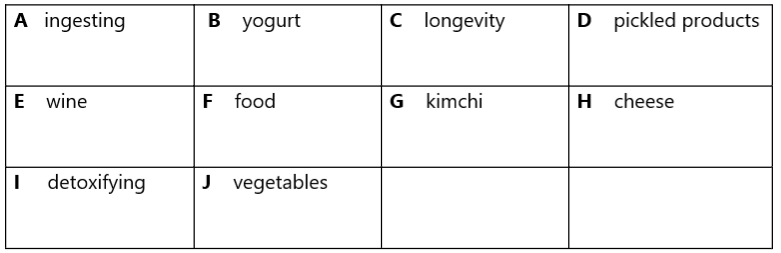
Complete the summary below by selecting the right word from the list (A-J) below. Write the correct letter for your answer.

 International Uses for Fermentation

At the start of the 20th century, Dr. Elie Metchnikoff put forward his belief that the  1 ……………… and good health of Bulgarians could be attributed to eating fermented food each day. By  2……………. and preserving milk, they were able to convert it into  3……………… and  4…………………. In other parts of Europe, fermented  5……………… was consumed as a replacement for clean water. People used to ferment  6……………….. which gave them a longer lifespan but nowadays mass production favours pickling.

IELTS Reading Summary Completion

ANSWERS

Click below to reveal the answers.

Answers

  1. C
  2. I
  3. B (any order)
  4. H (any order)
  5. E
  6. J

Passage from healing naturally by bee.com

All reading exercises on ieltsliz.com have been written by myself to help you prepare for your IELTS test.   

Liz

.

RECOMMENDED FOR YOU

FREE SUBSCRIBE

Subscribe to get new lessons & tips by email.

.

Short Answer Questions: IELTS Listening Practice

IELTS Listening Practice: Short Answer Questions. These questions can appear in any section of the IELTS listening test. You are required to listen to the recording and spot the answer to the question given.

Read through the questions before you listen to the audio. Predict the type of answer you need to listen for and underline any key words that might help you find the answer. Also prepare paraphrases as this is the key to IELTS.

IELTS Listening Short Answer Question Tips

  1. Check the title of the listening because they will tell you the type of language you are likely to hear.
  2. Note keywords in the question that:
    • tell you the type of word you need to listening for, such as a noun, verb, adjective or number
    • indicates the answer is coming in the recording
  3. Words given in the question are likely to be paraphrased.
  4. Pay attention to the word count for the answer.
  5. Get the answer from the recording – you need the precise word or words.
  6. The answers come in order.

IELTS Listening Short Answer Questions Practice

Listening Practice 1

Dashwood Sports Center

Questions 1-5: Write no more than two words and/or a number.

1. What time does the center open?
2. What kind of sports equipment does it sell?
3. How long do you have to return faulty items?
4. Who can give advice?
5. What time does it close on Tuesdays?

RECORDING:

.

TRANSCRIPT & ANSWERS

Click below to reveal the transcript and answers.

Transcript

So let me show you round our Sports Center. As you can see, it is set in lovely grounds where you can find outdoor tennis courts as well as a swimming pool. The center itself opens daily at 9am and closes at 6pm. To the right here you can see the reception where you can book courts and find more information about the sports center. Further along to the right, just after the reception room, you will find the restaurant which opens at 11am and serves brunch, lunch and light snacks in the afternoon before it closes at 4pm. To the left, opposite the reception, there’s a small shop which sells sports equipment. I’m afraid it’s rather pricy but the quality is excellent as it sells only professional equipment. If you do decide to treat yourself to something, make sure you check it as soon as you get home as you’ll only have three days to get a refund if there’s anything wrong with it. If you go straight ahead, you’ll come to our advice desk. Now it’s only open for a short time each day around lunch time when one of our ex-pros, John Roberts, comes to give help to anyone who needs it. Oh and before I let you go to have a look around on your own, I just have to mention that on Tuesdays we have late night opening until 9pm. Well, that’s all. I hope you enjoy your time here and if you need me at all you can find me in reception.
Answers

1. 9am
2. professional / professional equipment
‘…there’s a small shop which sells sports equipment. I’m afraid it’s rather pricy but the quality is excellent as it sells only professional equipment.’
3. 3 days
‘…you’ll only have three days to get a refund if there’s anything wrong with it.’ (faulty = anything wrong with it)
4. John Roberts (capital letters not needed)
5. 9pm
‘…on Tuesdays we have late night opening until 9pm’. This question was a trap because a closing time was given at the beginning of the audio but you can’t answer question 5 before question 2, so you need to wait for another answer to come. Also the information at the beginning was about a daily closing time not specifically on Tuesdays. This is a very common trap in IELTS.

.

*********************

Listening Practice 2

Superbugs 

Questions 1-8: Answers should be no more than two words and/or a number.

  1. Which mammals are often considered to be the strongest?
  2. How much weight in comparison to their body’s weight can a leaf-cutter ant pull?
  3. What animal was present on Earth when ants emerged?
  4. What are ant societies called?
  5. How much of the Earth’s biomass do ants make up?
  6. A dung beetle can pull the equivalent to what as a human being?
  7. What type of sound do dung beetles mostly use as communication?
  8. How much cattle dung are dung beetles thought to bury in some areas of Texas?

RECORDING:

.

Vocabulary Focus Questions

Questions 9-13

Listening again to spot the paraphrases in the recording for the following words. Your answer should be one word only. These types of questions do NOT come in IELTS listening, but they are a great practice exercise for you.

  • 9. impressive
  • 10. pieces
  • 11. lorry
  • 12. audial
  • 13. waste

.

TRANSCRIPT & ANSWERS

Click below:

Transcript

Transcript: When we think of animal species that are exceptionally strong, we usually think of large animals such as the elephant or rhino. These are formidable mammals that from their size are clearly so much stronger that we are. However, when it comes to strength in relation to size, we need to look at insects and in particular ants and beetles.

The leafcutter ant can carry over 20 times its own body weight in its jaws, which are known as mandibles. When they come across a leaf that is too heavy for them to carry, they cut the leaf into more manageable fragments. If we compare this to human strength it is similar to a human being lifting a truck with their teeth.

Ants are interesting for many reasons. They had already emerged about 90 million years ago at the time of the dinosaurs. Much later on, their numbers seem to grow as they developed into organised societies or as we know them, colonies. They now represent about 15% of this planet’s biomass.

However, the dung beetle is even more remarkable for its strength in relation to body weight. The dung beetle can pull weights which are in excess of 1,000 times their own body weight. If we translate this into human strength. It is like one person pulling six double-decker buses.

Unlike many insect or animal species, the dung beetle inhabits a range of habitats and can be found in most places on the planet. Their communication techniques mainly seem to focus on acoustic vibration. They are also great recyclers and play an important part in processing waste. For example, it is said that in parts of Texas, dung beetles are responsible for burying 80% of cattle excrement.

 Answers

  1. ELEPHANT  RHINO
  2. 20 TIMES
  3. DINOSAURS
  4. COLONIES
  5. 15%
  6. 6 DOUBLE-DECKER BUSES
  7. (ACOUSTIC) VIBRATION
  8. 80%
  9. FORMIDABLE
  10. FRAGMENTS
  11. TRUCK
  12. ACOUSTIC
  13. EXCREMENT

.

RECOMMENDED FOR YOU

More Short Answer Question Listening Practice, click here

ALL LISTENING PRACTICE LESSONS & KEY TIPS

FREE SUBSCRIBE

Subscribe to get new lessons & tips by email.

.

IELTS Speaking Part 2: How to start your talk

Start your talk with confidence by paraphrasing your topic card in IELTS speaking part 2. This video lesson gives advice and tips about the best way to begin your part 2 talk with example paraphrasing techniques to demonstrate a good command of English to the examiner. Target band score 6 and above.

Recommended Lessons

IELTS Video Lesson: How to improve your IELTS speaking: click here
Topics for IELTS speaking part 2: click here

Transcript

hello in this lesson I’m going to show
you

how to start your talk for IELTS speaking
part 2

now there is no right way all wrong way

to start your talk but I want to show
you a good way

to start and the topic we will use for
this lesson

is described a book you

recently read so let’s look at how to
start

here are to different ways to start

you could say I’d like to talk about

or I’m going to tell you about

now this one is a little bit more

formal and this one is less formal

but they are both fine the

IELTS Speaking test is not academic

it’s not formal so it’s okay to use

both of them you can also see here

that I’ve written I’d

and I’m so we don’t say

I would like to tell you about or

I am going to tell you about we say

I’d I’m and

this is to help you get a better band
score for your pronunciation

when you use the contraction I would

I’d this is better for your
pronunciation

now after this what

do you need to put well a lot of students

copy the words on that card and it’s not
very good to do that

if you want to get a band score

6 7 and above you need to show the
examiner

that you can use your own language

that you have flexible language

to paraphrase what is written on your
card

so it now let’s look at how we could

paraphrase that so here is one way

to paraphrase the information on the
card

I’d like to talk about a novel

which I read

two weeks ago so you can see that

the word book we paraphrased for the
word

novel now you need to

learn all the different types books

that you can’t read so was it a novel

was it fiction non-fiction was it a
guidebook

was it a self-help book so that’s
one way to paraphrase

take this word and be more accurate

what kind of book was it you can also
see here

I have put clause into the sentence

and that will help you get a higher band
score for your grammar and

here we’ve got two weeks ago

so instead of repeating the word
recently

we can give the time when

you did it two weeks ago 1 week ago

a month ago you can do that so that’s

a very nice way to paraphrase

and start your talk but we can improve
it

let’s have a look at one more and here’s
how we can improve

that start so you can see here that one
thing you can do

it give more information more
description

and we can use an adjective so here

I’ve used the adjective fascinating

which means really interesting
fascinating

you could also put useful

exciting you can describe

the book more and you can also see that
I’ve changed

this the paraphrase here and instead of
giving the information

I have given a paraphrase which is “not

so long ago” and that in a direct
paraphrase for recently

it’s very nice to use that and it

also means that during your talk

you can give more information about exactly

when you read the book and that’s
a way to

develop and extend your talk so I hope
you understand now

one way a good way to start your talk

well that’s all for this to happen I’ll
see you again

in another IELTS lesson

IELTS Model Essay Score 9 for Direct Questions

This is an estimated band score 9 model for an IELTS writing task 2 direct questions essay. This model essay shows you how to answer each question directly and how to organise the answers into paragraphs.

The Direct Questions Essay is also known as the IELTS Double Question Essay because it usually has two questions. However, I prefer to called it a Direct Questions Essay because sometimes it is possible to be given three questions instead of two. Also, your task is to answer the direct questions which can be very varied in nature.

IELTS Model Essay Band 9

Some people think that money is one of the most essential factors in promoting happiness.

Do you think people can be happy without much money?

What other factors contribute towards happiness?

Money is considered by many people to be one of the most important contributing factors towards happiness. In my opinion, it is possible for people to be happy even if they have little money and other aspects of life can play a more vital role in creating happiness than wealth alone.

Although money allows people to afford luxuries and treats, which certainly do bring temporary enjoyment and satisfaction, a substantial number of people are happy without money. Firstly, money is no guarantee of happiness, particularly if disease or disaster feature largely in someone’s life. Secondly, as long as people have the money to cover their necessities, doing without luxury items does not negatively affect the pleasures that a good life can bring.

Another way people can gain satisfaction in their life is through their work rather than money. For instance, a doctor doing volunteer service overseas in underdeveloped countries may earn little or no money, but the reward of doing such work is profoundly rewarding. Not only that but it can be a long-term fulfilment that they carry with them through life in the form of rich memories and the knowledge of a life well-lived.

Finally, another influencing factor of contentment in life is having supportive and loving people in one’s life.  While money may bring opportunities to enjoy pleasures, few people would enjoy them in isolation. Being surrounded by a loving and caring family is considered by many people to be the most valuable thing in life. This is one aspect of life that money certainly cannot buy. 

In conclusion, money is not essential for happiness, which can be found through job satisfaction as well as family. If more people strived in life towards true happiness rather than money, the world would be a better place.

297 words.

Examiner Comments: The task given was to answer two questions. The writer answered both questions with relevant main points that were well-developed. The main points were each sufficiently developed for a high score and organised into logical paragraphs with clear signposting. The use of three body paragraphs is not so common in IELTS writing task 2 with most people choosing an essay of only two body paragraphs. However, three body paragraphs does allow for enough developed of main points for a high score. The use of linking devices is skilfully managed. Vocabulary is flexible with less common expressions. Grammar is complex and widely varied with only an odd slip, but not obvious errors.

RECOMMENDED FOR YOU FOR WRITING TASK 2

FREE SUBSCRIBE

Subscribe to get new lessons & tips by email.

.

error: Content is protected !!