Origins of Bread: IELTS T F NG Reading Practice

A reading practice for the IELTS T F NG questions  (true / false / not given). I’ve put some difficult questions in and also one easy question. I’m sure you can all spot the easy question 🙂 Good luck with the difficult questions 🙂

Here is a quick review of what each one means:

True = the statement matches the information in the passage

False = the statement contradicts the information in the passage

Not Given = the information is not found in the passage

Origins of Bread

Bread is the most widely consumed food in the world. Not only is it an important source of carbohydrates, it’s also small and easy to carry, which helps to explain why it has been part of our diet for thousands of years. In fact, recent scholarship suggests humans started baking bread around 30,000 years ago.

Prehistoric man had already been making gruel from water and grains, so it was a small jump to starting cooking this mixture into a solid bread form by frying it on stones. A 2010 study by the National Academy of Sciences discovered traces of starch (likely from the roots of cattails and ferns) in prehistoric mortar and pestle-like rocks. The roots would have been peeled and dried before they were ground into flour and mixed with water. Finally, the paste would be cooked on heated rocks.

Question 1-4

Which of the following statements are true, false or not given?

  1. Bread is eaten in all countries in the world.
  2. Bread contains carbohydrates.
  3. The first bread was made about 30,000 years ago.
  4. Bread was first made from gruel cooked in clay pots.

Answers

Click below to reveal the answers.

Answers
  1. Not Given (It states in the text that bread is widely eaten in the world but we are not given information that shows it is eaten in all countries. If bread is widely eaten, we still don’t know which countries eat it – possibly only 90% of countries eat it. All countries is not confirmed in the passage)
  2. True (did you spot the easy question?)
  3. True (This is a direct paraphrase of the statement in the passage)
  4. False (The passage says that bread was made from gruel and fried on stones)
Vocab Builder
  • consume food = eat food
  • carbohydrates = foods with sugars and starch (potatoes, bread, pasta etc)
  • gruel = porridge
  • traces = small amounts
  • peeled = had their skins removed
  • ground = crushed / pounded

All reading exercises on ieltsliz.com have been written by myself to help you prepare for your IELTS test.   

Liz


IELTS Listening Practice: Sentence Completion

These IELTS listening practice lessons have gap fill questions called Sentence Completion. The two practice lessons below have different levels of difficulty because they are based on different sections of the IELTS listening test. All IELTS candidates take the same IELTS Listening Test (both GT and Academic candidates).

IELTS Listening Practice: Sentence Completion

Below you will find two sentence completion listening practice lessons for IELTS. Use these practice lessons to develop your listening skills and also review your techniques for Sentence Completion Listening Questions.

  • Practice Lesson 1: Short Answer Questions & Sentence Completion / Section 2 Level
  • Practice Lesson 2: Sentence Completion Questions / Section 4 Level

For tips and techniques for sentence completion questions, click here: SENTENCE COMPLETION TIPS

****************

IELTS Listening Practice 1: Sentence Completion 1

This lesson is based on section 2 of the listening test. I’ve added some short answer questions to this practice lesson because in the IELTS listening test, you will get more than one type of question with every section.

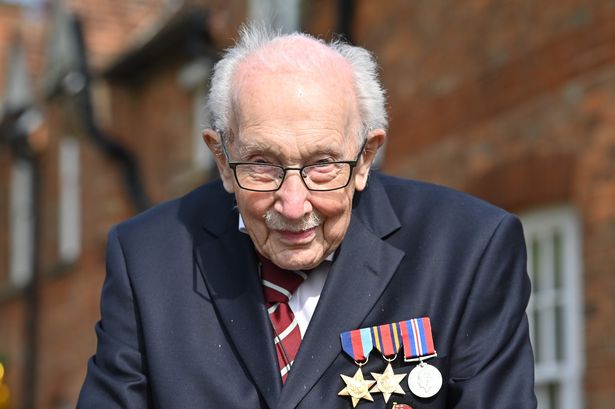
Listening Practice: Tom’s Sponsored Walk

Questions 1-3: Use no more than one word or number for your answer.

  1. Does Tom currently serve in the army?
  2. How much did he hope to raise in pounds?
  3. Where was his sponsored walk to take place?

Questions 4-7: Use no more than one word for your answer.

  • 4.  Tom eventually raised a ………………….. £21 million.
  • 5.  Many hope that Tom will be ……………….. for his efforts.
  • 6.  Tom’s aims to support the NHS ………… a chord with many people in the UK.
  • 7.  Tom has shown how a single person can ……….. the nation.

RECORDING:

.

TRANSCRIPT & ANSWERS

Use the transcript to check answers after you complete the lesson. Also use it to review keywords and paraphrases. Click below:

Transcript

Army veteran Tom Moore did a sponsored walk at the age of 99 years old to raise money for the NHS (the National Health Service in the UK). His aim was to raise £1,000. This was an ambitious walk of 1.6 miles in his back garden given that he had recently been treated for a broken hip and skin cancer.

As he began his sponsored walk, he was surprised to see the response from the British public as donations started pouring in. By the end of this sponsored walk, he had raised not £1,000 but a staggering £21 million. Many around the country are now calling for Tom Moore to be knighted for his remarkable fund-raising efforts.

Tom Moore has stated that he was “overwhelmed by this sum of money” that was donated. His praise for the NHS struck a chord with many around the country today as the population watch doctors, nurses, other hospital staff and all front-line workers put themselves in harms way to save lives as they battle against the coronavirus crisis. This story truly is an example of how a humble, unambitious person can stir the nation and effect incredible change. Surely we should all be doing more in one way or another. As the saying goes “Every little helps” and who knows whether your modest attempt to help might not also create a flame of support throughout your own country.

Answers
  1. NO
  2. 1,000
  3. GARDEN
  4. STAGGERING
  5. KNIGHTED
  6. STRUCK
    • “to strike a chord” is idiomatic and means:
    • a) to say or do something that other people agree or approve of.
    • b) to say or do something that causes emotions to rise or triggers memories in another person.
  7. STIR
    • to stir a nation means to raise emotions within a country.
  8. News: Unfortunately, Captain Sir Tom Moore died in 2021. He eventually raised a total of just over £30 million before he died. What a man!
.

********************

IELTS Sentence Completion Listening Practice 2

This lesson is similar to a level of section 4, which means the language and topic are more challenging.

Comet Landing

Questions 1-8: Write no more than two words and/or a number for the answer.

  1. On ………………. 2014, Philae landed on a comet.
  2. Philae’s goal is to collect information about a comet’s composition and also to capture ………….. of the surface.
  3. Because of an ………… relating to Rosetta’s orbit, Philae could have missed landing on the comet.
  4. The time delay between Rosetta and the controllers on Earth was ……………….
  5. Because of a lack of ……………., the lander had to find its own way down to the comet.
  6. There is an element of ………. in landing in a good location on the comet. 
  7. The lander can drill ……………… into the exterior of the comet for stability.
  8. Analysis will be done on surface composition, amino acids and ……………..

RECORDING:

.

TRANSCRIPT & ANSWERS
To see the transcript and answers, click below. 

Transcript
Rosetta spacecraft released Philae lander which landed successfully on a comet on 12 November 2014 at 08:35 GMT. The Philae lander achieved the first-ever controlled touchdown on a comet nucleus. The aim of Philae is to obtain the first images of the surface of the comet as well as make the first in situ analysis to determine the composition of the comet.
An inaccuracy of a few millimetres per second in Rosetta’s orbit could have resulted in Philae completely missing the comet. The descent, monitored from Esa’s mission control in Darmstadt, Germany, lasted about seven hours. Because the comet is about 510 million km from Earth, communication between Rosetta and controllers takes about 28 minutes each way. As a consequence, confirmation of the landing came through just after 16:04 GMT.
There was no steering of the lander down to the comet’s surface. Once released, it was on a path of its own. A certain amount of luck was needed for Philae to land in a nice spot. When the lander hit the surface, harpoons were fired to be used as anchors, although they do not appear to have anchored the craft as intended. The lander also has footscrews to drill into the surface of the comet to keep it secure. Now it’s on the surface of the comet, Philae can get to work. Drills, ovens, cameras and sensors onboard Philae will analyse everything from the surface composition and temperature to the presence of amino acids – essential building blocks in the chemistry of life. (from BBC news)
Answers
  1.  12th november / 12 november
    1. capital letters at the start are not required
    2. IELTS listening does not pay attention to punctuation or the use of capital letters. So, you can use or not use capital letters as you wish.
  2. images
  3. inaccuracy
  4. (about) 28 minutes 
  5. steering
  6. luck
  7. footscrews / foot screws
  8. temperature
VocabBuilder
  • nucleus = center / core
  • in situ = in position
  • to determine = establish / conclude / decide
  • composition = makeup / consistency
  • an inaccuracy = mistake / error
  • to release = liberate / let go
  • to anchor = fasten / secure
  • to fire = to discharge / shoot
  • intended = planned

.

*******************

RECOMMENDED FOR YOU

FREE SUBSCRIBE

Subscribe to get new lessons & tips by email.

.

IELTS Listening Practice: Time

It is common to be asked to listen for a time in IELTS listening section 1. This lesson gives you practice in listening and writing down times.


Recommended Lessons

IELTS Listening Video Lesson: Predicting Answers
IELTS Listening Video Lesson: Names
IELTS Listening Practice: Picture Multiple Choice
IELTS Listening Practice: Selecting from a List

IELTS Reading Practice: Multiple Choice Exercise

Before answering the IELTS multiple choice reading exercise questions, read through the passage and then prepare paraphrases for the multiple choice options.

Having an Ear for Music

It brings new meaning to having an ear for music. Musical aptitude may be partly down to genes that determine the architecture of the inner ear.
We perceive sound after vibrations in the inner ear are detected by “hair cells” and transmitted to the brain as electrical signals. There, the inferior colliculus integrates the signals with other sensory information before passing it on to other parts of the brain for processing.

Questions 1 – 2. Choose the correct letter, A-C.

1. What does ‘having an ear for music’ mean according to the passage?

a) a person enjoys listening to music
b) a person has an ability and predisposition for music
c) a person has special hearing

2. Sound is perceived when vibrations are sent to the brain in the form of ……………..

a) hair cells
b) electrical signals
c) sensations


Answers

Click below to reveal the answers.

Answers

1 = b (aptitude means an ability or predisposition for something)

2 = b (this answer is testing your grammar as well as vocab – to be transmitted as = sent in the form of)

All reading exercises on ieltsliz.com have been written by myself to help you prepare for your IELTS test.   

Liz

Vocab Builder

  • aptitude = skill / ability / capacity
  • to determine = decide / conclude / establish
  • perceive = notice / observe
  • vibrations = sensations
  • integrate = combine / amalgamate / put together


Recommended Lessons

IELTS Reading Practice: Summary Completion
IELTS Reading Practice: Sentence Completion
IELTS Reading Practice: Matching Paragraph Information

Structure & Paragraphs for IELTS Writing Task 1

Learn how many paragraphs for your IELTS Writing Task 1 with tips about where to put your overview statement. In writing task 1, the examiner will mark you on your structure as part of the marking criterion of Coherence & Cohesion, which is 25% of your marks. Below, learn about how to structure your writing, how to organise information into the right paragraphs and which paragraph is the most important.

IELTS Writing Task 1 Structure

In writing task 1, you will be asked to write a report for a bar chart, line graph, table, pie charts, maps or diagram. All IELTS Writing Task 1 reports have the same structure, regardless of which task you are given. There are four main paragraphs that you need to use.

  1. Introduction Paragraph
  2. Overview Paragraph
  3. Body Paragraph 1
  4. Body Paragraph 2
  5. Body Paragraph 3 (not usual, but occasionally possible)

Remember, IELTS writing task 1 is a report, not an essay. This means the structure will be different and the examiner is looking for an overview, not a conclusion. 

IELTS Writing Task 1 Paragraphs

Below read about the individual paragraphs you need in your writing task 1 report.

Introduction Paragraph

The first paragraph will be your introduction and that contains a description of the graph – what it shows. IELTS will always give you a  description and you can use that information for your introduction but don’t copy it. You need to paraphrase it. So write it again using your own words. 

It is your chance to introduce information such as categories, titles, headings, names, dates etc. Make sure your introduction is complete. It is usually one sentence but sometimes it can also contain a second sentence about the measurement of units. See this video: How to Write an Introduction for WT1

Overview Paragraph

This paragraph is the most important paragraph in your IELTS writing task 1 report. This is where you collect all the key features shown in the task  and present them together. This paragraph has a direct impact on your band score for Task Achievement, which is 25% of your score. You can read more about the band scores here: IELTS WRITING TASK 1 BAND SCORES 5-8 TIPS. But to give you an idea:

  • Band Score 5 = key features are very limited or there is no overview 
  • Band Score 6 = a relevant overview is attempted (it is tried but not well done)
  • Band Score 7 = presents a clear overview
  • Band Score 8 = key features are skilfully selected (referring to the overview)

The clearer and more complete your overview paragraph is, the higher your score for Task Achievement. The biggest challenges with the overview are: 

  • not spotting all key features
  • spreading key features into various paragraphs instead of into one overview paragraph
  • presenting only one key feature

You can see examples of key features in all my model answers for writing task 1: ALL MODEL ANSWERS

All writing task 2 reports have an overview no matter which task you get. An overview is not the same as a conclusion. Writing task 2 has a conclusion, writing task 1 has an overview. This is clearly stated in the IELTS Band Score Descriptors. An overview has a different function to a conclusion. See the video below:

An oldie, but a goodie. My older videos are still packed with useful tips. All still relevant today.

Overview or Conclusion Video

Body Paragraphs

These paragraphs (usually two) contain the details. If your task contains numbers, such as a chart, you will need to support your sentences with data. Failing to do that will lower your score for Task Achievement. 

You should organise the details of the task into logical body paragraphs based on the key features. You should also take into consideration what type of task you have. For example, a bar chart shows comparisons between two things, such as men and women, for different categories so your aim is to compare men and women within each category. You would then see which categories are most  popular and which are least and then organise categories into body paragraphs. Of course, it might not be about popularity, it might be about which categories have the biggest differences or the least differences. Which ever way you organise the information, it must be logical.

WRITING TASK 1 STRUCTURE & PARAGRAPHING – A SUMMARY

To sum up, it can feel complicated and overwhelming when you first start preparing for your writing task 1. So, I made this video years ago to sum up how to organise your task 1 report. It’s an old video, but of course still relevant today. The test hasn’t changed.

How to Organise Your Writing Task 1 Video

Another oldie which is still great today and reviews the paragraphing for writing task 1.

  • I hope you enjoyed this page and found it useful. I wanted to give you as much as I could because it’s so important to your scores. All the best, Liz

Now it’s time to review model answer for writing task 1 and see what the paragraph looks like. See links below:

RECOMMENDED FOR YOU

FREE SUBSCRIBE

Subscribe to get new lessons & tips by email.

.


Opinion Essay Introduction: The Thesis Statement

In an IELTS opinion essay for writing task 2, your introduction has a Background Statement and a Thesis Statement. You should aim for between 40 to 50 words for the length of your essay introduction. While the background statement introduces the topics, the thesis statement is your answer to the task given by IELTS. It should introduce the main points and show the direction your essay will take. Below are two possible introductions with different thesis statements for the following IELTS task.

IELTS Task 2

The increase in the amount of traffic is responsible for growing problems in many large cities and this has resulted in more traffic congestion, particularly at rush hour. What measures could be taken to deal with this problem?

IELTS Essay Introductions – Comparing Thesis Statements

The introductions below have different thesis statements. Which one do you think is the best?

1. The growth in the quantity of traffic in most major cities has led to problems of congestion in the peak travel hours. There are a number of solutions to this issue which I will discuss in this essay.

2. The growth in the quantity of traffic in most major cities has led to problems of congestion in the peak travel hours. This can be solved by having a traffic free zone and improving the public transportation system offered to the public.

ANSWER

Click below:

Answer

Number 2 is the best introduction because the thesis statement is more specific and directly related to the topic. 

Explanation:

  1. Introduction 1 contains what is called a “generic” thesis statement. This means it is a learned phrase which the writer has memorised to use for all solution essays. This is the type of sentence that isn’t useful for your score. All your sentences need to be relevant to the specific topic you have been given. This is a very common sentence that is taught by teachers who do not fully understand IELTS marking. Students like it because it’s easy to learn and easy to use – but it doesn’t help your score. 
  2. Introduction 2 provides a clear, relevant thesis statement. It introduces the main points clearly. This allows the reader to know what is about to be explained in the body paragraphs. It provides coherence for the whole essay. This will help your score.

.

RECOMMENDED FOR YOU:

RECOMMENDED VIDEO:

This is an old video but it is good and still relevant over a decade later. Please watch to learn:

HOW TO WRITE AN INTRODUCTION FOR IELTS WRITING TASK 1

.

……………………………………………………….

FREE SUBSCRIBE: to get my new lessons & tips by email

.

IELTS Diagram: Introduction and Overview

For an IELTS diagram, you need an introduction and overall paragraph containing the main features of the diagram or process in your report. The overview is one of the most important parts of your report and a full overview is essential for a high band score.

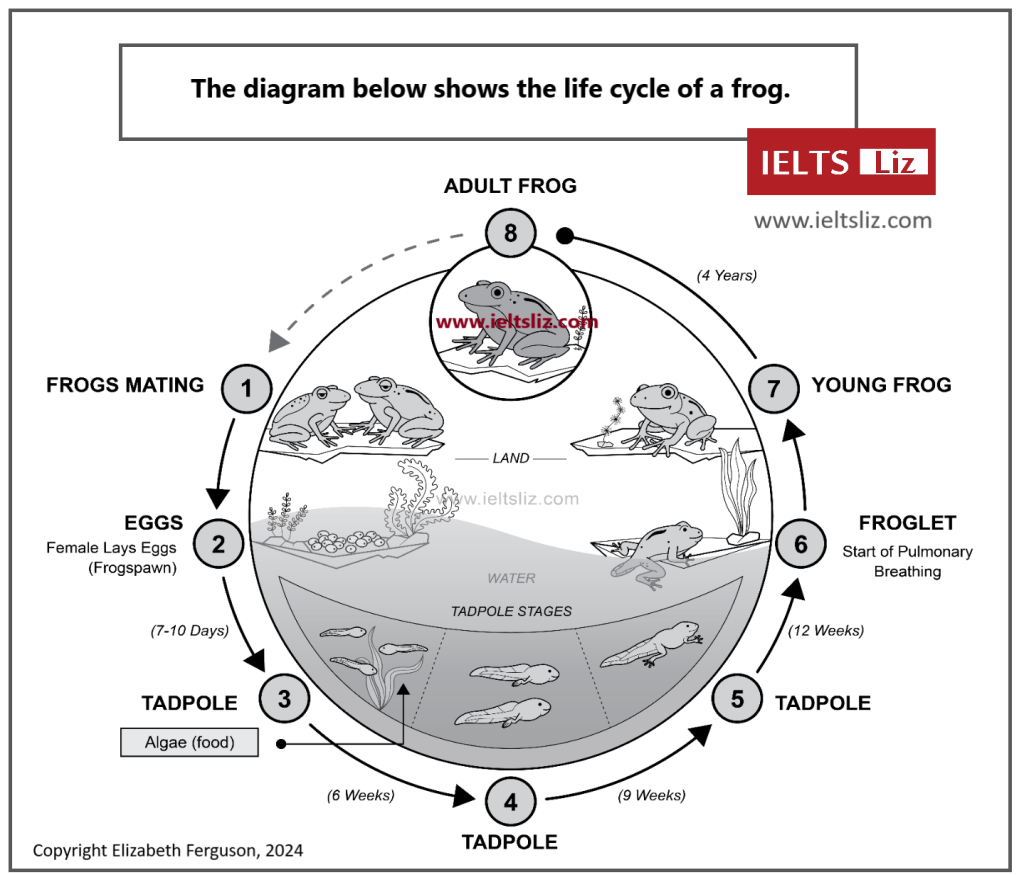
The diagram below is of the life cycle of a frog. Life cycles and other cycles, such as the water cycle, are quite common diagrams to get in IELTS writing task 1. The other common type is a process which shows how something is made or how it works.

Introduction and Overview for IELTS Bar Chart

Introduction Paragraph

The introduction paragraph for most diagrams in IELTS is short. Don’t try to make it longer. All you need to do is paraphrase the description given above the diagram.

Overview Paragraph

This is the most important paragraph is all writing task 1 (academic). This means you should aim to have a full overview with stages well summarised. This isn’t just about the number of stages, but an overview of what the main stages are. And yes, you can use the words given in the diagram. The words are given for you to use.

Model Answer Click Below:

Model Introduction and Overview

Introduction Options

  • The diagram illustrates the stages in a frog’s lifetime.
  • The diagram illustrates the different stages in the life of a frog.
  • The diagram illustrates the phases that a frog passes through during its lifetime.

Overview Paragraph

  • Overall, a frog passes through eight stages which start with adult frogs mating and eggs laid in the water from which tadpoles emerge. Tadpoles pass through a number of stages before becoming a froglet, a young frog and finally an adult frog, starting the life cycle again.

Note: this overview is complete. It gives a full summary of the key stages without going into detail. All the detail is then given in the body paragraphs.

Full Model Answer

The diagram illustrates the developmental phases that a frog passes through during its lifetime.

Overall, a frog passes through eight stages which start with adult frogs mating and eggs laid in the water from which tadpoles emerge. Tadpoles pass through three stages before becoming a froglet, a young frog and finally an adult frog, starting the life cycle again.

Initially, adult frogs mate and then the female frog lays eggs in the water, which are called frogspawn. Seven to ten days later, tadpoles emerge from the eggs which can swim and eat algae for food. Six weeks later, the tadpole grows and develops back legs. This development continues and nine weeks later it develops front legs. Its head and body also become more pronounced.

Twelve weeks after the tadpole stages, it becomes a froglet  which resembles a small frog. However, it still has a tail, although shorter than that of a tadpole. At this stage, it also develops pulmonary breathing which enables it to leave the water and breathe air on land. Over time, the froglet becomes a young frog and eventually, four years later, it is an adult frog ready to start the life cycle again.

.

Recommended Lessons

FREE SUBSCRIBE

Subscribe to get new lessons & tips by email.

.

Common Topics for IELTS Speaking Part 1

The key for success in speaking is to prepare the common topics which the examiner can ask you about in IELTS speaking part 1. You will be asked a total of 3 topic for IELTS speaking part 1. The examiner has a list of subjects to take the questions from so you need to prepare ideas for a range of different topics.

This video tutorial will explain what the common topics are for part 1 and which ones you should focus on for your preparation.

IELTS Speaking Part 1: Common Topics

Transcript

Hello my name is Liz
in this lesson I’m going to look
at the types of topics
that the examiner could ask you
in IELTS speaking part 1
and at the end of this lesson
I’ll give you a link so that you can
take a look at the topics and questions
for yourself
the examiner will probably ask you
about 12 different questions
in speaking part 1
and these questions come from usually
3 different subjects these are all
familiar and they are topics that
are common to everybody
throughout the world
now the first IELTS speaking part 1 topic of these three
usually come from one of these
work study home and hometown
you will probably get
one of them for your first topic
work or study now if the examiner
decides to ask you about work or study
the first question that
the examiner will ask
is “do you work or do you study”
now the examiner is asking
this question
only because he or she needs
to know which
topic to choose to ask
the questions so with this question
you do not need to expand your answer
you can just say very clearly
“I work” or “I study”
now if you’re a students and
you’ve finished university
but you aren’t not working either
then you need to tell the examiner that
and you need to say “I’ve just finished
university but I don’t have a job yet”
and the examiner will then continue
and ask you about the topic of study. Now with
these topics the common questions
which the examiner could ask you is
where do you study or work
why did you choose that subject or job
the examiner might ask you about
your first day
about the people you that
you work or study with
and other things about your work
or your study
Now for the topic of home
this topic is all about where you live
so it could be about your house
or your apartment
and in that topic
the examiner can ask you
about the rooms in your house
how they are decorated
so what you can see on the walls
or what you kind of views you have
from the windows
the examiner might also ask you
about the people you live with
or the area and street that you live in
And the last topic hometown
now if you get the topic of hometown
this is about the place
where you were born or where you
spent your childhood
and for this topic
the examiner often asks you
about places in your hometown
for example buildings or
old buildings in your hometown
the examiner might ask you
about the weather
or transportation
in your hometown
or if you plan to still live
there in the future
so those are To read more, click here

Recommended

List of Topics and Questions for Speaking Part 1, click here
IELTS Video Tutorial for speaking part 1 1: What’s your favourite…?, click here

error: Content is protected !!