IELTS General Training & Academic Writing Differences Explained

Learn about IELTS GT (General Training) exam content and writing tasks. Learn how the IELTS GT writing is different from the academic writing test.  Useful links are provided for GT students below.

Understanding GT IELTS

  • The GT listening test is the same as the academic test. Everyone takes the same listening test with the same scoring. You can use my free listening lessons and tips for your preparation. Click here: Free Listening Tips & Lessons
  • The GT speaking test is the same for everyone. There is one speaking test only with the same scoring. You can use my free speaking lessons and tips for your preparation. Click here: Speaking Tips & Model Answers
  • The GT reading test is slightly different. The question types are 100% the same as the academic test, but the passages have a different content and layout. You can use my free reading lessons and tips for your preparation, but make sure you do full authentic GT reading tests at home. See this page for more GT reading information:  GT Reading Tips. Click here to use my Free Reading Lessons for All Candidates
  • To understand GT writing (both task 1 and task 2), see all the tips and information listed below.

This page will explain both writing task 1 differences and writing task 2 differences.

IELTS GT Differences for Writing Task 1

General training students will need to write a letter for writing task 1 but academic students will need to write a report.

  • GT Writing Task 1 = Letters: Formal, informal and semi-formal
  • Academic Writing Task 1 = Report: table, pie chart, bar chart, line graph etc.

This means writing task 1 is completely different for GT candidates. GT candidates do NOT get charts, they are given letters only. See the information below:

General Training Writing Task 1 Letter

Use the following 10 tips and links to ensure you understand GT letters properly

  1. Candidates are required to write a letter which can be formal, semi-formal or informal.
  2. A list of points is given for the letter as well as the aim. It is your task to make sure your letter covers all points with a clear aim.
  3. Pay attention to opening lines, closing statements, paragraphs etc.
  4. You also need to pay attention to style and tone depending on whether the letter is formal or informal.
  5. Get to know the scoring for task 1 – see below. Remember, task 1 is worth only 33% of your writing marks.
  6. You must write over 150 words. But it is recommend not to write over 200 words.
  7. It is recommended to take no more than 20 minutes for this task. It is up to you to manage the one hour given for the whole writing test.
  8. GT students are NOT asked to write a report on a chart or graph.
  9. Sample Practice Letters for GT Students
  10. MUST READ: Essential Tips for IELTS GT Letters

Academic Task 1 Report

  • Students must analyse a chart, graph, table, map or diagram.
  • Students must highlight key features and present data or information.
  • Students must write over 150 words.
  • It is recommended to take no more than 20 minutes for this.
  • IELTS Sample Academic Charts

IELTS Writing Task 1 Scoring

There are four marking criteria for IELTS writing task 1.

Only one criterion is different for GT students.

  • Task Achievement General Training: This refers to using the appropriate tone and also purpose. It also relates to the word count.
  • Task Achievement Academic: This is about presenting key features, having an overview and accurate information. This also relates to the word count.
  • Coherence and Cohesion: This is the same for both GT and Academic. It is based on organisation of information, paragraphing and linking devices.
  • Lexical Resource (Vocabulary): This is marked using the same band scores for both GT and Academic. This is about using appropriate language, using collocations and the number of errors made.
  • Grammar: This is also marked using the same band scores for both GT and Academic. This is about using a range of grammar structures and tenses, punctuation and the number of errors made.

Each criterion is 25% of your total marks for writing task 1. The scoring is the same as the Academic Writing Task 1 test and used the same Band Score Descriptors, which you can find on IELTS.org. However, there is slight differences in aims with Task Achievement and that is shows in the descriptors.

IELTS GT Differences for Writing Task 2

There are only minimal differences between IELTS general training writing task 2 and the academic task 2. GT candidates can use all my free writing task 2 lessons to prepare. Click here: Free Writing Task 2 Tips & Model Essays. You can also benefit from my advanced lessons and e-books which you can find in my online store: IELTS LIZ STORE

Below is a list of the minor differences and similarities between the essays.

1. Essay Question Difficulty

One difference is that the essay question for the General Training writing task 2 is often easier. It is written in a way that makes the issues clearly and easier to understand. Here’s a sample of a GT essay question and an academic essay question.

GT Essay Question Sample

Some students travel abroad for one year before starting university.

What are the advantages and disadvantages of doing this?

Academic Essay Question Sample

Some people think that space exploration is a waste of money and the funds should be relocated to other more needed areas.

To what extent do you agree?

* Please note that it is still possible to get the education essay question in the academic test.

2. Topics for Essays

Another slight difference is that the topic giving for the IELTS general training essay question is a more common topic, such as family, society, TV, schools, communication etc. However, in the academic test, there is a wider range including space exploration. Even so, it is best for GT candidates to prepare all topics because the topic of space exploration could come in the speaking test.

3. Essay types for General Training

The types of essays are the same for both general training and academic IELTS papers. You could get an opinion essay, a discussion essay, an advantage disadvantage essay, a solution essay or a direct question essay. At the bottom of the 100 IELTS essay questions page, you will find some practice essays for each type. And on the writing task 2 page, you will find model essays for each type. All this is suitable for both GT and academic students.

4. Marking & Scoring

The marking criteria and band scores are the same for both GT and academic students in writing 2. Here is a link to learn about the band scores for writing task 2 from band 5 to 8. There is only one scoring for GT Writing Task 2 and Academic Writing Task 2 with no differences at all.

5. IELTS GT Essay Writing Techniques

Another similarity is the technique for essay writing. It is the same for both GT and academic essays. Students for both the GT test and academic test will study from the same methods, tips and advice for IELTS essay writing.

This means all writing task 2 lessons on this blog are suitable for both GT and academic IELTS students. See here: IELTS Writing Task 2 Tips, Model Essays and Free Video Lessons

6. Essay Length and Timing

The length of the GT essay is over 250 words which is the same as the academic essay. Likewise, 40 minutes is the recommended length of time for both types of essays.

Recommended IELTS Tips

IELTS GT Writing Task 1 Letter: Essential Tips

IELTS Writing Task 2 Lessons, Tips & Model Essays

FREE SUBSCRIBE

Subscribe to get new lessons & tips by email for free.

.

Reading Practice: History of Sugar

This reading practice lesson is based on IELTS Yes, No, NG Questions. The approach is the same as the TFNG questions. The only difference is that this is about the writer’s opinions. You need to think what the writer is implying and what the writer is trying to say.

Tips:

  1. Skim reading the passage paying attention to keywords, and the opening and closing lines of each paragraph.
  2. Then read the questions.
  3. Do not look for the answers until you have thoroughly analysed the questions. You must know what a YES answer is, what a NO answer is and what a NG is before you look for the answer.
  4. Scan the passage looking for keywords to locate the information in the passage.
  5. Read around that location. Sometimes answers are based on more than one sentence.

Passage: The History of Sugar

It is thought that cane sugar was first used by man in Polynesia from where it spread to India. In 510 BC the Emperor Darius of what was then Persia invaded India where he found “the reed which gives honey without bees”.  The first sugar was recorded in England in 1099. The subsequent centuries saw a major expansion of western European trade with the East, including the importation of sugar. Sugar was expensive and only used as a luxury item by those who could afford it. Columbus sailed to the Americas, the “New World” and in in 1493 he took sugar cane plants to grow in the Caribbean. The climate there was so advantageous for the growth of the cane that an industry was quickly established.

This food, which nobody needed, but everyone craved, drove the formation of the modern of the world. There was a huge demand for labour to cultivate the massive sugar plantations in Brazil and the Caribbean. This need was met by a transatlantic slave trade, which resulted in around 12,570,000 human beings being shipped from Africa to the Americas between 1501 and 1867.

In many ways, the story of sugar and tobacco are closely aligned. Both products were initially produced through slave labour, and were originally seen to be beneficial to health. And although both sugar and tobacco have ancient origins, it was their sudden, mass consumption from the mid-17th century onwards that created the health risks we associate with them today. But in the 21st century, the grip of sugar is stronger than comparable scourges like tobacco, or even alcohol. Sugar is not only ubiquitous – it is potentially responsible for approximately 20% of the caloric content of modern diets – but also central to the world’s economy and cultural heritage.

The effect sugar has on our health is considerable. A high intake of sugar causes our blood sugar levels to shoot up, giving us that feel-good ‘high’ followed by a crashing slump that leaves us tired, irritable and craving more sugary foods. It’s a vicious cycle that may be contributing to our weight problems as well as health conditions like diabetes and heart disease.

Source: An adaptation of three sources: BBCGoodFood, Sucrose.com, and iflscience.com

Questions 1-7: YES / NO/ NOT GIVEN

  1. The Emperor Darius invaded India to find sugar cane.
  2. Sugar was a common food item for people in western Europe after it was introduced in England in 1099.
  3. The weather in the Caribbean was conducive to the growth of sugar cane.
  4. The slave trade was fuelled by the sugar industry.
  5. In ancient times, both sugar and tobacco were considered a health risk.
  6. 20% of all people are addicted to sugar these days.
  7. The “high” people get from sugar can be compared to alcohol.

Answers

Click below to open the answers.

Answers
  1. NO
    1. The passages states “[he] invaded India where he found [sugarcane]”. From this we see that first he invaded India and when he was in India he discovered sugarcane. This means the invasion happened first and the discovery of sugarcane was result of the invasion. Consequently, finding sugarcane was not a motivation for the invasion. Sugarcane was discovered while he was in India after having invaded it. For this reason, the answer is NO. As you see, you need to understand the meaning rather than trying to match words. If you only look for synonyms, you would not find this answer. Always look at the meaning.
    2. Also note that if the sentence had been written “he invaded India to find sugarcane”, the preposition “to” indicates reason/intent and this would give the answer YES. So, you can see this question really tests your understanding of English. This was a very challenging question, so don’t worry it you didn’t get it correct. Hopefully you got all the others right.
  2. NO
    1. There are particular keywords in the question statement: common food, western Europe & 1099. You should use the year “1099” to locate the area of the passage with the information. You then look for “western Europe” which is found in the next sentence. Then you keep your eyes open for the concept of “common food”. This is found in the following sentence, but with an opposite meaning “luxury item”. For this reason, the answer is NO. As you can see, you needed to read at least three sentences to find this answer. This is a good tip for IELTS reading – locate the area and then read around it to understand the answer
  3. YES
    1. The keyword is “conducive”. You needed to understand this word to get the right answer. It means that the weather was good for growing sugarcane in the Caribbean. The answer is found in the last two sentences of the first paragraph.
  4. YES
    1. This is found in the second paragraph. The need for labour for the sugarcane industry resulted in slave labour.
  5. NO
    1. Third paragraph – they were thought to be beneficial to people’s health originally.
  6. NG
    1. The passage gives information what proportion of calorie content in our diet is sugar. However, it does not give information about how many people are addicted. We do not know if 20% of people are addicted. We do not know if addiction accounts for more or less than 20%. The passages does not say anything about percentages of addiction.
  7. NG
    1. The last paragraph does describe the “high” from sugar as “feel-good”, but it does not compare this high to anything else.

.

I hope you found this lesson useful 🙂

All the best

Liz

Reading Practice: Procrastination

This reading lesson is based on Sentence Completion questions that are very common in IELTS reading, both GT and Academic.

Reading Exercise: Procrastination

Procrastination refers to the voluntary postponement of an unpleasant task, often against one’s better judgement (Steel, 2007). There are a few reasons for procrastination. One reason is the lack of imposed direction that’s become common in the workplace. People tend to dawdle in completing a task when they are not given set deadlines and goals. The most significant predictor of procrastination is a task that’s considered unpleasant, boring, or uninteresting. The less people are interested in their task, the less effort they put into completing it. Furthermore, avoidance is a well-known form of coping with anxiety. Procrastinators may postpone getting started because of their doubts and a fear of failure. Finally, when difficulties arise, people with weak self-confidence easily develop doubts about their ability to accomplish the task at hand, while those with strong beliefs are more likely to continue their efforts. When low self-confidence causes people to avoid activities, they miss opportunities to acquire new knowledge and skills. All these reasons are typical of procrastination. However, there is one other reason not mentioned so far and that is passive aggressive behaviour. These people use avoidance tactics to express their anger in a non-confrontational way by purposely not completing their task which they know might cause problems for others.

Source: Adapted  from psychologytoday.com. Parts of this passage have been altered from the original to suit the lesson.

Questions 1-5: Complete the sentences using no more than two words and/or a number.

  1. People may procrastinate if they are not given clear aims and …………………
  2. Without an interest in what they are doing, people might not put enough …………. into it.
  3. People may delay beginning their task because of a ………..of …………
  4. Some people avoid learning new skills due to  ………………
  5. Passive aggressive people procrastinate to convey ………..

Answers

Click below to reveal the answers:

Answers
  1. DEADLINES / SET DEADLINES
    1. The answer cannot be “goals” because that is already paraphrased in the question as “aims”.
  2. EFFORT
    1. This should be singular. This is not usual in IELTS and is specifically for this lesson only. The question I have written requires you to change the noun.
  3. FEAR FAILURE
    1. It is not necessary to use punctuation in any listening answers. You can just write two words only. If you use a comma, it is fine – but not necessary.
    2. Your answer will be marked wrong if you wrote “of”. This word is given in the question and you do not repeat it. Your task is to write what it missing.
    3. Some people struggled with this one. They thought the answer was “doubt fear. For example, “People may delay beginning their task because of a doubt of fear.” = this is 100% wrong.
    4. The term “a fear of failure” is an expression which is well known. It cannot be written as “a doubt of fear”.
    5. In the passage, it said that people procrastinate because of doubt AND a fear of failure. As you see “doubt” and “fear of failure” are two different things. You can have “doubt and fear”, but you can’t have “doubt of fear” – the question had the word “of”, it did not have the word “and”.
    6. So this question really tests your understanding of language. I hope this explanation will help you understand if you got that question wrong.
  4. LOW SELF-CONFIDENCE / WEAK SELF-CONFIDENCE
    1. If you wrote only “self-confidence” it would be marked wrong. This is not about self-confidence, it is specifically about LOW self-confidence.
    2. You must decide when to add the extra word and when not to. This will always depend on meaning. To miss the word “low” changes the meaning.
  5. ANGER
    1. You should not use “their”. It is not necessary to include the pronoun, only the noun.
Useful Vocabulary
  • postponement
  • against one’s better judgement
  • procrastination / procrastinate
  • dawdle
  • deadlines
  • predictor
  • avoidance
  • a fear of failure
  • low self-confidence
  • acquire knowledge
  • passive aggressive behaviour
  • avoidance tactics
  • non-confrontational

.

I hope you enjoyed the topic. Procrastination is a common problem for many people – don’t let that happen with your IELTS preparation 🙂

All the best

Liz

Listening Practice: My University

This listening practice is with a video rather than an audio recording. It is a video of Royal Holloway, University of London, which is actually where I completed my BA Hons degree. I thought you would enjoy seeing it. The main building is one of the most beautiful I have ever seen for a university and I was lucky enough to live in the castle for one year.

The listening exercise is not difficult so I expect you all to get at least 5 out of 6 correct 🙂

Listening Practice: My University

Read the questions first and then listen to the video below and answer the questions.

Questions 1 – 6: no more than three words and/or a number

  1. The University of London is made up of ………. different institutions.
  2. The college was established in ………..
  3. Nowadays, the university has ………… students from over 100 countries.
  4. The campus feels like a peaceful, ……….. place in the countryside.
  5. Royal Holloway is located ………… from the centre of London.
  6. There are three world class faculties: the arts faculty, …………….and ……………………, and the science faculty.

Liz’s University: Royal Holloway, University of London

Listen to the video and answer the questions above. Please note that in the IELTS test, you won’t be given a video with music to listen to. I have created this lesson to be enjoyable, to learn about the university I went to and also to practice sentence completion questions, which are very common in the IELTS listening test.

.

Answers

Click here: Answers for My University Listening Lesson

All the best

Liz

…………………………

FREE SUBSCRIBE: Get New Lessons & Posts from Liz by Email

IELTS Writing Task 1: Pie Chart Model Score 9

How to compare two pie charts in IELTS writing task 1. This sample answer illustrates the method of organising the report as well as useful language and sentence structures to get a band score 9.

IELTS Pie Charts

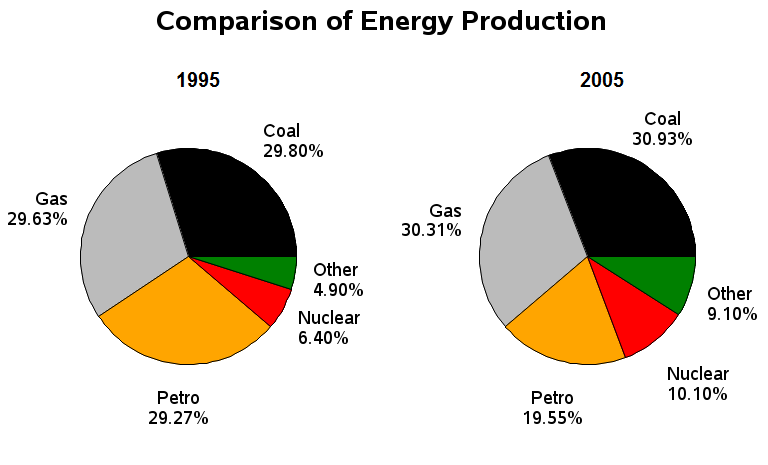
The pie charts below show the comparison of different kinds of energy production of France in two years.

ielts pie chart comparison

Source: Above pie charts not created by IELTS Liz.

Pie Chart Sample Answer

The two pie charts illustrate the proportion of five sources of energy production (coal, gas, nuclear, petrol and other sources) in France in two years (1995 and 2005). 

Overall, in both years coal and gas accounted for over half of all energy production, while the least was other energy sources. There was only a very minimal increase in production from gas and coal, whereas nuclear and other sources almost doubled. Petrol was the only energy source to decrease over the period.

Energy produced by coal totaled 29.80% in 1995 and by 2005, it had increased by about 1% to 30.9%. Likewise, the amount of energy generated by gas likewise went up by approximately 1% from 29.63% in the first year to 30.1% by the final year. The use of nuclear power rose significantly from 6.40% in 1995 to 10.10% in 2005. Other sources of energy production accounted for 4.90% but then climbed to 9.10%.

Petrol, on the other hand, produced 29.27% of all energy in 1995 but 10 years later only 19.55% of energy came from this source. 

Words = 177

IELTS Pie Chart Tips

  • Introduction paragraph should introduce all aspects of the task.
  • The overview must contain all key features of all pie charts. This is the most important paragraph and should not be only one sentence. You must identify the key features of both charts and present them as an overview. You are being marked on the content of this paragraph.
  • Always highlight the largest and smallest proportions in the overview. 
  • Note whether the pie charts show change over time or comparison of categories divided by gender or in a similar way. Not all pie charts are the same. Depending on the information given, you’ll use different language and organise things differently.
  • If there are two pie charts in different time periods, then you must highlight the key changes / trends.
  • Use pie chart language – accounts for / comprises of / represents.
  • The phrase “Units are measured in …” should be used when the units have not been stated in the previous sentence.

RECOMMENDED FOR YOU

Click below:

FREE SUBSCRIBE

Subscribe to get new lessons & tips by email.

.

Positive or Negative Development: IELTS Model Essay

An IELTS model essay for positive or negative development questions. It is common in IELTS writing task 2 to be asked to choose either something is a positive or negative development/trend. Your task is to answer the question in the introduction and explain your answer in the body paragraphs.

These instructions are asking for your opinion so it is important that you give it clearly. If you fail to present a position of your own (a view point), you will have failed to complete the task and that will affect your score.

IELTS Positive Negative Essay Question

Nowadays, more people are choosing to socialise online rather than face to face. Is this a positive or negative development?

IELTS Model Essay: Positive or Negative Development?

An increasing number of people meet and talk to their friends online instead of in person. In my opinion, this is a negative development which can lead to isolation, potentially harmful situations and also problems later on in life.

One serious problem that can arise from people socialising online is that it can lead to isolation. Before the internet, people would frequently go out to meet friends, for example in cafes, bars or restaurants, whereas now people prefer to stay at home alone, chatting online. As a result, people are starting to spend the majority of their time alone at home in their room without meeting others. Isolation of this kind is not healthy and can sometimes lead to depression and other issues.

Another issue is that meeting people online can be risky. In other words, people can assume fake identities online as well as hide their true characteristics. This is particularly concerning for teenagers who are impressionable and can easily be led into dangerous situations. Furthermore, as this interaction is online, parents have no way of monitoring it and protecting their children.

Finally, socialising online can end in difficulties years later as conversations and shared photos that had been forgotten reappear. This situation is currently critical for many people, again especially for teenagers who do not think carefully before posting online. That is to say, information which is put online can remain there forever and while people may share intimate communications with close friends, these words can then resurface later on leading to much embarrassment.

In conclusion, although it has become more popular for people to socialise through the internet, it has brought about too many problems for this to be considered a positive trend.

Examiner’s Comments: This essay provides a clear answer to the essay question. The position is clearly presented in the introduction and also explained and supported throughout the essay. Linking devices are well used and ideas are organised logically. Language is flexible and accurate. This would reach band 9. (Word count = 286)

More IELTS Model Essays:

FREE SUBSCRIBE

Subscribe to get new lessons & tips by email.

.

IELTS General Training Reading: Information & Tips

Learn about the IELTS General Training Reading Test. The IELTS GT reading is different to the academic reading in a number of ways but mainly due to the language and difficulty level of the texts. Similar to the academic reading, the general training reading test is 60 minutes in length and has 40 questions.

General Training Reading Sections

There are three sections in the IELTS GT reading. However, sections one and two might have more than one text. The sections get increasingly difficult.

Section 1

: This section is based on one, two or three texts about English life and could be, for example, an advertisement for a hotel,  sports center facilities or educational courses. The texts are not long and are factual rather than descriptive.

Section 2

: This section may also consist of more than one text and often relates to work about pay schemes, work conditions or machinery instructions.

Section 3

: The final section is usually one text which is quite long and it is the hardest.

IELTS General Training Reading Band Scores

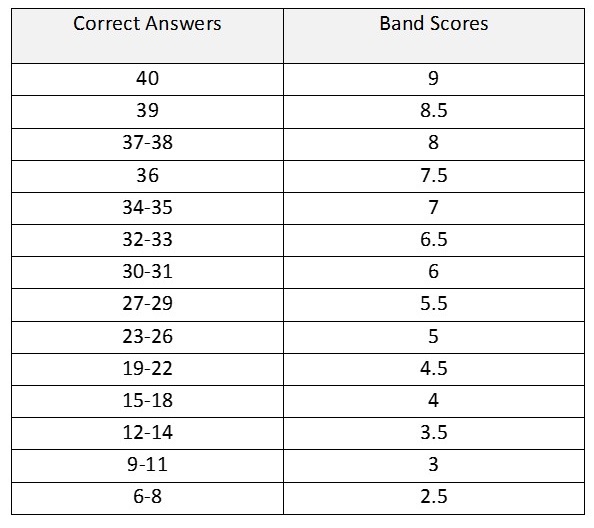
Below is a list of the scores from band 2 to 9 for the GT reading test. The scores are not the same as the academic reading test. Click on the table to enlarge.

general training reading scores

IELTS Reading Question Types for General Training

The types of questions you will be asked in the GT reading test are the same as the academic test. Here is a list:

  • matching headings
  • true false not given / yes no not given
  • matching paragraph information
  • summary completion
  • sentence completion
  • short answer questions
  • table / flow chart completion
  • diagram labeling
  • multiple choice / list selection
  • choosing a title
  • categorisation
  • matching sentence endings

You can click here for: Tips on the Different Types of Reading Questions. You can find free practice lessons for most of these types of questions in the reading section:  IELTS Reading Lessons. However, must practice exercises are on the level of section 3. Also learn: How to Improve your IELTS Reading. For one full GT IELTS practice reading tests, please visit the BC IELTS page of practice tests.

GT writing. For information about GT writing, see this page: GT Writing Information

IELTS True False Not Given Questions

….

FREE SUBSCRIBE

Subscribe to get new lessons & tips by email.

IELTS Table Band Score 9 Model Answers with Tips

Below is an IELTS table with model answer for Writing task 1. The tables below are typical of what you will get in your IELTS test. The model answers help you understand how to structure your table writing and organise data into paragraphs. Getting lost in too many numbers is the biggest challenge for IELTS tables. All model answers are estimated at band 9 and are written as a safe guide to learn from for all band scores.

How to Approach IELTS Table Questions

Useful strategies for IELTS Tables in Writing Task 1: Below are useful steps to ensure that you approach your IELTS table correctly. Try not to get lost in detail and instead look for patterns, similarities and differences to group information together.

  1. Analyse the key information in each category.
    • look for key features (highs/lows/usual data/ changes)
  2. Think about grouping information and categories together
    • if numbers are all below 5%, group them together as one but avoid writing them as a list and instead refer to them collectively
        • group information together with similar trends is essential for an IELTS table because of the volume of data given.
        • you get a lower score if you give too many small details
        • you get a lower score if you miss out information
    • if a number or a category is unusually high, single it out as an individual feature
  3. Plan your paragraphs and content. Each paragraph has a unique and clear function. Use the model table answers above to review them.
    1. Introduction
    2. Overview
    3. Body Paragraph 1
    4. Body Paragraph 2
    5. Body Paragraph 3 (not usual but possible at times)
  4. The introduction should be short and factual.
    1. For a free video lesson, click here: How to Write an Introduction for Writing Task 1
  5. The overview is the most important paragraph. Make sure it contains all key features for a high score.
  6. Divide your body into paragraphs.
    1. In most tables, you will have categories along the top and the side. You must decide the best way to divide categories into body paragraphs. Always choose the most logical.
    2. The time to give data in the body paragraph. Each statement must be supported with numbers from the table given. If you don’t give numbers, you’ll get a lower score for Task Achievement which counts for 25% of your marks.
    3. You don’t have to give all details. You can group details together by giving averages or ranges.
    4. Be selective. Don’t put too many details in your report.
  7. Make sure you write over 150 words but aim for less than 200.
  8. Try to avoid being repetitive with your sentence structures.
  9. Pay attention to what type of information the table gives (static figures or changes over a period of time). This will help you decide what kind of language to use.
  10. Do not try to paraphrase all words, all the time. This leads to vocabulary mistakes. Choose wisely which words to change and which to keep the same.
  11. All information and language should be accurate for a high score

IELTS Table Model Answers

IELTS Table: Question 1

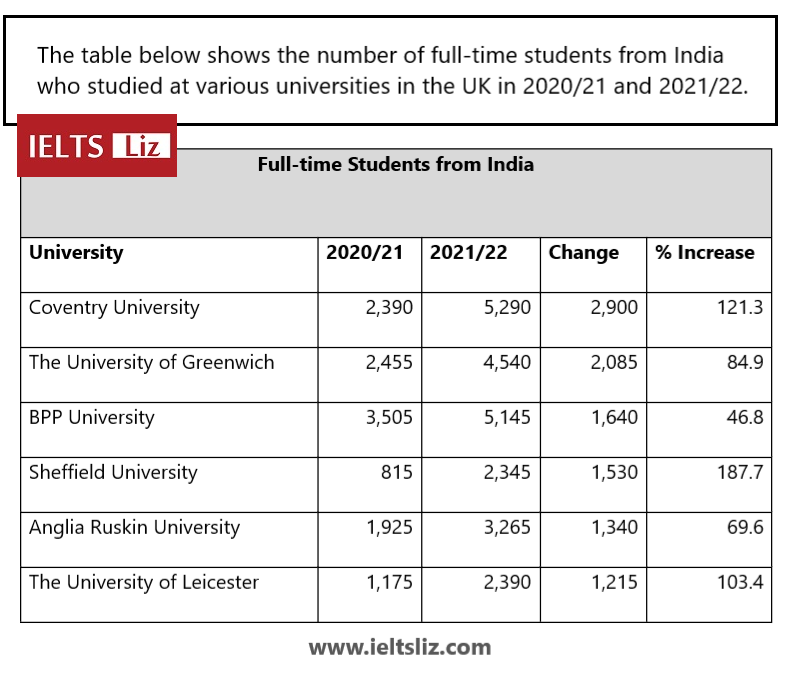
As you see, this IELTS table shows  change over two time periods with four categories in total.

IELTS Table

IELTS Table Model Answer 1

The table gives information about how many full-time students coming from India studied in six British universities in two academic years (2020/21 and 2021/22) as well as the change in numbers and percentage increase.

Overall, the greatest increase in Indian students could be seen in Sheffield University, while BBP University showed the lowest increase over the two years. The university with the most students from India was BBP University in the first year and Coventry University in the second year.

Sheffield University saw a dramatic rise of 187.7% in India students reaching 2,345 in 2021/22. Likewise, the number also climbed considerably for Coventry University by 2,900 students (121.3%) to hit 5,290 students in 2021/22. Another significant increase was seen in Leicester University from 1,175 to 2,390 students, a rise of 103.4%.

All other universities saw an increase of under 100% in the number of Indian students over from 2020/21 to 2021/22. The number of students going to University or Greenwich and Anglia Ruskin University rose by 2,085 students (84.9%) and 1,340 (69.6%) respectively. Regarding BBP University, the number of students remained high in both years at 3,505 and 5,145, which was a growth of only 46.8%.

IELTS Table: Question 2

This IELTS table is slightly easier because it contains less data. You can also see trends for each category more easily.

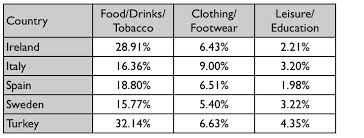
 The table below gives information about consumer spending on different items in five different countries in 2002.

IELTS Table Question Writing Task 1

(Source: IELTS Cambridge English Test Book

IELTS Table Model Answer 2

The table illustrates the proportion of consumer expenditure in Ireland, Italy, Spain, Sweden and Turkey on three types of consumer goods in 2002.

Overall, the category of consumer goods that all countries spent most on was food, drinks and tobacco, which was three times higher than on the other types of goods. The lowest spending could be seen in the category of leisure and education in all five countries. The outlay of Turkey was generally higher than the other four countries.

In terms of food, drinks and tobacco, Turkey spent the most at 32.14%. The expenditure of Ireland was also high (28.91%) compared to Sweden which spent the least (15.77%). Spain and Italy spent 18.80% and 16.36% respectively. On the other hand, the lowest expenditure was on leisure and education which accounted for under 5% in all countries. Turkey spent most on these items at just 4.35% of their national expenditure which is around double that of Spain (1.98%).

Clothing and footwear was the third category of consumer goods and outlays for those items were between 9% in Italy and 5.40% in Sweden.  The national spending in this area for the remaining countries averaged around 6.5%.

Note: in most writing task 1 reports, body paragraphs do not need to be a similar length. In report writing, it is common to very some long paragraphs and others quite short. Tables are no different to other task 1 charts.

RECOMMENDED FOR YOU IN WRITING TASK 1:

FREE SUBSCRIBE

Subscribe to get new lessons & tips by email.

.

error: Content is protected !!