Linking Words for IELTS Writing Task 2

The linking words list below is essential for IELTS writing task 2 for high score. The examiner needs to see a range of linking words in your essay to award you a high score for the criterion of Coherence and Cohesion which is 25% of your marks. You will be checked on your range, accuracy and your flexibility of linking words in IELTS writing task 2. These connecting words are suitable for all types of essay writing as well as GT IELTS writing task 2
IELTS Writing Linking Words

Listing

These words are often used to either put your paragraphs in order or used inside the paragraph to highlight and organise your supporting points. However, using “Firstly” and “Secondly” to start each body paragraph is considered “mechanical” which means it is like a machine and this isn’t good for people aiming for band 7 and above. So, being flexible using a combination of linking words is better.

  • firstly
  • secondly
  • another point to consider
  • a further consideration
  • another issue
  • lastly /last but not least / finally

Adding Information

You will need to support your main points in your IELTS essay. These linkers inform the reader that extra information is about to be presented.

  • in addition
  • additionally
  • furthermore
  • moreover
  • also
  • not only … but also
  • as well as
  • and

Giving Examples

It is often useful to give examples to support your ideas in IELTS writing task 2. Make sure you use this range of linking words to do so.

  • for example
  • one clear example is
  • for instance
  • such as
  • namely
  • to illustrate
  • in other words

To learn how to put examples in sentences for essay writing, please follow this link: How to Add Examples to Essays.

Results and Consequences

These linking devices can be used for solution essays or any essay when you need to explain the consequences of something.

  • as a result
  • consequently
  • therefore
  • thus
  • hence
  • so
  • for this reason

Highlighting and Stressing

It is important to be clear about what you mean in your essay. These linking words help you stress particular points.

  • particularly
  • in particular
  • specifically
  • especially
  • obviously
  • of course
  • clearly

Concessions and Contrasts

You often need to give opposite ideas, particularly for discussion essays so the linking words below will help you show the reader when you want to introduce an opposite point. Also you might want to give exceptions to a rule for a concession.

  • admittedly
  • however
  • nevertheless
  • even though
  • although
  • but
  • despite
  • in spite of
  • still
  • on the other hand
  • by contrast
  • in comparison
  • alternatively
  • another option could be

Reasons and Causes

These connecting words will help you explain reasons and causes for something which is very common in IELTS writing task 2, especially for cause / solution essays.

  • because
  • owing to
  • due to
  • since
  • as

Giving your Opinion

  • in my opinion
  • I think
  • I believe
  • I admit
  • in my view
  • I concur / agree
  • I disagree / I cannot accept

Don’t make a mistake with the way you express your opinion. Watch this video for useful tips on giving your opinion and how to avoid mistakes: IELTS ESSAY: WHEN & HOW to give your opinion

.

Linking Words for Conclusion

Which is the best?

In a nutshell,

To sum up,

To conclude, 

In conclusion,

Rounding off,

Practice with Linking Words

Improve your use of linking words by fill in the gaps below with linking words from the above list.

  • .(1) …………………….. of the popularity of Facebook, there has been a rise in online crime, (2) ………….. fraud and identify theft. 
  • There are a number of drawbacks to people using Facebook as a way of communicating (3)………………… it is (4)…………….. one of the most common social networking platforms for both individuals and businesses.
  • (5)……………………….. the lack of exercise taken by average people, obesity and other weight related problems are on the rise.
  • Unemployment and poverty, (6) ………….. in urban areas, is often deemed to be the cause of the rising crime rate.
  • (7) …………… the rise in urban crime, more and more people continue to relocate to cities looking for a better life.
  • More children are becoming obese and (8)…………….. schools should be encouraged to provide more sports lessons and outdoor activities.

ANSWERS

Click below to reveal the answers:

Answers
  1. Regardless
    • You cannot have despite because the preposition of in the sentence prevents this being used.
  2. such as / for instance / namely
    • like is not possible because it is not suitable for formal writing in IELTS.
  3. even though
  4. admittedly
  5. Due to / Owing to
    • ( you can’t have “because of” because it is at the beginning of a sentence. Never use but or because at the start of a sentence in formal IELTS writing.)
  6. particularly / especially / specifically
  7. despite
    • If you wanted to use the word “although”, you would have to change the sentence structure:
    • Although the urban crime rate is rising, more and more people are continuing to relocate to cities looking for a better life.
  8. therefore / so / for this reason

.

RECOMMENDED FOR YOU:

FREE SUBSCRIBE

Subscribe to get new lessons & tips by email.

.

Capital Letters in IELTS: Will it affect your score?

When to use capital letters in your IELTS Listening, Reading and Writing test. Will you get a lower score if you make a mistake with capital letters? Can you write your answers in all capital letters? What are the rules for capital letters in IELTS? What about using capital letters in the computer based IELTS test? Read below to learn about this.

Using Capital Letters for IELTS Answers: Rules & Advice

Below you will find advice for using capital letters for writing your answers in IELTS Listening, Reading and Writing.

Capital Letters in IELTS Listening and Reading

In IELTS listening and reading, you can write all your answers in capital letters if you want. You can do this for the paper based test and the computer based test. It is completely up to you. There is no rule stating whether you should use capital or lower case.

  • You can write your answers in small letters if you want.
  • You can write in all capital letters.

Examples of capital letters in listening and reading:

  • HOSPITAL = correct / hospital = correct / 9am = correct / 9AM = correct 

Which is best? Capital letters or lower case?

I recommend writing your listening and reading answers in capital letters for the paper based test. This avoids any problems of markers struggling to read your handwriting. For the computer based test, it doesn’t matter. Both lower case and upper case will be easy to read. 

Transferring Answers in Listening & Reading

In IELTS listening, you will be given 10 mins extra to transfer your answers to your answer sheet in the paper based test. Check your answers and check your spelling – then write your answers on the answer sheet.  If your handwriting is poor, write using all capital letters so it is easy to read. For the computer based test, you do not need to transfer answers. You only need to check what you have already put into the computer. For this reason, you will be given only 2 mins to check your answers after the recording ends.

In IELTS reading, you will not get 10 extra mins to transfer your answers. You must write your answers directly on your answer sheet. But it is completely your choice how to write your answers. The most important factor is clear writing for the paper based test. Use all capital letters if your handwriting isn’t clear.

Capital Letters in IELTS Writing

In IELTS Writing, you can choose to write your essay in capital letters. But I would not recommend it because:

  1. you WILL be marked on punctuation so the use of capital letters and lower case is important to show. You must have a capital letter at the start of a sentence, for example.
  2. you have a strict time limit and it takes too long to write in capital letters

So, write your essay in lower case and remember to use capital letters when grammatically appropriate. The examiner will mark you down if you use capital letters incorrectly. Here is a list of typical words that use capital letters:

When to use capital letters in English grammar

  • Days/ Months = Thursday / September
  • Names and Titles = Mrs J Blogs / Dr Author Jones
  • Countries / Cities = India / Vietnam / Paris / Hong Kong
  • Names of Places = University of London
  • Acronyms = BBC (British Broadcasting Corporation)
  • Start of a Sentence = “The majority of people use cars to go to work these days. However, it would be better if they used healthier means of transport such as the bicycle.”

Biggest Mistake with Capital Letters

  • but / because / and
    • These linking words should NEVER be used to start a sentence in formal writing. See my page of linking words for writing task 2 to learn tips and get a useful list: IELTS Writing Task 2 Linking Words

What about speaking part 2? Well, the notes you make for your talk are not marked and only you see them. The examiner will not check them or mark them. So, don’t write sentences or bother with punctuation, just write words, ideas and tips to help you present a good talk.

More IELTS Tips

What about using a pen or pencil? Click on this link: IELTS Pen or Pencil

How are words counted in IELTS Listening? Click on this link: How Words are Counted in IELTS

Can I use “I” or “my” in writing task 2? Click on this link: How to express your opinion in IELTS WT2

Tips & Practice for Listening, Reading, Writing and Speaking:

……………..

Free Subscribe to get New Posts by Email

IELTS Listening Test Changes Jan 2020

Starting January 4th, the IELTS listening test will have the following changes:

IELTS Listening Test Change 1

There will be no example played in part 1. Usually there would be an example answer for you to listen to at the start of the recording. This helped you get used to the accent and check the volume if you were using headphones. This example has now been removed. This is a very important change that you need to be ready for. You must listen carefully from the start of the recording for answer 1.

IELTS Listening Test Change 2

The word “sections” will now be changed to “parts”. This won’t affect the actual test, but it is something that is useful to know.

IELTS Listening Test Change 3

There will be no page number references. But there will still be references to question number. Again, this is no big change for you, but it is something to be aware of.

There are no other changes to the IELTS Listening Test or the Reading, Writing or Speaking Tests. For pros and cons of the computer based test, see this page: Computer based IELTS. For useful information about the IELTS test does and don’ts, see this page: IELTS FAQ Visit the Official IELTS page for verification of the above changes: IELTS Listening Test Format

…………………………..

Subscribe to get New Posts by Email

IELTS Line Graph Model (Band Score 9)

This model line graph for IELTS is estimated at band score 9. The model answer below is for IELTS writing task 1 academic paper. Use this sample writing as a template for structure, key features and language for any IELTS line graph. There are also some tips given below to guide you and help you understand how to describe this type of graph.

Line graphs will typically have between two or five lines. However, it is possible to have more than five lines. Depending on how many lines you have, you’ll need to decide how much data you present in your report. See the tips at the bottom of the page.

IELTS Line Graphs with Model Answers

IELTS Line Graph 1

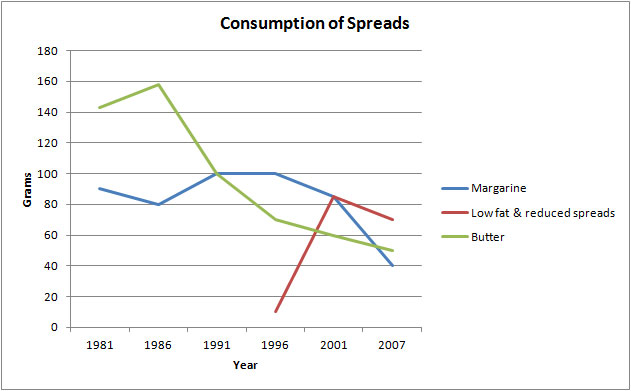
This line graph is typical of IELTS writing task 1. It shows three lines and one of the lines doesn’t have any data for the first few years. See the model answer below to learn how to tackle this task.

The graph below shows the consumption of three spreads from 1981 to 2007.

IELTS Line Graph

IELTS Line Graph Model Answer

The line graph illustrates the amount of three kinds of spreads (margarine, butter, and low fat and reduced spreads) which were consumed from 1981 to 2007. Units are measured in grams.

Overall, the consumption of margarine and butter decreased over the period given, while for low fat and reduced spreads, it rose.  At the start of the period, butter was the most popular spread. Margarine was the most widely consumed in the middle of the period but, by the end, low fat and reduced spreads was most popular.

With regards to the amount of butter used, it began at around 140 grams and then peaked at 160 grams in 1986 before falling dramatically to about 50 grams in the last year. Likewise, approximately 90 grams of margarine was eaten in the first year, after which the figure fluctuated slightly and dropped to a low of 40 grams in 2007.

On the other hand, the consumption of low fats and reduced spreads only started in 1996 at about 10 grams. This figure, which reached a high of just over 80 grams five years later, fell slightly in the final years to approximately 70 grams in 2007.

IELTS Line Graph 2: Five Lines

Essential tip for a line graph with many lines:

  • Don’t get lost in too much detail. Going beyond 200 words is very rare. Most tasks require only 170 and 190 words. Getting lost in detail and writing too much will give you a low score for Task Response, which counts for 25% of your marks. See this page: Band scores, Marking & Tips for bands 5 to 8.

IELTS Line Graph Model Answer

Line Graph Model Answer

The line graph illustrates how many weekly hospital admissions there were in Fortsmith, Adlin, Stanton, Bardley and Oxley, which are hospitals located in a European country, between 2004 and 2018.

Overall, for most of the period given Bardley had the most admissions, while Stanton had the least. Oxley was the only hospital to see a decline in admissions and Fortsmith was unique in that their admission figures remained relatively stable over the period. Admissions to all other hospitals increased during the years given.

Admissions to Oxley hospital started at just under 250 a week in 2004 but more than halved by the final year (just over 100 admissions). Fortsmith weekly hospital admissions fluctuated at around 200 for the whole period.

On the other hand, the number of people admitted to Adlin hospital rose dramatically from just over 100 in the first year to 250 by 2018. Likewise, Bardley also saw a rise from 200 to peak at over 250, the highest for any hospital. In terms of Stanton hospital, only approximately 70  people were admitted in 2004 and this gradually climbed to slightly over 150 in 2018.

Words = 187

Below are key steps for tackling an IELTS line graph:

  1. Paraphrase the line graph information for your introduction.
  2. Add axis information to your introduction if needed, such as categories or units.
  3. Put main trends and any other key features in an overall statement. The overview is the most important statement in your writing task 1. One sentence for an overview usually isn’t enough.
  4. Organise body paragraphs logically because you are being marked on this. Make sure to always have two body paragraphs (three occasionally). Decide which lines show trends that should be grouped together.
  5. Make sure each sentence in the body paragraphs has numbers and dates to support it. This is vital for Task Response.
  6. Ensure all data is accurate. If you are not sure the number is precise, write “about” or “approximately”.
  7. Use a range of linking words. Try not to repeat them.
  8. Aim for around 180 words for writing task 1. Try not to write over 200 words. More does not mean better.
  9. Line graphs have specific vocabulary that you must showcase. Learn nouns, adjectives, verbs and adverbs carefully: Line Graph Vocabulary

RECOMMENDED FOR YOU – IELTS WRITING TASK 1

Click below:

FREE SUBSCRIBE

Subscribe to get new lessons & tips by email.

.

How many Sentences for an Essay Introduction

IELTS Writing Task 2 Academic & GT Essay Introductions

Hi guys, here are model answer introductions and essential tips for Tuesdays lesson on writing task 2 introduction paragraphs. I hope you find this lesson useful 🙂

1) How long should the introduction be?

Most essays will require only two sentences for your introduction paragraph. You will need to write a background statement and a thesis statement. There is no need to write more. It won’t help your score to add more to the introduction. Your introduction should usually be between 40-60 words. Below are details of the content of an introduction paragraph.

2) Background statement:

This is the first sentence of your essay and it paraphrases the essay question. This is the way to introduce the issue or issues given to you by IELTS because that is what your essay is responding to. Paraphrasing is a way to avoid copying directly from the essay question by using your own sentence. For example:

Essay Question: The government should allocate more funding to teaching sciences than on other subjects so that the country can develop. Do you agree or disagree?

Background: It is often thought that in order for the country to progress more funding ought to be allocated to teaching sciences instead of other subjects.

As you can see above, the background statement contains exactly the same information but written differently. It is an easy sentence to write if you practice your paraphrasing skills. You can find a useful page on paraphrasing here: Paraphrasing Background Statements and examples of background statements here: Background Examples

3) Thesis Statement

Your thesis statement will introduce your answer or your opinion. It is the second and final statement needed in the introduction. It shows the reader the direction you plan to take in your essay. Furthermore, it is important that you write this carefully and clearly because it will impact both Task Response and also Coherence and Cohesion which together count for 50% of your marks.

The thesis does not need to be detailed. It is possible to split it into two sentences if you need more space, but mostly it will be one sentence only. For example:

Essay Question: The government should allocate more funding to teaching sciences than on other subjects so that the country can develop. Do you agree or disagree?

Thesis Statement Agree: I completely agree that focusing on science subjects at school is essential for a country’s future.

Thesis Statement Disagree: In my opinion, funding should not focus on the sciences but should rather be allocated to maths, technology and languages.

Thesis Statement Partial Agreement: While I agree that the sciences do need extra funding, this should not be at the expense of other subjects which are also crucial to a country’s development.

As you can see above, each thesis statement is simply written and presents a clear opinion. Do not try to create a complicated thesis statement. Your opinion and having a clear position is more important.

Short thesis statements

Yes, it is possible to write just a few words: “I completely agree with this position.” or “I strongly agree with this opinion.” However, I personally prefer to showcase more language skills with a slightly longer thesis statement as shown above.

Below you can see a full introduction for a one sided approach:

It is often thought that in order for the country to progress more funding ought to be allocated to teaching sciences instead of other subjects. In my opinion, funding should not focus on the sciences but should rather be allocated to maths, technology and languages.

4) Giving Your Opinion in IELTS Essays

Yes, you need to give your opinion if the instructions ask for it. Using the words “this essay” does not represent your own personal opinion. If you are asked for YOUR opinion, you need to use I or MY – failure to do this will result in a lower score. See this page for more details: How to give your opinion

5) More Writing Task 2 Tips

You can find more IELTS writing task 2 tips, model essays and lessons on this page: IELTS Writing Task 2 . All main sections of this website are access through the RED MENU BAR at the top of the site.

High Band Score Essay Techniques: Advanced Lessons

If you are struggling to hit band 7 or you need more help understanding how to write a high band score essay, get my Advanced Writing Task 2 lessons which you can find here: Liz’s Advanced Lessons.

You can also find a useful e-book about Ideas for Essay Topics. Containing over ideas for over 150 essay topics. Ideas are presented as vocabulary exercises to help you improve your range and accuracy in English.

.

6) How to Write an Introduction

Here is a useful video tutorial I made some time ago which helps you understand more about writing an introduction paragraph:

.

…………………….

Subscribe to Get New Posts by Email

Essay Introduction Practice 1

Hi guys,

Below is an essay question that is common to get in IELTS writing task 2 Academic & GT tests. This is your chance to post your introduction and compare it to others. Writing the introduction is the easiest part so use this lesson to practise.

Essay Question: The government should allocate more funding to teaching sciences than to other subjects so that the country can develop. Do you agree or disagree?

Answer

The answers to this lesson are now available.

CLICK HERE: MODEL ANSWER & TIPS FOR INTRODUCTIONS

Remember: you need to have a background statement and a clear thesis statement. Always aim for clarity rather than aiming to impress. Avoid errors and keep your meaning clear. Keep it under 60 words.

All the best

Liz

……………………….

Subscribe to get New Lessons by Email

Why the IELTS Speaking Examiner Stops your Answer

Learn why the IELTS speaking examiner might interrupt your answer in the IELTS Speaking Test. A lot of IELTS candidates are shocked that the examiner stops them in the middle of their answer to ask a new question. They are not prepared for interruptions and when it happens, they lose focus, get stressed and their performance suffers. Don’t let this happen to you. Be prepared and understand why the examiner is interrupting your answer.

Why the IELTS speaking examiner interrupts your answer

There are three main reasons why the IELTS speaking examiner might interrupt you and not let you finish your answer.

  1. The main reason is that time is limited. If your answer is slow, lengthy or not giving enough good English, the examiner might choose to stop you and start with a fresh question. It’s one way that the examiner can help guide you and keep you on track.
  2. Another reason is that you already gave the examiner the aspect of language they wanted to hear. When this happens, the examiner doesn’t need to hear the rest of your answer and can interrupt you to move on. Let me give you an example:
    1. Question: What changes would you make to your home if you could?
    2. Answer: If I could, I’d expand the living room so that we have more space and maybe build a patio. But I’d also like to ….
      1. Comments: Why would the examiner stop the answer after only one sentence? Well, this question was testing if the candidate could speak in the hypothetical tense (second conditional). The candidate already showed that this tense was easy for them, so the examiner can stop them and move on to a new question. Remember, some questions are testing specific language functions and once you’ve shown that ability in your answer, the examiner could stop you so that they can test other aspects of your language.
  3. The examiner will also interrupt you if time is up in any part of the test. This is actually obligatory.

It is important that you understand this fully:

  • The IELTS speaking examiner is not being rude or lacking concentration by interrupting you. In fact, when they change questions, they usually have a valid reason for doing so, which is neither bad or good as far as you are concerned.
  • The examiner is not trying to undermine your confidence. You actually should be prepared for interruptions to your answers if you have prepared fully for the test. This aspect of the IELTS speaking test should not be a surprise to you.
  • Being off topic does not affect your score in IELTS speaking. So, when the examiner interrupts you to redirect the question, it won’t affect your score. It is the examiner helping you.
  • The examiner isn’t interrupting you because you gave the wrong answer. There are no right or wrong answers – only opportunities to showcase your English. Interrupting your answer gives you a chance to tackle a new question.
  • The examiner does not rapidly ask questions to test your ability to handle stress – this is not how the IELTS speaking test works. The examiner only has a certain amount of time to test your English thoroughly so that they can give you a fair and valid score. Often you might show a wider range of English when you are given more different questions and topics.
  • Each examiner is different. Some examiners do tend to interrupt more than others so always be prepared. Whether they interrupt a lot or not at all doesn’t mean one examiner is better than another.

Always remember that the examiner is only testing 4 things: fluency, vocab, grammar and pronunciation. Nothing else is marked. 

Will interruption to your answer lower your score?

No. 100% not. This is a choice made by the examiner to cover all language functions and direct the test in the way the examiner wants.

How Can you Prepare and Cope for Interruptions

  1. You should know that the IELTS speaking examiner might interrupt you before you enter the test room. This is knowledge about the test that you ought to learn during your exam preparation.
  2. When it happens, don’t be upset or confused. 
  3. Being interrupted isn’t bad or good. It’s just part of the testing system and will help the examiner assess many parts of your language.
  4. Don’t think you made a mistake. The examiner might be moving on because your answer was actually excellent already. For whatever reason, it is simply a way for the examiner to manage the test and you don’t need to be concerned about it.
  5. Keep talking until you are interrupted. Let the examiner manage the test their way.
  6. As soon as you are interrupted, focus on the new question.
  7. Regardless of interruptions, be confident and try to enjoy the test. It is an informal speaking test.
  8. Remember, interruptions are normal.

Free IELTS Speaking Tips & Model Answers

Click here to learn more about IELTS Speaking for free: IELTS Speaking Tips & Answers

……………………….

Subscribe to get new posts for free in your inbox


Listening Practice: Autism Hour

This lesson focuses on sentence completion questions which basically means filling the gaps with a word or words from the recording. It’s a common question type in IELTS listening tests. To do well at this type of question you need to be good at paraphrasing and being able to spot keywords in the question to help you navigate the audio.

I chose the topic of Autism because I feel it is one we all need to know more about. Autistic people experience the world in a very different way to people who are neuro-typical. The more we understand, the more we will love, value and respect people with Autism.

Listening Practice for IELTS 

AUTISM

Questions 1-5: No more than two words.

  1. Autism can affect how someone ……….. with others and how they experience the world.
  2. Businesses should ………. their lights and reduce noise during Autism Hour.
  3. Too much light and noise and lead to a sensory ………… which can be painful for people with autism.
  4. Society is mostly …………. towards neuro-typical people.
  5. Some people with other illnesses can also struggle to cope with ………… information.

Recording: Listen only once.

.

Answers

Answers for this lesson are now available.

Click here: Answers to Autism Listening Lesson

Message from Liz:

Autism is something close to my heart. Please take the time to learn more by choosing one of the following links:

The Reason I Jump. This is one of the most remarkable books I have ever read. It opened my eyes to the incredible world experienced by autistic people. Written by Naoki Higashida, who has severe autism, it provides a special insight into what someone with autism experiences and the reasons for their reactions so we can understand and support them. You can purchase this on Amazon. Here is a link to it for UK buyers: The Reason I Jump 

National Autistic Society, UK. This website will give you information about autism and what you can do to help: https://www.autism.org.uk/

…………………………..

FREE SUBSCRIBE: Get New Lessons & Posts From Liz by Email

error: Content is protected !!