Listen & Write: Dealing with Natural Disasters

This lesson is about listening to an audio recording, taking notes and then reproducing the full written text. This is not an IELTS test practice. It is just a practice exercise to develop sharper listening skills and check your accuracy of written English. Many people preparing for IELTS say they don’t know if their grammar is accurate or not. This is one way to check. When someone speaks aloud what they want you to write down, it is called Dictation. This is a dictation practice.

In this lesson, you will check your ability to:

  1. listen for keywords such as nouns
  2. make notes at the same time as listening 
  3. recreate what you hear in writing – produce a written script of what you hear
  4. check your grammar
  5. check your spelling
  6. check your basic punctuation

How to use this lesson:

  1. get a pen and paper
  2. listen and make notes at the same time
    1.  write down all the nouns you hear. Nouns are always the most important words to write down when you want to reproduce what you hear on paper. 
    2. the aim is not to pause the audio, but to keep it running while you make notes. Of course, the first time, you will only get about 15% of the words. But you can listen again to collect more nouns.
    3. when you write down the nouns, don’t worry about spelling the full word. You can edit all this later after you have finished listening three times.
    4. make sure you keep the order of nouns correct so that you can create the sentences afterwards. You will use those nouns to recreate the full script.
    5. Your aim is not to write all the words while listening. It is to write only key nouns and keywords so you can then recreate the script. This is the same as you do in a university lecture.
  3. listening again and add more nouns to your list
  4. Listen a third time and even a fourth if necessary. You can also write down other useful words as well.
  5. using the nouns you have written down, try to write the whole script on your paper. Don’t listen at this point. Just look at the nouns on your paper and recreate the passage. You will need to add verbs, adjectives, adverbs, articles (a/the) and any other words to make your writing grammatically accurate.
  6. review what you have written and put in full stops, commas and capital letters.
  7. when you think your writing is accurate, listen one more time to see what  words you have missed. 
  8. after those steps, when you are sure your writing is an accurate reproduction, check the answer.
    1. Check which words you are making mistakes with  – are they plurals, articles, verb agreement – which aspects of grammar do you make the most mistakes with
    2. check your spelling and punctuation

This is NOT an IELTS test. It is an opportunity to develop note taking skills at a high level and check the accuracy of your written language. 

Listen and Write: The Best Way to Deal with Natural Disasters

.

Natural Disaster = tsunami, typhoon, earthquake etc

ANSWER

The answers are available by clicking below:

CLICK HERE: ANSWERS TO THIS LESSON

i hope you found this useful.

All the best,

Liz

………………………

Subscribe for Free to get New Lessons by Email

How to write an IELTS Essay

Learn how to write a high band score IELTS essay step by step. You will find 15 key steps for a high score IELTS essay. These steps are for both GT and Academic Writing Task 2. After the steps listed below, you will find useful links that will help you learn more and develop the right skills necessary to be successful in IELTS.

Step by Step: How to tackle your IELTS essay

None of these steps below can be missed if you are aiming for a good score in your IELTS Writing Task 2 essay. Be strategic and focused in how you approach your IELTS essay. Failure to tackle the points below will result in a lower score. They are particularly important for candidates aiming for band 7 and above. For those candidates, you must fulfill the requirements of the higher band scores by following and mastering the steps below.

Step 1: Make sure you identify the type of essay you have been given. This essay is what I call a “Direct Questions” essay. There are two specific questions that you must answer. The first question is about cause. You must state the cause of this trend. The second question requires you to evaluate. This means you must present your opinion as to whether you think this is a good thing or a bad thing. Click here to learn about the Types of IELTS Essays.

Step 2: Before you plan your essay, think about the structure. You have two questions and they are of equal weight. This means you will have two body paragraphs. Both body paragraphs will have equal length. Click here to learn about how many paragraphs in your essay.

Step 3: Identify the issues in the essay question. The essay question above is very simple. It is about computer games. However, some IELTS essay questions are more complex so you must take time to identify the issue or issues. 

Step 4: Brainstorm main ideas. When you brainstorm main ideas. it does not mean you will use all your ideas in your essay. First, brainstorm ideas and after that select the best ideas. To prepare ideas, see this list of common essay topics.

Step 5: Develop supporting points. This is the step that most people miss. Most people plan their main ideas and then start writing. Your main ideas are certainly important, but the supporting points are equally as important. And this is the area where most people easily go off topic. So, using your planning time to prepare your supporting points. Don’t start writing until you are clear about the whole content of your body paragraphs.

Step 6: Think about linking for body paragraphs and supporting points. Linking is another area that is often forgotten during the test. Linking and paragraphing is crucial. They are also both very very easy for you to score high points in. So, never overlook these two points. Plan your paragraphs and make sure you are using a good range of appropriate linking words. Here is a list of keywords.

Step 7: Don’t waste time on your introduction. It is a functional paragraph which usually contains just two sentences. The bulk of the marks are in the body paragraphs.

Step 8: Read the essay question again before you start each body paragraph. This will help you make sure you are using the right language to present your ideas. People think having good ideas is enough. It is NOT enough. You must think about how you will present them. So, read the essay question again and get your bearings.

Step 9: Use a range of grammar features. This is not just about tense. There are a whole range of features that you can use to show your grammatical prowess. 

    1. noun phrases
    2. gerund noun phrases
    3. noun clauses
    4. language of probability
    5. relative clauses
    6. conditional statements
    7. Referencing
    8. quantifiers and intensifiers
    9. comparatives & superlatives
    10. passive voice

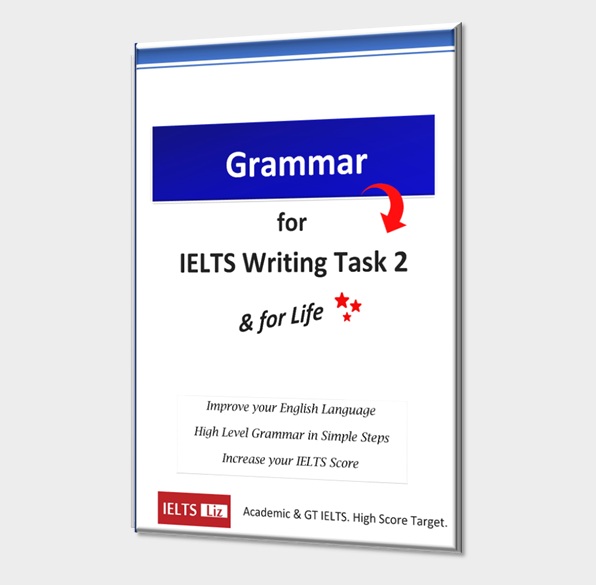
To learn more about grammar in Writing Task 2 and to avoid errors, consider my Grammar E-book whcih will help you boost your grammar score and improve your English. Click here to see a Preview of my Grammar E-book. My Grammar E-book is available in my online store: Liz’s Online Store

Step 10: Avoid errors in grammar: articles, pronouns, uncountable nouns, word order, tenses, complex sentences. The more errors you have, the lower your score. Knowing the strength of your grammar will help you avoid errors. Aim for accuracy – do not aim to impress. 

Step 11: Vocabulary only counts for 25% of your marks. Too many candidates focus too heavily on this area. Use vocabulary appropriate for the topic. Don’t over use idiomatic language. Idioms are mostly informal, not formal, so go with phrasal verbs instead which are also idiomatic. Don’t use less common vocabulary if you might use it incorrectly. Errors will lower your score. Aim for accuracy. Spelling counts. There are some useful vocabulary lists on this page: IELTS Vocabulary.

Step 12: Paraphrasing is a language skill that you need to demonstrate. This doesn’t mean changing all words all the time. It means being selective about which words you change and which words you will leave and repeat. It is fine to repeat some words. Over paraphrasing is one reason why many people get a low score in vocabulary.

Step 13: Don’t aim for a long essay or a short essay. If it is too short, it means you haven’t developed your main ideas enough. If it is too long, it gives you room for more errors which will lower your score. Aim for between 270-290 words on the whole. Click here for a video lesson about essay length.

Step 14: Edit your essay. Leave 2 mins to edit your essay. Pay attention to not repeating linking words, checking spelling and spotting vocabulary errors. You might have other areas specific to your language skills that you want to check. Know your weaknesses.

Step 15: Look at the clock. Timing is everything. You must be very strict with timing so that you have enough time to finish your essay. You can start with task 2 if you want, but if you do, make sure you leave 20 mins for task 1. Use no less than 5 mins preparing your essay. Use no less than 2 mins to check your essay at the end. This leaves around 33 mins for you to write your whole essay. Practise this at home under exam conditions until you are able to do this.

Step 16: If you find my free lessons are not enough for you or if you want more in-depth training for essay writing, please get my Advanced Writing Task 2 lessons which are available in my online store. Click here: Liz’s Online Store

Other Useful Links

Hope you find this page useful. From Liz 🙂 

……………………………………………………..

FREE SUBSCRIBE

Subscribe to get new lessons & tips by email.

Improving Sentences for IELTS Writing Task 2

Improve your Sentences for IELTS Writing Task 2 by creating more complex sentence structures and reducing your grammar errors. Below are some sentences written by a student. Your task is to spot the mistakes and also to improve the sentences so that they are a higher band score.

Creating Higher Band Score Sentences for IELTS Writing

There are many ways to improve sentences in your IELTS writing. Some people think the only way is to create long sentences – this is not true. To improve sentences you can:

  1. use clauses
  2. using linking words to connect ideas
  3. give more precise information that improves the quality of the sentence 
  4. reduce errors

See the sentences below and the ways I use to improve the sentences to make them higher band score.

Improving Sentences Example 1

Below are three short sentences. You can increase your IELTS writing band score by connecting them and also adding more precise details

Many children are obese. They eat too much junk food. They should do exercises.

Option 1: Connect the sentences:

  • Many children are obese because they eat too much junk food and one way to tackle this is to encourage them to do more exercises.

Option 2: Add more valuable information:

  • An increasing number of children are struggling with obesity which can have a serious impact on their health. This is mainly because they are eating foods which are high in unhealthy fats and sugars as well as having a sedentary lifestyle lacking in sufficient exercise. To tackle this, children must be given a balanced, controlled diet and encouraged to get exercise every day to burn the calories they consume as well as reduce blood sugar levels.

Improving Sentences Example 2

Facebook is a good way to connect to friends. People can keep up to date with friends. Personal information is not always secure.

Option 1: Connect the Sentences

  • Although Facebook allows people to connect to each other and keep up to date with their news, their personal information might be at risk.

Option 2: Add more valuable information

  • Admittedly, Facebook provides a fun, interactive way for people to stay connected and remain in each other’s lives no matter the distance. However, by sharing so much personal information on a public, insecure platform, people are opening themselves up to online security problems such as identify theft, fraud and even cyber stalking.

Reduce Sentence Errors to Increase your IELTS Score

The more errors your sentences contain, the lower your score will be. It is better to write two sentences which are controlled in length and with no errors than one long sentence with errors. A long complex sentence with errors will not help your score.

The most common errors are in:

  • articles  a/the
  • plural nouns and countable nouns
  • prepositions
  • linking words
  • clauses
  • gerunds (verb+ing = noun)

Spot the errors in the sentences below:

  1. In my opinion, study history is extremely important in term of learning about culture, and science, medicine development.
  2. On the one hand, history is a subject that is rarely used in people’s lives. Thus it would be better to focus on science and technology, which is more relevant to the future.
  3. In other word, they should use the school time effectively, because students are loosing the motivation to study subjects like history that has no importance role in day to day life.
  4. For instance, most people memorising dates, names and facts when they studying history. This information is not useful for future.
  5. Furthermore, Valuable information can often be found in history, how science and technology had developed over the years.
  6. Although history has many information that is not useful in today’s world, studying history can help people learn about their background.

ANSWERS

Click below to see the mistakes and how to improve the sentences:

ANSWERS
  1. In my opinion, study history is extremely important in term of learning about culture, and science, medicine development.
    • Answer: In my opinion, studying history is extremely important in terms of learning about culture, the development of science and medicine.
      • studying = you need a gerund (a verb that has been converted to a noun using +ing).
      • in terms of = this is a linking word that you should learn by heart. It is quite common to use in writing task 1 and writing task 1. See this page for LINKING WORDS LIST
      • and = you must have the word and before the last item in a list.
      • Improvement = In my opinion, studying history is important because it can help people gain a deeper insight into certain aspects of everyday life such as the evolution of culture, science and even medicine.
  2. On the one hand, history is subject that is rarely used in people’s lives. Thus it would be better to focus on science and technology, which is more relevant to the future.
    • Answer: On the one hand, as history is a subject that is rarely used in people’s lives. Thus, it would be better to focus on science and technology, which are more relevant to the future.
      • “subject” is a countable noun and requires an article = a
      • Thus, = sure you use a comma after a linking word at the start of a sentence.
      • science and technology are two separate subjects so the verb should be plural =  are
      • Improvement = On the one hand, as history is a subject that is rarely of use in people’s everyday lives, it would be better to focus on subjects that are more relevant in today’s modern world and to our future, such as science and technology.
  3. In other word, they should use the school time effectively, because students are loosing the motivation to study subjects like history that has no importance role in day to day life.
    • Answer: In other words, school time should be used effectively because students are losing the motivation to study subjects, such as history, that play no important role in day to day life.
    • In other words = another example of a mistake with linking words. Linking words are easy to learn and make a huge difference to your final band score for writing task 2. You shouldn’t make any mistakes with this language.
    • “the school time” does not require an article (no “the” needed).
    • losing = the spelling loosing is a spelling mistake
    • such as = you cannot use like as a linking device in writing task 2 because it is too informal. Also, don’t forget the commas
    • has no importance role = play no important role
    • Improvement = In other words, the time spent in schools should be used more effectively by focusing on subjects that are more relevant in today’s world rather than subjects such as history, which has little meaning for most young people, so that students do not lose motivation to learn.
  4. For instance, most people memorising dates, names and facts when they studying history. This information is not useful for future.
    • Answer: For instance, most people memorise dates, names and facts when they study history which is not considered useful information for their future. (Combine the sentences.)
    • most people memorising = most people memorise
    • when they studying = when they study
    • the future = their future
    • Combining the two sentences into one complex sentence is better and it is quite easy to do.
    • Improvement = For instance, most people are forced to memorise long lists of dates, names and facts for events that happened centuries ago when studying history, which is not particularly useful information for their future.
      • Note: I’ve changed when they study to when studying (using a gerund is better for your band score).
  5. Furthermore, Valuable information can often be found in history, how science and technology had developed over the years.
    • Answer: Furthermore, valuable information can often be found in history relating to how science and technology have developed over the years.
    • valuable should not have a capital letter in this sentence
    • the two clauses in the sentence should be connected using relating to
    • had = have (plural)
    • Improvement = Furthermore, there is a lot to gain from the study of history namely valuable information relating to how science and technology have developed over the decades, which can help people spot trends of how they are likely to continue developing in the future.
  6. Although history has many information that is not useful in today’s world, studying history can help people learn about their background.
    1. Answer: Although history has a lot of information that is not useful in today’s world, studying it can help people learn about their background.
    2. many information = a lot of information (information is an uncountable noun)
    3. studying history – studying it (don’t repeat words)
    4. Improvement = Although the study of history requires people to learn a lot of information that does not seem to directly relate to their life today, it can help people gain a sense of their own cultural identity, which can bring understanding, tolerance and even unite a country.

I hope you found this lesson useful. If you did, let me know and I’ll post more like this for you. All the best, Liz

.

RECOMMENDED FOR YOU:

Linking Words List for IELTS Essays

100 IELTS Essay Questions

ALL MODEL ESSAYS & TIPS FOR IELTS WRITING TASK 2

FREE SUBSCRIBE

Subscribe to get new lessons & tips by email.

.

IELTS Essays: Five Types of IELTS Essays

There are 5 types of IELTS essays which can appear in IELTS writing task 2. These types of essays are for both GT and Academic writing task 2. Below you will find sample essay questions for each type of essay and links to model answers. 

Please note that IELTS teachers sometimes divide essays into different categories based on how they teach. This means IELTS and teachers give essays different names and categorise them differently.

1) IELTS Opinion Essay

This type of essay is where you are presented with someone else’s opinion and you are asked if you agree or disagree with it. The opinion is often flawed or extreme in its views. Some teachers call this the Argumentative Essay. The instructions can be written in a number of ways. Below are a few examples:

  • Do you agree or disagree?
  • Do you agree?
  • What do you think?
  • To what extent do you agree?
  • To what extent do you agree or disagree?
  • What is your opinion?

No matter how the instructions are written, you can take any position you want: agree, disagree or partial agreement (balanced view). Below is an example essay question:

Some people think that only electric cars should be allowed on the road by 2040. Do you agree?

Note:

  • IELTS will not tell you which type of essay you are given. You must identify the essay type yourself by looking at the instructions and the task given.
  • The biggest mistake for an opinion essay is not giving a clear opinion. Writing “this essay will show that…” does not express your own opinion. Your opinion must be clear and remain the same opinion throughout the entire essay.
  • Another problem is when people sit on the fence without any clear opinion. A balanced view does not mean you agree with both sides fully. You can’t turn an opinion essay into a discussion essay.

2) IELTS Discussion Essay

This type of essay presents you with a statement and you must present the two sides. This might be two sides of the same issue:

Some people think there should be free health care for all people, but others disagree. Discuss both sides.

Or it might be two separate issues which you need to discuss:

Some people think that urban spaces should be used for parks rather than for housing. Discuss both sides and give your opinion.

3) IELTS Advantage Disadvantage Essays

There are two types of questions in this category.

i) Advantage and Disadvantage Essay

This is similar to a discussion essay where you are given a statement must present the positive and negative side of the issue:

Some people think it is good for students to take a gap year before going to university. What are the advantages and disadvantages of doing so?

ii) Outweigh Essay

This is by far the most difficult of the two essay types in this category. It requires you to present an opinion and explain your opinion.

Some people think the world will eventually have only one language. Do you think the advantages of having one global language outweigh the disadvantages?

4) IELTS Solution Essays

There are a number of types of possible questions in this category:

i) Solution Only Essay

Some children have serious weight problems. What are the possible solutions?

ii) Cause Solution Essay

Children in rural areas are being left behind in their academic development. Why is this is the case? What solutions can you suggest?

iii) Problem Solution Essay

More and more people are moving to cities to look for work. What problems does this cause? What are the possible solutions?

iv) Cause Effect Essay

More and more people are moving from the countryside to cities. Why is this? What problems does it cause?

5) Direct Questions Essays

Some teachers call these the Double Question Essays or Two Question Essays. However, these types of essay questions might contain one, two or three questions for you to answer. Below are some examples.

Pollution around the world is becoming a serious problem. Do you think this is a problem that should be solved internationally or on a local level?

In the question above, you are asked one specific question. Your whole essay must tackle this question only.

More and more people are choosing to work from home. Is this a positive or negative development?

This essay question has just one issue and one question. You must explain what type of development you think working from home is.

Some people spend a lot of money on weddings. Why do they do this? Do you think it is good to spend a lot of money on weddings?

Above, you will see you have been presented with two questions to answer: reasons and opinion (evaluating if it is good or not.) 

News editors decide what to print in newspapers and what to broadcast on TV. What factors do you think influence these decisions? Do we become used to bad news? Would it be better if more news was reported?

It is not common to be given three questions. However, it has appeared in the test before so I’ve included it in this list.

******************

Model Essays & Tips

You can find model essays for each type of IELTS writing task 2 on this page: IELTS Writing Task 2 Model Essays & Tips. You’ll also find tips for essay structure, paragraphing, linking words etc. Everything on this website is free for you to use.

Practice Essay Questions for IELTS

You can find over 100 essay questions to practice on this page: 100 IELTS Essay Questions. The questions are divided first into topics and then into essay types. This way you can get lots of practice before your actual test day.

.

FREE SUBSCRIBE

Subscribe to get new lessons & tips by email.

**********

IELTS LIZ STORE

Advanced Lessons & E-books for IELTS Writing Task 2.

.

Listening Practice for IELTS: Plastic Straws

This listening practice is about the current world issue of plastic straws and how they affect the environment. This is the type of listening you are likely to hear in section 4 of the listening test.  Furthermore, the ideas are useful to learn for your writing and speaking test. It is also something I feel very strongly about. We all know about the problems of plastic straws, but how many of us are choosing not to use them? Hopefully this listening practice will remind us all about the importance of not using such pollutants. 

In the IELTS listening test, you can listen only once. For this lesson, read the questions and make a note of keywords before you listen to the audio. You will always have time to do this in the real test.

Listening Practice Lesson for IELTS

Listening Questions 1- 6

Complete the sentences with words from the recording. Use no more than two words and/or a number.

  1. Plastic straws have a limited ……………… owing to their predominantly single usage.
  2. These straws do not …………….. and can pollute the environment for hundreds of years.
  3. ……………….. straws are thought to be used annually in the UK.
  4. Kasey Turner found ………… straws during her 20-minute ………………
  5. One plastic straw was even found in the airway of a …………………
  6. Understanding the relationship between what we do and the negative ……………. can be a motivation for ………..

Recording

Don’t forget that in the test, you can listen only once and you won’t be able to pause the recording.

Source: This article was adapted from 1millionwomen.com.au and also bbc.co.uk/news

ANSWERS & TRANSCRIPT

Please note, the transcript is something I usually offer with all listening lessons as a way to check your answers and improve your pronunciation by listening and repeating on your own. Transcripts are not given with questions and you won’t be given them in your test. 

Click to open:

ANSWERS

  1. LIFESPAN
    1. Plastic straws have a limited LIFESPAN owing to their predominantly single usage.
  2. BIODEGRADE / BREAK DOWN
    1. These straws do not BIODEGRADE and can pollute the environment for hundreds of years.
    2. Both options are correct. However, you must choose one only as
    3. You cannot have the answer “break down”. Biodegrade and break down are the same.
  3. 8.5 BILLION
    1. 8.5 BILLION straws are thought to be used annually in the UK.
  4. 319 SNORKEL
    1. Kasey Turner found 319 straws during her 20-minute SNORKEL.
    2. It is not necessary to use punctuation to separate the number and word. However, if you do use punctuation, your answer would still be marked correct.
    3. If you wrote “319 and SNORKEL”, it would be wrong because the word “and” is an extra word that is not given for the answer.
  5. SEA TURTLE
    1. One plastic straw was even found in the airway of a SEA TURTLE.
    2. If you wrote only “turtle”, the answer would be wrong.
  6. OUTCOMES CHANGE
  7. Understanding the relationship between what we do and the negative OUTCOMES can be a motivation for CHANGE.

 TRANSCRIPT

Use this to review the answers and improve your pronunciation.

TRANSCRIPT: Single use plastic is a particularly nasty form of plastic. These items have a shockingly short lifespan, normally used once and then discarded to landfill. Like other plastics they never biodegrade and take hundreds of years to break down. Plastic straws are one such single use item and are ending up in our oceans by the thousands. The Marine Conservation Society estimated that the UK uses 8.5 billion straws every year.

Avid scuba diver Kasey Turner was snorkelling after work recently at a popular dive site in Manly Australia. In the area, she found 319 straws on a single 20 minute snorkel. It can be hard to see how using one measly plastic straw is going to cause huge amounts of damage to the environment but let me put it into context for you. Recently a team of scientists in Costa Rica came across an endangered species of sea turtle with what they thought was a parasitic worm blocking its airway. They realised it was actually a plastic straw. Most people just do not realise that the majority of plastic straws are not recycled.

The simplest way you can eradicate straws from your life is to just stop using them at home. It’s as easy as that. Making a connection between our actions and the often devastating outcomes they can have on the environment acts as a catalyst for change.

.

Raising Awareness of Plastic Straws

If you would like to learn about about the effects of plastic straws, watch the video footage of the endangered sea turtle mentioned above. Click here: Effect of Straws on a Sea Turtle. Warning: The video is distressing to watch – be warned!!

RECOMMENDED FOR YOU

FREE SUBSCRIBE

Subscribe to get new lessons & tips by email.

Can you Tell Lies in IELTS Speaking? Advice & Tips

Is it ok to lie in IELTS speaking? Is it ok to make up a story and tell the examiner? 

Many students ask me if they can tell lies in their IELTS test and if they will get a lower band score if they are found lying in their IELTS speaking test.

Is it possible to lie in IELTS Speaking?

Yes, you can lie. It won’t affect your score. But it isn’t necessary. It’s better to tell the truth.

Telling the truth has advantages.

Why lying isn’t necessary in IELTS Speaking

  1. There is no reason to lie. Lying will not increase your score.
  2. If you don’t have a clear answer – just say so. You are marked on your ability to communicate in English, not on your knowledge or ideas for IELTS speaking. Below are some examples:
    • Q) What is your favourite museum?  
    • A) I don’t have one. I don’t have much interest in history or culture and I think the last time I went to one is when I was a child.
      • Comments: The above answer is excellent. It answers directly and explains more. I also uses both present simple and past simple grammar tenses.
    • Q) Do you like cooking?
    • A) No, actually I don’t. My mother has always cooked for me. To be honest, I find it incredibly tedious and a waste of my time, and anyway I’d rather use my time more productively.
      • Comments: This is a full answer which offers different grammar tenses and a range of language features.
  3. Lying requires imagination – it is better just to focus on your language rather than trying to be creative at the same time.
  4. When you say the truth, you usually have better intonation which will help your pronunciation score. Matching your meaning with your tone of voice is very important for your pronunciation score.
  5. It’s hard to add extra details when you lie. It requires too much effort to add all the extra details to a lie.
  6. Under exam pressure, it is hard to lie and create an answer at the same time. Sticking with the truth is easier. 

Adapting the Truth

Adapting the truth is easier than a huge creative lie.

If you are asked to talk about a book you recently read, instead you can talk about a book you read one year ago but say it was recent. It is a “white lie” but all details you will give will be truthful – this will make it easier for you to talk about. However, even in this situation, you can still tell the truth – see below:

  • I’d like to talk about a novel I read about a year ago. To be honest, I’ve been so busy during this last year with work that I haven’t had time to read any books. So, I’m going to tell you about one I remember very well from about one year ago. …..
    • Comments: This is a great start to your talk. There are quite a few different grammar tenses used already at the start of the talk. The answer also show that you can communicate clearly and easily in English by giving precise meaning to what you want to say. As long as you stick to the main topic “A book”, you can adapt it as you like. By explaining your choices for the topic, the examiner will be satisfied. It doesn’t affect your score to do this.

ID Check & Facts: Don’t Lie!

Before the recording device is switched on, the examiner will ask you four questions to check your ID. Do NOT lie at this point. The information you provide must match the information given on your ID card.

RECOMMENDED FOR YOU

Click below to open:

FREE SUBSCRIBE

Subscribe to get new lessons & tips by email.

.

IELTS Reading – Matching Paragraph Information Questions

IELTS reading matching paragraph information questions are quite common in IELTS reading. They can appear in both GT and Academic reading tests. They are not the same as matching headings questions.

  • Matching headings = match the title to the aim of the paragraph – requires deeper understanding
  • Matching paragraph information = locate the information in the paragraph – requires only to find information

The passage below is Academic level which means it is harder that GT reading passages. However, GT candidates can still benefit from the practice as the techniques for these questions are the same for both tests. This topic of carnivorous plants and their trapping mechanisms did appear in the IELTS reading test.

This type of question is really testing your ability to scan. Scanning means to move your eyes over the passage to locate specific information. Always remember that the information you are looking for might be paraphrased. So, always prepare the possible paraphrases before you start scanning for the answer. The lesson below is not an IELTS test. It is just a free practice lesson to help you develop skills and awareness.

  1. skim read the passage for gist
  2. read & analyse the questions
  3. tackle the questions in any order
  4. prepare paraphrases for the statement questions
  5. scan the passage to locate the information
  6. write a letter as your answer

Passage: Carnivorous Plants

A) Sarracenia, or the North American Pitcher plant, is a Genus of carnivorous plants indigenous to the eastern seaboard, Texas, the great lakes and south eastern Canada, with most species being found only in the southeast states. It is a plant with a pitfall trap. The plant’s leaves have evolved into a funnel, with a hood like structure growing over the opening to prevent rain water from diluting the digestive juices. Insects are attracted by colour, smell and a nectar-like secretion on the lip of the pitcher. Slippery footings, aided in at least one species, by a narcotic drug lacing the nectar, causes insects to fall inside where they die and are digested.

B) Nepenthes, tropical pitcher plants or monkey cups, are another genus of carnivorous plants with pitfall traps. There are about 130 species that are wide spread, and can be found in China, Malaysia, Indonesia, Philippines, Madagascar, Seychelles, Australia, India, Borneo and Sumatra. The nickname “monkey cups” comes from the fact that monkeys have often been observed drinking rain water from them. The trap contains fluid, produced by the plant, which is used to drown and digest the insects. Most of these plants are small and tend to trap only insects, but some larger species, such as Nepenthes Rafflesiana and Nepenthes Rajah, have been documented to catch small mammals like rats.

C) Dionaea Muscipula, more commonly known as a Venus flytrap, is probably the most well-known carnivorous plant and it feeds mainly on insects and arachnids. The Venus flytrap is a small plant that has 4-7 leaves that grow from a short subterranean stem. The plant is so advanced that it can tell the difference between live stimulus and non-living stimulus. The lobes snap shut in about 0.1 seconds. They are fringed by stiff thorn-like protrusions or cilia, which mesh together and prevent large prey from escaping. Once prey is unable to escape and the inner surfaces of the lobes are continuously being stimulated, the edges of the lobes grow or fuse together, sealing the trap and creating an enclosed “stomach” in which digestion and absorption can take place.

D) Aldrovanda vesiculosa, also known as the waterwheel plant, is a fascinating rootless, carnivorous, aquatic plant. It generally feeds on small aquatic vertebrates, using a trap mechanism called a snap trap. This is a very fast growing plant and can reach 4-9mm per day, in some instances even producing a new whorl every day. The traps basically consists of two lobes which fold together to make the snap traps. The openings of the trap point outwards, and are covered in a fine coating of trigger hairs, which will cause the trap to snap shut around any prey that comes too close. The trap closes in only 10 milliseconds, making it one of the fastest examples of plant movement in the animal kingdom.

Source: this passage was sourced online. I can’t find the original source but if anyone knows please let me know so I can put a link to it.

Questions 1-7

Which paragraph contains the following information? Write the correct letter, A-D, as answers. Note, you may use any letter more than once.

  1. The plant preys on animals that live in water.
  2. The plant is able to tell the difference between prey and inedible items.
  3. Prey is known to die through submersion in liquid.
  4. Prey is drawn to the plant by its appearance.
  5. The plant is known for its speed in trapping prey.
  6. The soporific effect of the nectar can cause prey to tumble into the plant’s trap.
  7. The plant is capable of trapping creatures large than an average insect.

Answers for Reading Passage

You can find the answers by clicking below:

Click here: Answers to this Lesson

All the best

Liz

More IELTS Reading Lessons & Tips

For more free reading lessons and tips, please click here: IELTS Reading

If you want free lessons for the other sections of the test, please go to the HOME page or use the RED MENU BAR to access those sections.

………………………

Free Subscribe to get New Lessons by Email

Predicted IELTS Speaking Topics May-Aug 2020

Below are predicted IELTS Speaking Topics for May, June, July & August 2020. Please read all this page carefully so that you prepare properly for your IELTS Speaking Test.

Note:

  • Below are predicted topics for part 1 and part 2 speaking
  • Part 3 questions are based on your part 2 topic
    • Example:
    • Part 2: A skill
    • Part 3: learning, practical skills, technology, skills for business & work, children learning skills etc
  • Do you want topics for IELTS Writing Task 2?

Preparing Speaking Topics

IELTS do not release their list of questions for IELTS Speaking. This is to ensure that you don’t memorise answers and the test fairly checks your natural level of English. But you can prepare predicted and common topics. By preparing as many topics as possible, you will hopefully be better prepared. The list below is predicted list of topics for this period that are due to be recycled. Also prepare other common topics, click here: Speaking Section.

Do not memorise whole answers. Prepare ideas and useful vocabulary that you can use naturally in your test. Remember to be natural and chatty – not rehearsed or repeating from memory.

IELTS Speaking Part 1 Topics May-Aug 2020

The list below shows topics that could appear in IELTS Speaking Part 1. This part lasts from 4-5 mins in length. Answer directly and then add one or two sentences more. Be prepared for the examiner to take the lead and interrupt your answers. Can you find more common topics here: Common Part 1 Topics which will likely appear in your test.

  1. Work/Study
  2. Your home or your house
  3. Where you come from originally
  4. Friends, friendship and socialising
  5. Family (people in your family and relationships)
  6. Diet – types of food, meals, places to eat
  7. Plants, flowers and places in nature (beauty spots)
  8. School, subjects, homework and teachers
    1. languages, history, geography (maps), cookery, art
    2. science, maths, technology, social sciences
    3. note: IELTS do not use political or religious topics.
  9. Holidays, places to stay, activities, journey
  10. Health and exercise (including gentle exercise)
  11. Leisure time
  12. Sport – types of sport
  13. Animals – types of animals, your experience of animals
  14. Visitors to your home
  15. Bags, Shoes and Accessories
  16. Shops & Purchases & Money
  17. Routine – your day and night routines – changing routines
  18. Gifts and special occasions
  19. Cars, buses, trains and planes
  20. Music, songs and singing
  21. Bread and rice: staple foods
  22. Films & TV
  23. Writing – letters, emails, messages
  24. Happiness, enjoyment and fun
  25. Museums and Galleries
  26. Weather

May-Aug IELTS Speaking Part 2 Predicted Topics

Use your 1 mins planning time to think about language as well as ideas that you want to use in your talk. Try to speak for 2 mins. I will add to this list as more topics are reported. Part 3 will last for between 4 and 5 mins. Part 3 is the discussion where the examiner might challenge your answers and push you for more detail – give as much as you can in your answers.

The examiner will have many topics to choose from in part 2. So, I’ve put some predicted topics and also common topics that are frequently used.

The bullet points below are the usual directions that part 3 can take. Part 3 is a discussion so be prepared for the examiner to interrupt and challenge you.

  1. An animal
    • Part 3 questions about:
    • Pets, Zoos, Vegetarianism
  2. A healthy activity
    1. keeping healthy, types of exercise and sport
    2. dangerous sports, bad lifestyles, hobbies
  3. A family member
    1. spending time with family, older generations, family roles
  4. A successful business
    1. local products, success in business, skills for success, family run business, international/local business, business in your area (shops), famous brands
  5. A quiet or crowded place
    1. places to relax, crowds, stress, health concerns around other people, mental health, balanced life style
  6. An old person you admire
    1. retirement, taking care of the elderly
  7. A charity
    1. volunteer work, helping people, types of problems in society
  8. A book
    1. types of books, books & real life stories, films, children stories, learning, e-books etc.
  9. A meal
    1. healthy eating, restaurants, home cooking, food allergies, the food industry
  10. A famous Person
    1. TV or music stars, role models, how media influences people

Usual Types of Part 2 Topics

The topics below are divided into common types. These are the usual types of topics you get in part 2 which are based on everyday life. Remember, IELTS Speaking Part 2 is not about knowledge, it is just a chance to speak at length on a topic that touches everyone’s life.

A person

  • old or young people
  • famous people or people you wish you could meet
  • professions and jobs in society and that help the environment
  • family, friends and strangers
  • children and teenagers

Place

  • to relax, to have fun, to learn, to meet people
  • quiet place, busy place, crowded place, interesting place, colourful place
  • in nature,
  • cities, towns, parks
  • hotels, restaurants, libraries, shops
  • a house, your neighbourhood, 
  • a foreign country and place you wish you could visit
  • a place from your childhood or a recent place you have visited

Objects

  • films, books, newspapers
  • clothes, furniture, recently bought items
  • gifts, art, a souvenir
  • a device, a toy, a game
  • animal, bird, plant, flower, garden park
  • a meal
  • a charity, a business, an organisation

Abstract objects

  • websites, skills (learned and innate), a language, useful advice, information
  • holidays, travel, journeys – recent or didn’t go as planned
  • future goals, dreams
  • routine, hobby, activity 
  • something that hindered you, something that helped you
  • weather, seasons, sky, stars, climates, environmental problem
  • professions and jobs 

A time when

  • you were happy, sad, bored, exited, worried, embarrassed, disappointed, confused
  • you helped someone, someone helped you, you got advice, you gave advice etc, you got news, you told someone good news
  • you got lost, you found something, you learned something, you achieved something, you forgot something, you remembered something important

……………………………………

Free Speaking Tips

For tips, free video lessons and model answer for speaking, go to the HOME page of this site and read how to access them.

…………………………….

E-BOOKS for Ideas & Grammar

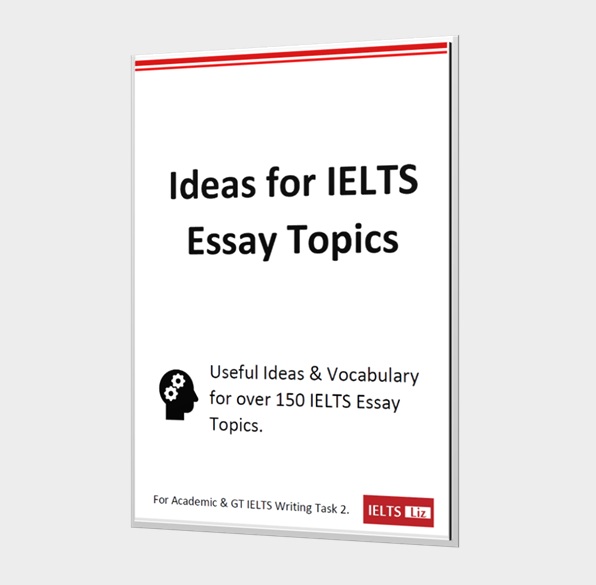
Just a reminder that my Ideas for Topics E-book and my Grammar E-book are available in my store. Both will help improve with your level of English. Click here: Visit Store

………………………………..

Free Subscribe to get New Posts by Email

error: Content is protected !!