IELTS Reading Sentence Completion: Life on Earth

This is a short reading passage to practice sentence completion questions for IELTS preparation . It’s quite an easy passage to give you all a chance to practice.

Life on Earth

Life on Earth started around 3.8 billion years ago and has since evolved and diversified through the process of natural selection to be adapted to almost every environment possible. There are currently an estimated 1.9 million animals, plants, and other forms of life on Earth.

Life can be found in every nook and cranny/niche of the globe, from the extreme environments of deep sea hydrothermal vents and the freezing conditions of the Polar Regions to the lush habitats found at the equator.

Looking back through time, by means of the fossil and phylogenetic record, we can see that the Earth has been home to many more species than are alive today. Taking a historical perspective shows that life is constantly evolving, with the success and dominance of different groups waxing and waning over time.

The diversity of life is truly amazing, but all living organisms do share certain similarities. All living organisms can replicate, and the replicator molecule is DNA. As well, all living organisms contain some means of converting the information stored in DNA into products used to build cellular machinery from fats, proteins, and carbohydrates. 

Questions 1-4

Complete the sentences. Choose no more than three words and / or a number from the passage for each answer.

  1. The world has been developed and changed by ……………………………… for over 3.8 billion years.
  2. The past history of the species that used to exist on earth can be found through the …………………………………………. record.
  3. The coming and going of specific groups and species can illustrate to us that life is forever ………………………………………. .
  4. Without ……………………, life forms would not be able to replicate.

ANSWERS

Click to get the answers: Answers

  1. natural selection
    1. developed and changed = evolved and diversified
    2. it is not possible to have “the natural selection”
    3. it is not possible to have “natural selection process”
  1. fossil and phylogenetic (spelling must be correct)
    1. past history = looking back through time
  1. evolving
    1. coming and going = waxing and waning
    2. forever = constantly
  1. DNA
    1. life forms = living organisms

All reading exercises on ieltsliz.com have been written by myself to help you develop skills for IELTS. These lessons are not practice tests, they are exercises for students.   

Liz

.

RECOMMENDED FOR YOU

FREE SUBSCRIBE

Subscribe to get new lessons & tips by email.

.

IELTS Writing Questions July 2016

Here are some IELTS writing task 1 and task 2 questions for July 2016. These questions and topics have been reported by students who have recently taken the IELTS test. You can follow Recent IELTS Exam Questions by clicking on the link.

Writing task 2 Questions July 2016

1. Many people regard films as a less important form of art than literature and painting. To what extent do you agree or disagree?

2. Studies have shown that children are spending more time watching television and less time doing active or creative activities. Explain why this is the case. Suggest possible measures that can encourage children to participate in active or creative activities.

3. The responsibility to prevent and reduce global environmental damage is for politicians rather than individuals. How far do you agree or disagree?

4. Some believe children should have activities organised for them during their free time, whereas others think children ought to plan their own free time. Discuss both sides and give your opinion.

Writing Task 1 Question July 2016

1. A table giving information about the number of students in 6 departments (Maths, English History, Modern Languages, Chemistry and Physics) in an Australian University in 2009.

2. A line graph showing the difference in incomes between men and women from 1978 to 2008.

3. A table giving information about the weekly expenses of retired single people and couples in terms of housing transportation, clothing, food etc.

4. A line graph and table: a line graph about the min and max temperature over a year, and a table about the amount of rainfall (cm) and sunshine (h/day) in every month. Both relate to Glasgow.

Writing task 2 questions cane be both academic & GT. But the writing task 1 GT is not the same. GT candidates get a letter only for task 1.

Get my free lessons by email

Subscribe for free to get my new IELTS lessons sent to your email inbox.

Relocating businesses outside cities: Essay Ideas

Here are some ideas for questions and essays about relocating businesses outside city centers to regional areas. This is a common IELTS topic in writing task 2 and also speaking part 3.

In some countries, the government is encouraging businesses and industries to move outside city centers and relocate to regional areas.

What are the advantages and disadvantages of this trend?

Advantages of businesses being outside urban areas

  • Land prices are cheaper and more available in rural areas which is beneficial to businesses. Many overheads will be cheaper.
  • Workers in regional areas can be hired for a lower salary.
  • Industry and business can often produce pollution so locating them away from residential areas is sensible.
  • Raw materials are located in rural areas so it makes sense for many businesses to be situated nearer their required resources.
  • Local communities usually support the arrival of new businesses as they bring jobs. This local support can be beneficial for businesses.

Disadvantages of relocating businesses

  • The infrastructure is sometimes less developed in rural areas which can be a problem for businesses.
  • Internet connection may not be reliable and this can adversely affect companies.
  • Workers in rural areas may be plentiful but they might not be as skilled as those in urban centers. A lack of skilled, experienced workers can be a problem for some companies.
  • For many companies, their customers are in city centers so moving away from their customer base is not beneficial.

Recommended

Main IELTS Pages

Develop your IELTS skills with tips, model answers, lessons, free videos and more.

Get my free lessons by email

Subscribe for free to get my new IELTS lessons sent to your email inbox.

IELTS Speaking Using Contractions: wanna, gonna

Should you use contractions in your IELTS speaking test? Will you get a lower mark if you use contractions like “gonna”?

What are contractions?

A contraction is when you combine two (or more) words to make them shorter and make them flow together when speaking. “It is” = “it’s” or “want to” = “wanna”. Most contractions are used in informal speaking. Is the IELTS speaking test formal or informal? The IELTS speaking is 100% informal.

  • Part 1 is informal short answer questions
  • Part 2 is an informal talk
  • Part 3 is an informal discussion on broader current issues
    • This means informal language is fine to use in all parts of the test.

They are an accepted part of SPOKEN English. One student pointed out that they even heard contractions used by the BBC and the British Royal Family – this is true.

Using Wanna / Gonna

Yes, it’s fine to use contractions (words joined in pronunciation) in the IELTS speaking test. In fact, it will boost your score for pronunciation.

  • want to = wanna
    • I really wanna go to the cinema tonight.
    • The majority of students wanna travel before starting university.
  • going to = gonna
    • He’s gonna visit his grandmother this evening.
    • The local council are gonna improve the roads in this area.

Wanna and gonna are only used in spoken English and NOT in formal writing. The reason is that “wanna” and “gonna” are pronunciation features – it is how we pronounce “want to” but it is not how we write it in formal written English. It is fine to use these words in your IELTS speaking test and in fact will help with your pronunciation band score. Are these contractions in the Cambridge dictionary? Yes, they are. Follow the links: wanna and gonna.

IELTS Speaking Pronunciation

Pronunciation is 25% of your marks for IELTS speaking. This means the way you pronounce sounds, words and sentences is marked in your speaking test. Part of that does include linking sounds and linking words, such as gonna, wanna, it’s and doesn’t. So, try to learn these contractions and use them naturally in your test.

Common  List of Contractions

To Be

  • I am = I’m
  • you are = you’re
  • he is = he’s
  • she is = she’s
  • it is = it’s
  • we are = we’re
  • they are = they’re

To Have

  • I have = I’ve
  • you have = you’ve
  • he has = he’s
  • etc

Will

  • I will = I’ll
  • you will = you’ll
  • he will = he’ll
  • etc

Negatives

  • is not = isn’t
  • are not = aren’t
  • does not = doesn’t
  • did not = didn’t
  • has not = hasn’t
  • have not = haven’t
  • should not = shouldn’t
  • would not = wouldn’t
  • could not = couldn’t
  • don’t know = dunno

Remember, these contractions are NOT used:

  1. in formal writing, such as in IELTS writing task 2
  2. report writing, such as writing task 1 (academic test)
  3. formal letters or business letters

But contractions are good to use in the IELTS Speaking Test.

Advanced Contractions

The contractions below are only used in speaking and NOT in writing. It is good to use these types of contractions in IELTS speaking.

  • I should have = I should’ve
  • should not have = shouldn’t’ve
  • I could have = I could’ve
  • I could not have = I couldn’t’ve
  • I would have = I would’ve
  • I would not have = I wouldn’t’ve

Contractions: Listen, Pause and Repeat Practice

Listen to the recording and read the sentences below. Pay attention to the contractions. Listen again and repeat aloud.

  1. If I’d know it was going to be expensive, I would have saved up more money.
    1. going to = gonna  /  I would have = I’d’ve
  2. He would not have gone by bus if he would have known how bad the journey was going to be.
    1. he would not have = he wouldn’t’ve / he would have = he would’ve / going to = gonna
  3. The government should have developed better public transportation a long time ago. If they want to limit global warming, they have got to limit the use of cars.
    1. should have = should’ve  / want to = wanna    /   got to = gotta
  4. If you’re going to learn a language, then you have really got to focus on your pronunciation.
    1. going to = gonna    / you have = you’ve  /   got to = gotta
  5. I don’t know what my favourite time of day is. I suppose it’s the evening because then I can really chill out.
    1. don’t know  = dunno    /   because = coz

RECOMMENDED FOR YOU

FREE SUBSCRIBE

Subscribe to get new lessons & tips by email.

.

IELTS Writing Task 1 Future Prediction Model Answer

Below is an IELTS table with dates in the future and past for writing task 1. This means you will need to use a combination of tenses to write this table task. IELTS Tables in writing task 1 can be complicated because of of all the data given to you. The model answer below shows you how to organise information and write an answer with different grammar tenses.

IELTS Table: Past & Future  Dates

IELTS Table Model Answer

Note: I’ve highlighted examples of future forms to show the options you have for presenting future predictions.

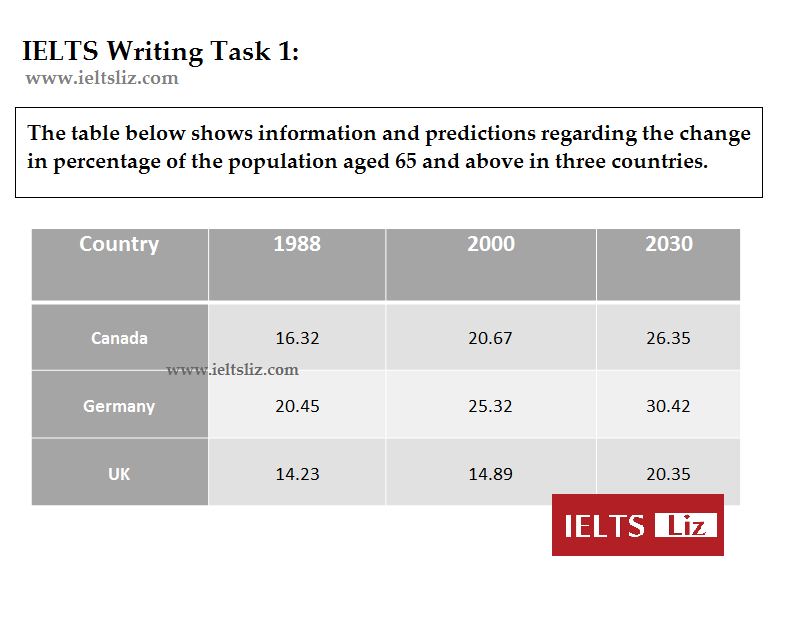
The table gives information about the proportion of the population aged 65 years and over in 3 countries (Canada, Germany and the UK) in 1988, 2000 and an estimated percentage for 2030.

Overall, the population of elderly people is predicted to rise in all three countries over the period given. The highest percentage of older people was in Germany, which is forecast to continue to remain the highest for the entire period, while the lowest proportion can be seen in the UK.

Between 1988 and 2000, the aging population of Canada and Germany went up by around 5% to 20.67% and 25.32% respectively. The UK, on the other hand, showed relatively little change in the proportion of its population who were 65 years old and above remaining at just under 15% in both years.

By 2030, it is expected that the population of people aged 65 and above will increase by approximately 5.5% in all three countries. The percentage is predicted to reach 30.42% in Germany, 26.35% in Canada and 20.35% in the UK.

(176 words)

Recommended FOR YOU:

FREE SUBSCRIBE

Subscribe to get new lessons & tips by email.

.

IELTS Writing Task 1 Table with Future Predictions

The IELTS table below shows information with both past and future predictions. This IELTS writing task 1 table appeared in the exam recently and has been reproduced as accurately as possible with data provided by a student called Oyon (April 16th). This table is the IELTS academic writing test.

I will post a model answer for the table below next week.

If you want to try this task 1 table with future predictions, please post your writing in the comments box below. However, I am not currently available to comment on your writing. This will solely be for the purpose of practice and to compare with my model when it is published.

IELTS Table with Future Predictions

ielts table future predictions

Useful Links for Writing Task 1

Main IELTS Pages

Develop your IELTS skills with tips, lessons, free videos and more.

Get my free lessons by email

Subscribe for free to get my new IELTS lessons sent to your email inbox.

IELTS Listening Practice: Selecting Names from a List

This IELTS listening practice is based on multiple choice when you must choose names from a list. Be prepared to hear many names – try to listen out for the names which answer the question.

Health Care Conference

Multiple Choice Questions 1-3

Who will be lecturing at the conference today?

Choose three letters, A-G.

  • A = Dr Christopher Lord
  • B = Dr David Bishop
  • C = Dr George Ripley
  • D = Dr William Benson
  • E = Dr Roger Dean
  • F = Dr Daisy Mandalay
  • G = Dr Ralph Morris


Answers

Answers

E  A  B (any order). This question counts for answers 1, 2 and 3. This means three points – one point for each correct answer.

  • E = ‘Dr Roger Dean who will be presenting his speech…’
  • A = ‘Dr Christopher Lord will address everyone…’
  • B = ‘Dr David Bishop, as I mentioned earlier, will take the floor to tell you about…’

Comments: The answer is not C (Dr George Ripley) because he is talking tomorrow not today. The answer is not D (Dr William Benson) because he is running a debate. He is not giving a lecture. The answer is not F (Dr Daisy Mandalay) because she is showing a video not talking. The answer is not G (Dr Ralph Morris) because he is collecting feedback and not speaking.

The key to success in this listening practice is to identify the word “lecture” as the key word in the question. Many names are mentioned but only three people are actually lecturing today.

Transcript

Transcript

Today’s topic under discussion is the health care system both past and present. We have a number of guests for today’s lectures, videos and debates, one of them the notable Dr David Bishop.

The morning will be kicked off by Dr Roger Dean who will be presenting his speech summarising the major changes and challenges of the health care system from the year 2000 to around 2012. Following him, will be Dr William Benson who will oversee the debate on today’s problems for hospitals. After lunch, Dr Daisy Mandalay will be showing a revealing video relating to the current trends in health problems faced by today’s society. Dr Christopher Lord will then address everyone on the problems faced by family doctors and the vital role they play in the health care system. Last, but not least, Dr David Bishop, as I mentioned earlier, will take the floor to tell you about his current research. Dr Ralph Morris will be responsible for collecting your feedback on the various parts of the conference at the end of the day. That will conclude our seminars for the day. Tomorrow’s conference details will be put up on the notice board later this afternoon but you will be all please to know that Dr George Ripley has agreed to lecture you all.

 Vocabulary

Vocabulary

give a lecture / to  lecture Synonyms:

  • give a talk about / on
  • to address people on
  • give a seminar on
  • hold a seminar on
  • to take the floor (to talk)
  • to instruct people on
  • to give a speech about / on
  • to present a speech / talk on about


Recommended for IELTS Listening:

Listening for Names Practice & Tips

List of Common English Names – Pronunciation

Multiple Choice Practice for Listening & Reading

All IELTS Listening Lessons, Tips & Free Videos

Main IELTS Pages

Develop your IELTS skills with tips, lessons, free videos and more.

Get my free lessons by email

Subscribe for free to get my new IELTS lessons sent to your email inbox.

IELTS Reading Practice: Marie Curie

IELTS reading practice for matching sentence endings questions. This topic is a biography of Marie Curie, a famous scientist. Skim read the passage before attempting the questions. Please note this is not a practice test but just IELTS reading practice to develop skills and understanding of this type of question.

Download the PDF file for the passage and questions: IELTS Reading Practice Marie Curie

Marie Curie

During the 19th century scientists knew little about what went on inside an atom. However, by the end of the century there were startling new ideas about the structure of the atom resulting from the discoveries of X-rays, radioactivity and the electron.

Marie Sklodowska was born in Warsaw in 1867. She was a brilliant student and dreamed of studying at the Sorbonne in Paris but it took eight years of scrimping and saving before she could afford to go. Despite very poor living conditions and a lack of French she graduated in physics in 1893 and mathematics in 1894.

While looking for a laboratory in Paris to continue with her experiments she was introduced to Pierre Curie, a highly regarded professor at the School of Physics. At 35 years old, Pierre was already an internationally recognised physicist. With his brother Paul-Jacques, he discovered piezo-electricity: the fact that crystals under pressure produce electric currents. He also studied crystal symmetries and the magnetic properties of bodies at different temperatures. His papers had been well received by distinguished colleagues but he was still an outsider in the French academic community. Like Marie he did not care for outward distinctions or a career. They married in July 1895.

During her studies Marie had heard about Henri Becquerel’s discovery of some sort of radiation emitting from uranium salts and decided to investigate these mysterious ‘uranium rays’ for her doctoral thesis. She soon discovered that the intensity of the rays was in direct proportion to the amount of uranium in her sample. Nothing she did to the uranium affected the rays. This, she said, ‘shows that radioactivity is an atomic property’. She also found that two minerals, pitchblende and chalcite, were much more radioactive than uranium itself, and realised that they must contain a new radioactive element.

After the exciting results of Marie’s early experiments, Pierre abandoned his study of crystals to join her in her search for new substances. The couple laboured over their work, Marie carrying out the chemical separations and Pierre taking the measurements. They continued with the painstaking refining and by December 1898 the couple announced the discovery of an even more radioactive substance in pitchblende which they called radium. This discovery had far-reaching effects; opening up the fields of radiotherapy and nuclear medicine.

Matching Sentence Endings

Complete the sentences by selecting the correct ending, A-L (not all letters will be used).

  1. In the early 20th century, scientists….
  2. It took Marie 8 years…
  3. Marie tolerated sub-standard accommodation but still…
  4. The research of Pierre Curie was received well …
  5. Both Marie and Pierre shared the same belief that…
  6. The research by Henri Becquerel …
  7. On discovering that there must be a hitherto unknown substance …
  8. The revelation of radium had a momentous  impact on …

Endings

  • A) by the college where he worked.
  • B) lacked French.
  • C) had already made novel discoveries about the atom.
  • D) by notable fellows in his field.
  • E) recognition or vocation was not the main goal.
  • F) graduated in two subjects.
  • G) had rediscovered the x-ray.
  • H) nuclear medicine and radiotherapy.
  • I) prompted her to investigate his discovery further.
  • J) pitchblende.
  • K) her husband relinquished his work for hers.
  • L) of economising prior to  realise her goal of studying in Paris.
Answers
  1. C
    • novel = new / by the end of the 19 century means that this was already happening at the start of the 20th century
  2. L
    • Second paragraph. economising = being careful with money and not overspending = saving
  3. F
    • The answer can be found here: “Despite very poor living conditions and a lack of French she graduated in physics in 1893 and mathematics in 1894.”
  4. D
    • notable = distinguished / colleagues = fellows in his field. Please note that colleague and college do not have the same meaning.
  5. E
    • The answer can be found at the end of the third paragraph: “Like Marie he did not care for outward distinctions or a career.” Please note that “he” refers to her husband, Pierre. outward distinctions = recognition / career = vocation
  6. I
    • The answer can be found in the fourth paragraph: “During her studies Marie had heard about Henri Becquerel’s discovery ………and decided to investigate these mysterious ‘uranium rays’ for her doctoral thesis.”. Prompted means that she was persuaded or it caused her to.
  7. K
    1. The answer can be found in the last paragraph: “Pierre abandoned his study of crystals to join her in her search for new substances.”.  “he reliquished his work” means that he abandoned (gave up) his work.
  8. H
    1. The answer is in the last sentence of the passage: “This discovery had far-reaching effects; opening up the fields of radiotherapy and nuclear medicine. “. The word far-reaching is paraphrased as momentous.

Article from sciencemuseum.org.uk

More Practice with Matching Sentence Endings:

IELTS Reading Passage: Crime & Punishment 

All IELTS Reading Practice & Tips

Main IELTS Pages

Develop your IELTS skills with tips, model answers, lessons, free videos and more.

Get my free lessons by email

Subscribe for free to get my new IELTS lessons sent to your email inbox.


error: Content is protected !!