How I got IELTS Band Score 9 Overall

Overall IELTS 9: A student’s Tips

Learn how Gokul, an IELTS student, got overall band score 9 in IELTS this year. He shares his useful tips and experience with you in order to help and inspire you to achieve your best in your IELTS test.

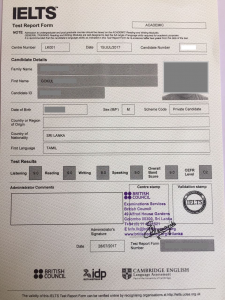
IELTS Test Results: Band 9

Location: Colombo, Sri Lanka.

  • Overall Band Score 9
  • Listening: 9
  • Reading: 9
  • Writing: 8
  • Speaking 9

Gokul’s Tips for IELTS Overall Band Score 9

This was my first ever IELTS attempt. I never thought that I’d be required specifically to do IELTS, since my studies have only ever been in English. Even the university that I’d applied for my Masters seemed happy enough to accept me without an IELTS requirement. However, I was told by my destination country’s embassy that they can only issue a visa given that I show an IELTS grade of 7 overall or above.

I had barely 10 days to prepare and do the test, since the results would take roughly 2 weeks to be released.

I’m listing some of the things that I followed, and I hope that you find it useful in your own preparation.

IELTS Listening Band Score 9 Tips

I’d say that the listening test is all about practice. I did about 8 practice tests, and as I was doing them I was able to see that I was getting better at picking up the points needed for the answer the more I practiced.

In my own test, I had a woman who spoke in a Scottish accent, and I’d say that this is one of the accents that people outside of the UK seldom come across. This is why it’s imperative that you try out some practice tests by yourselves. This would enable you to get used to the formats as well as the intonation and accents used by the people that you hear in the recording. Liz has a number of excellent practice less0ns on the blog at the IELTS Listening page.

You might sometimes find that you’ve missed the answer to a given question. If this happens – don’t worry! Panicking will only reduce your concentration and might cause you to lose more answers.

I also also recommend writing the answers in capital letters so that the examiner would find it easier to read what you’ve written.

Finally, make good use of the extra 10 minutes that you’re allowed at the end of the test (update – 10 mins for the paper based test only – the computer test has only 2 mins checking time). This can be used for filling out any answers that you may have missed.

IELTS Reading Band Score 9 Tips

I found the reading exam the easiest of the lot. You can read the passages at your own pace as opposed to following a pre-set sequence of events as in the listening test. I finished the test in about 40 minutes and had time to go through my answers again to check them for errors.

While there are some that say reading the entire passage is not worth it, I would still suggest that you at least skim the passages to get the gist of the content before you start. I recommend this in particular to people whose reading speed is high. This way, when you encounter a question, you’d have an inkling of where in the passage you saw the answer point.

Another point that I can’t stress enough is that you should never overthink the question. This was my biggest problem in the reading practice tests. Over-analysing the statement will often lead to incorrect answers. For YES/NO/NOT GIVEN type questions, if the passage explicitly agrees with the statement, say YES, and if it explicitly contradicts the statement, say NO. In all other cases, say NOT GIVEN.

Again, Liz has a set of excellent tips as well as practice questions in the IELTS Reading page.

IELTS Writing Band Score 8 Tips

My writing test for Task 1 involved a bar chart which compared bottled water vs. soda consumption in some western countries, while for task 2 I had the following:

Most countries want to improve the standard of living through economic development, however others think social values are lost as a result. Do you think the advantages of economic development outweigh the disadvantages?

I followed Liz’s tips on writing task 1writing task 2 to the letter and found that having a strategy helped me immensely. If you’re just starting out answering the tasks without a plan, it would likely end up costing you more time. As Liz rightly states, time management is vitally important in the writing test. I’d also recommend that you go through the answers you’ve written as well, which will help spot any errors that you may have made. A quick once-over may help you save points that you’d have lost if you’d misspelled any word.

IELTS Speaking Band Score 9 Tips

My speaking test went very well, and I almost felt as if I’d had a pleasant chat with the examiner as opposed to being graded.

My speaking part 1 was mostly about work/life balance (probably because I’d said that I was working full-time).

Then, for part 2, I was asked to speak about an important historical event and how it had helped shape the present. I picked the Assassination of Julius Caesar and it went without a hitch.

Part 3 then followed up on history and why it’s important to learn it.

For part 2, I made some short notes on the notepad given to me, which helped me marshal my thoughts before the talk itself. You can also structure your own flow which would enable you to showcase your language skills without being held up by lack of content. This is important because pauses due to language limitations will negatively impact your score.

It’s also worth noting that what’s being tested is your language level and not the content you’re presenting. Hence, if you don’t have an answer, you can say no and take it as an opportunity to display your proficiency. For instance, I was asked whether I had any pets, and I said something along the lines of “No, I’ve never really had the chance, but my neighbour has a beautiful Labrador that I enjoy playing with..” and so on.

Be clear and confident, and you’d do fine.

Closing thoughts from Gokul

Lastly, though you’re probably here to prepare for your exams, I’d urge you to develop an interest in the English Language in general. Not only would you find that it provides you with new opportunities, it would also help you enjoy some of the finest literature ever produced.

Liz – I can’t thank you enough for your collection of resources and materials for prospective test-takers. They were invaluable to me, and doubtless to countless others as well. Keep up the good work.

Message from Liz: Thanks for sharing your tips and your experience, Gokul. You’ve done amazingly well and clearly understand IELTS. I hope this will inspire students to learn more about their test before taking it. You’re tips are great for each part of the IELTS test and I highly recommend people to learn from what you’ve shared.

Get my free lessons by email

Subscribe for free to get my new IELTS lessons sent to your email inbox.

Is a Conclusion Important in IELTS Writing Task 2?

A conclusion is essential for IELTS writing task 2. It is more important than most people realise. You will be penalised for missing a conclusion in your IELTS essay.

Conclusions: What are they worth in IELTS Essays?

There are four marking criteria for writing task 2:

  • Task Response
  • Coherence & Cohesion
  • Grammar
  • Vocabulary

Your conclusion falls under the criterion of Task Response. You are given a band score for each criterion and then a total band score for writing task 2. If you fail to have a conclusion, you will get under band score 6 in Task Response, which is 25% of your marks.

Paragraphs in Writing Task 2

You must divide your essay into paragraphs. You can have four paragraphs or five paragraphs in total. You should not have three and you can’t have six. See below:

Option 1

  1. Introduction
  2. Body Paragraph 1
  3. Body Paragraph 2
  4. Conclusion

Option 2

  1. Introduction
  2. Body Paragraph 1
  3. Body Paragraph 2
  4. Body Paragraph 3
  5. Conclusion

Conclusion Length & Content

Your conclusion should be one or two sentences long. Not more. It is a waste of timing having a long conclusion and it won’t help your score.

Your conclusion should summarise the main points you provided in your essay.

Conclusion Linking Words

Use the right words to start your conclusion for IELTS writing task 2. This lesson is for IELTS essays in both GT and Academic writing. Using the wrong linking words will lower your score.

Get my free lessons by email

Subscribe for free to get my new IELTS lessons sent to your email inbox.

Question for you about conclusions in WT2

Conclusions for writing task 2

Some students have written in and told me that they didn’t write a conclusion for their essay. They wanted to know if it is a serious problem to run out of time and miss the conclusion. The questions below are for both GT and Academic students.

Questions for you:

  1. Do you think the conclusion is important in writing task 2?
  2. Do you think having no conclusion is a serious problem for your band score?

Answers

I have written a full page answer for these questions.

Click here: Is a Conclusion Important? Tips and Advice

IELTS Listening: Which answer is correct?

Hi guys,

I continue to have students who ask me how to write answer for their IELTS listening test. See the questions below and decide which of the answers is correct.

Recording:

Hi Mary, I guess you are not home so I’ll leave a message for you. You mentioned popping round for lunch tomorrow. I forget to tell you two things. The first one is to ask you to bring a cake. Make sure it’s free from milk or butter for John. You know he’s lactose intolerant. Also I forget to tell you that there’s a car park behind my house where you can park. But you’ll need to bring some small change because you have to purchase a ticket which will cost about 75p. Also I must warn you that the car park shuts at 9.30pm so make sure you get your car out before that. Well, that’s all. See you tomorrow.

Questions:

Answer using no more than three words and/or a number.

  1. John can’t have  ……………or …………….
  2. Mary will need  to buy …………… for the car park.
  3. The car park will close at ………………………

Answers:

Choose below which are the correct answers for these questions

**  You can choose more than one correct answer. In some cases, there might be two or three correct answers. **

Answer to Q1:   a) milk or butter         b) milk, butter           c) milk  / butter      d) milk  butter

Answer to Q2   a) ticket      b) a ticket     c) the ticket        d) car park ticket

Answer to Q3   a) at 9.30pm     b) at 9:30pm     c) 9.30pm     d)9:30pm

Answers to Above Options:

You can find the answers to this exercise on this link: Answers to Exercise Above


Get my free lessons by email

Subscribe for free to get my new IELTS lessons sent to your email inbox.


IELTS Cue Card: An Invention

Hi guys,

Yesterday, a student reported this IELTS cue card: Describe an Invention for speaking part 2. IELTS speaking topics can often be repeated so you should definitely prepare for this topic as well as other recent topics and common topics. I’ve provided links below.

An Invention: IELTS Cue Card 

Date: 26th July, 2017

Describe an invention that changed people’s lives.
You should say:
· What it is
· Who invent it
· When it was invented
And explain how it changed people’s life.

Ideas for An Invention Topic:

Tips: Don’t choose something impressive. The examiner will not give you a higher score because your ideas are impressive. Instead, choose something which is easy to talk about. Something which can have plenty of ideas for. If you don’t know who invented it or when – it doesn’t matter. It won’t affect your score at all.

  1. Smart Phones
    1. This is a great topic to choose because there are somany features of a mobile phone that you can talk forever about this. You can also talk about which features you use and why they are useful to you: camera, video, texting, calendar, weather, music player, GPS, web browser (shopping online, online banking etc)
    2. The cue card mentions who invented it – you don’t need to know this information. You can say “I do not know who invented it but some of the top selling brands are “Apple” etc. If you don’t know when it was invented, you can say “I’m not exactly sure when it was invented but most people have been using them for the last decade at least.”
  2. Internet
    1. Another great topic which allows you to take your talk in any direction you want: international business, social media (Facebook, Youtube, Twitter), globalisation, online education etc
  3. TV
    1. You can talk about: news, weather reports, films, soap operas, documentaries and education programs, escapism, relaxation, reality TV, chat shows etc
  4. Modern Transportation
    1. Cars, aeroplanes, trains. You can talk about each type as well as globalisation and tourism

Don’t forget that IELTS speaking part 2 is mostly about you, so add your own details. Tell a story about yourself or someone you know.

If you have any other ideas, please post them in the comments box below.

Useful Links

Click below to open links:

Recently Posted IELTS Speaking Topics

How to Start your IELTS Speaking Part 2 Talk

 All Common IELTS Speaking Topics, Model Answers & Tips

For information and tips about other parts of the IELTS test, click on the relevant links on the Red Bar at the top of my website 🙂

Get my free lessons by email

Subscribe for free to get my new IELTS lessons sent to your email inbox.

Reading Practice Question

Below is a short reading passage with questions to help you practice your IELTS reading TFNG. This topic was reported in the test this month, July 2017.  This is an IELTS Liz reading exercise, not a test paper.

Tips:

  • True = the passage shows the statement is correct
  • False = the passage shows the statement is incorrect
  • Not Given = not enough information is given to know if it is correct or incorrect

Reading Exercise: Pterosaurs

Neither birds nor bats, pterosaurs were reptiles, close cousins of dinosaurs who evolved on a separate branch of the reptile family tree. They were also the first animals after insects to evolve powered flight—not just leaping or gliding, but flapping their wings to generate lift and travel through the air. They evolved into dozens of species. Some were as large as an F-16 fighter jet, and others as small as a paper airplane.

Pterosaurs were an extremely successful group of reptiles. They flourished all through the age of dinosaurs, a period of more than 150 million years. Over time, the earliest pterosaurs—relatively small flying reptiles with sturdy bodies and long tails—evolved into a broad variety of species. Some had long, slender jaws, elaborate head crests, or specialized teeth, and some were extraordinarily large.

This passage is from amnh.org (American Museum of Natural History) See the full reading passage: What is a Pterosaur?

Questions: Are the following statements True/ False or Not Given according to the information in the passage?

  1. Pterosaurs were the first creatures to be able to fly by creating lift.
  2. Pterosaurs were able to fly as high as modern aeroplanes.
  3. The shape and the size of pterosaurs varied as they evolved.

Answers

The answers are now available. Click to see answers: Answers to pterosaur reading exercise

Get my free lessons by email

Subscribe for free to get my new IELTS lessons sent to your email inbox.

Look at your Notes in IELTS Speaking Part 2

Many students ask me if it is ok to look at your notes during your IELTS speaking part 2 talk. Let me explain…

Looking at your Notes

It is important to look at your notes during your talk. You can’t remember everything and this is the reason why you have 1 mins to plan and write notes.

Checking your notes will make sure you keep a logical order and also make sure you don’t forget to talk about something.

Does it lower my score to look at my notes a lot?

No, it doesn’t. You will not get a lower score if you look at your notes a lot.

Of course, it is good to have eye contact with the examiner because it shows confidence. But it won’t affect your score. Your score is based only on your level of English language: fluency, vocabulary, grammar and pronunciation.

Liz’s Advice

Keep checking your notes during your talk. But also look at the examiner. When students talk with their head in their notes, they often lose intonation and don’t speak naturally. So, try to aim for a balance – look at your notes as often as you need but also make sure you speak naturally by looking up at the examiner.

IELTS Speaking Tips & Answers

See my page of speaking tips and model answers for IELTS speaking: IELTS Speaking Main Page

Dreams Topic for IELTS Speaking Part 1

Model Answers for the Speaking Part 1 Topic: Dreams. I’ve written a few model answers for each question so you can see the usual length of answers. You do not need to concern yourself too much with the length of answers in part 1. Just keep talking and allow the examiner to interrupt you when the examiner wants to move to the next question. Allow the examiner to guide you through the test.

I’ve also written a list of useful vocabulary for Dreams Topic below.

Dreams – IELTS Speaking Part 1 Questions

  1. Do you often have dreams?
  2. Do you usually remember your dreams?
  3. Do you think we can learn something from dreams?

Model Answers for Dreams IELTS Speaking Part 1

  1. Do you often have dreams?
    1. Yes, I do. I have quite vivid dreams about things that are going on in my life at the time and I even have nightmares sometimes.
    2. No. I usually sleep very deeply and so I don’t dream at all.
    3. I used to dream all the time but in the last few years I’ve hardly had any dreams at all.
    4. I usually have dreams when I’m upset about something. I guess it’s my subconscious trying to work things out. But other than that, I don’t often dream.
  2.  Do you usually remember your dreams?
    1.  No, they’re usually very vague and I only remember the odd thing or image. But I can never remember the entire dream as they are too abstract.
    2. No, luckily I don’t remember them as they are almost always nightmares.
    3. Yes, I do. I remember almost every dream I have. I keep a dream diary so that I can analyse them later.
  3. Do you think we can learn something from dreams?
    1. No, I don’t. I think dreams are nonsense and not based in reality so I don’t think people should waste their time trying to find a meaning in them.
    2. No, I don’t. I think most people dream because they are not relaxed enough and are not able to enter deep sleep. I don’t think there’s any meaning in what people dream.
    3. Yes, I do. I think our subconscious is trying to figure things out and we can find clues by analysing our dreams.
    4. Yes, I do. I think dreams can reveal hidden messages if we know how to interpret them correctly.
    5. Yes, I do. I know dreaming of a snake means that enemies are close. And if you dream of your teeth falling out, it means a big change will happen in your life. I think dreams are very symbolic.

Useful Vocabulary for Dreams Speaking Topic:

It is possible to get this topic in Speaking part 2 and part 3. So, use this vocabulary list to help you prepare.

  • disturbed sleep / disrupted sleep
  • deep sleep
  • peaceful sleep
  • nightmares
  • daydreams
  • vivid dreams
  • vague dreams
  • abstract dreams
  • subconscious thinking / subconscious mind
  • symbolic meaning
  • to analyse our dreams
  • nonsense
  • dream diary
  • reveal messages
  • interpret dreams
  • dreams represent conflicted emotions or thoughts
  • dreams associated with past memories and current concerns
  • sleep cycles – people go through various cycles of sleeps during the night. Vivid dreams mostly happen during the REM cycle.
  • to fall asleep / struggle to get to sleep / struggle to stay asleep / wake up during the night

Recommended for you:

See ALL IELTS Speaking Tips & Model Answers

FREE SUBSCRIBE

Subscribe to get new lessons & tips by email.

.

error: Content is protected !!