Useful practice and tips for IELTS Listening Diagram Labelling Questions. IELTS listening diagrams can come in any section of the IELTS listening test. You will be presented with a visual diagram requiring you to either label parts of the diagram or complete notes in the diagram. It is important that you prepare for this type of IELTS listening question. Please note that the lessons below are not tests, they are practice lessons for IELTS listening diagrams.
ESSENTIAL TIPS FOR IELTS LISTENING DIAGRAM QUESTION
Take your time to read and understand the tips below. It can feel overwhelming to see a visual diagram in your listening test. You don’t have much time to absorb the illustration and prepare questions. So, the more you get used to diagrams in IELTS listening, the better.
- Title: Always notice the heading/title of the diagram. This gives you valuable information to understand the content.
- Details: Don’t get lost in trying to understand every detail of the diagram – you won’t have time. So, spot the keywords and notice which part of the diagram they relate to. IELTS do fill their listening tests with lots of information that isn’t required for answers. This is to test your ability to filter meaning and language in order to focus on your task.
- Questions:
- Note completion – often the questions require you to fill in the gap of a note or sentence. In this case, the other words in the notes will help you understand the type of answer you are looking for, such as a noun, verb, adjective, number etc.
- Empty Gaps – you must just have an empty gap relating to a part of the diagram with no extra words to help you. This usually indicates the name of that particular part of the illustration.
- Location: Notice where the questions are located and what order they come in. The questions will follow the order of the recording, but be placed in different places within the diagram.
- Answers: They will come in order. You must spell the word correctly.
- Instructions: Notice how many words or numbers you are allowed for your answer.
- Keywords: The diagram will contain keywords that are already labelled – pay attention to them. They will help you understand the recording and keep your place in the diagram.
- Always be ready to move on to the next question. It’s easy to lose your place in the recording, particularly when you are looking at the diagram as well as listening. This really is a multi-tasking listening test.
- Guess: If you are not sure about an answer, don’t leave it empty – guess. Your guess might be right.
Diagram Language Tips for Listening
Diagrams are visual and this means you will learn language which relates to the location of things in the diagram. Below are some examples, but you can learn many more from the transcripts for the recordings below. Always use the transcripts after you finish a lesson to enlarge your vocabulary.
- at the top / at the bottom / on the side (of)
- to the left / on the left side / to the right / the right side / either side / both sides
- behind / next to / opposite / adjacent to / in front of
- above / on top of / below / underneath / upside down / the right way up
- the center / the periphery / the focal point / inside / outside
Often (not always) the person speaking will indicate when they are about to speak about the diagram. For example, they might say:
- if we look at the diagram
- looking at the illustration
- as you can see by the visual representation
IELTS LISTENING DIAGRAM PRACTICE LESSON
Listening Practice Lesson 1
As you see, this lesson contains two types of questions. It is normal to get two or more types of questions in one section of your IELTS Listening Test. The first type of question is Sentence Completion and the second is a practice of the IELTS Listening Diagram Labelling question. The recording will not tell you when to move from one question to another – you must listen and be ready to move at the right time.
This is a challenging lesson with complex language and topic. The level is similar to Section 4.
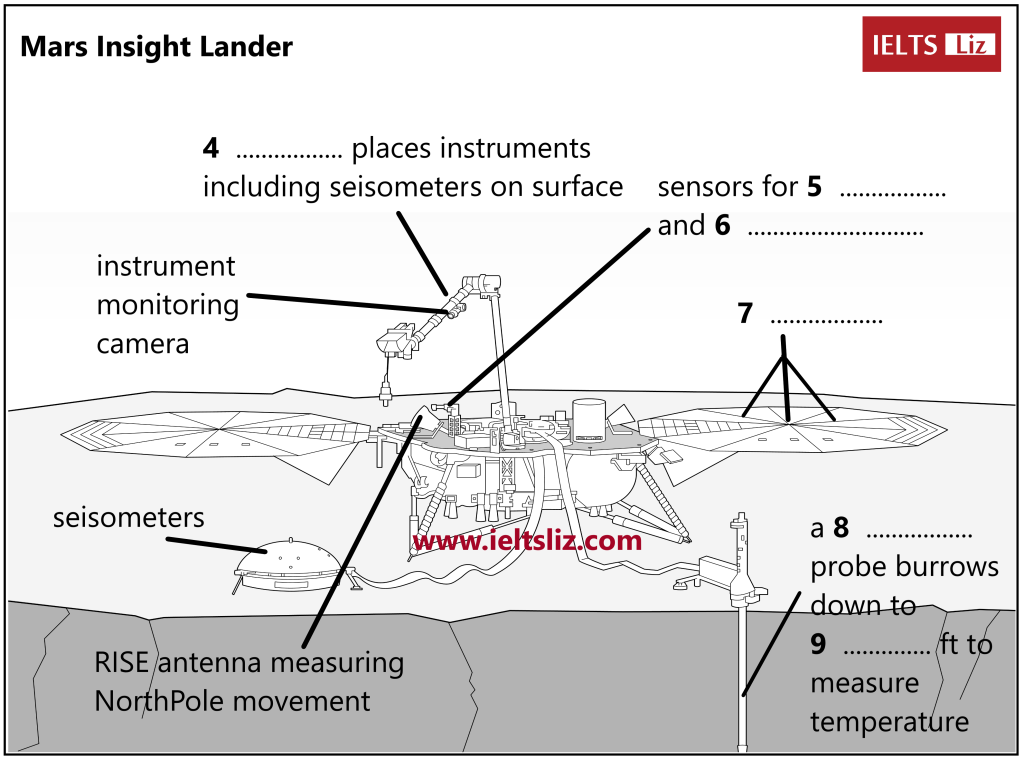
Mars Insight Probe
Questions 1 – 3: Complete the sentences using no more than one word and/or a number.
- The Insight probe will investigate Mars’ ………………
- The probe is currently situated near Mars’ …………..
- Scientists aim to learn about Mars’ composition from its core to its ………..
Questions 4 – 9
Complete the diagram below using no more than two words and/or numbers.
Source: Article from BBC NEWS
RECORDING:
Please note – there are now 9 questions in this listening practice (not 7).
.
**********
ANSWERS & TRANSCRIPT
Before you check the answers, read through the transcript while listening to the recording. This is a great way to review answers, spot paraphrases and keywords, analyse language, and gain test awareness. Remember, your aim is not to complete lessons, it is to learn and improve your listening score.
TRANSCRIPT
Click here: Transcript The US space agency Nasa has landed a new robot on Mars, otherwise known as the Red Planet. after a dramatic seven-minute plunge to the surface., The Insight probe aims to study the world’s deep interior, and make it the only planet – apart from Earth – that has been examined in this way. Insight is now sitting on a vast, flat plain, close to the Red Planet’s equator. This will be the first probe to dedicate its investigations to understanding Mars’ interior. Scientists want to know how the world is constructed – from its core to its crust. Looking at the functions of the Insight probe shown on the diagram, we can see that at the top there is a robotic arm which places instruments such as the seismometer on the planet’s surface. Attached to the arm is an instrument monitoring camera. On the main body of the probe there are sensors for both temperature and wind as well as a rise antenna. This measures the movement of Mars’ North Pole as it orbits the sun giving pointers about the iron-rich centre of the planet and hopefully more information about the composition and size of the planet’s core. On either side of the main body of the probe are two large circular solar panels which were deployed immediately on landing to operate its systems and warm equipment in the sub-zero temperatures on the planet . To delve deep into the ground and measure the planet’s temperature, there is a heat flow probe that will penetrate to a depth of 5m or 16ft. Note: you will not get the transcript in the real test. I am giving it to you for the purposes of learning. . ANSWERS Check your answers after you review the transcript above. Click here: ANSWERS . VOCABULARY review the vocabulary from this lesson. Click here: VOCABULARY . **************** RECOMMENDED FOR YOU MAP LISTENING QUESTIONS WITH TIPS TABLE LISTENING QUESTIONS WITH TIPS ALL PRACTICE LISTENING LESSONS & TIPS .