IELTS Writing Task 1: Introduction Errors

IELTS Writing Task 1 Introduction Paragraph – learn what mistakes to avoid. The introduction should be short and factual based on the information given. It should also be the quickest part of task 1 for you to write.

Look at the graph and introduction paragraph below. Then answer the questions.

comp-ownership-graph

Source: The above chart was not created by IELTS Liz.

Introduction Paragraph

Look at the introduction below and spot the mistakes.

Introduction: 

The graph give the information about the number of computer ownership by education level in two different years.

Questions:

  1.  How many mistakes are there in the introduction above?
  2. How would you write the introduction?

ANSWERS

Click below to reveal the answers and a model introduction.

Answers
  1. The graph
    1. should be = The bar chart
  2. give
    1. should be: gives (s)
  3. gives the information about
    1. should be = gives information about (no “the”)
  4. the number of
    1. should be = the percentage of / proportion of
    2. also, even if the chart did show numbers, you can’t say “the number of ownership”, you should say “the number of people owning a computer”
  5. computer ownership by education level = copied from graph. Do not copy phrases from the question paper. You can use the words, but change the order or paraphrase where possible.
    1. you should give the number of educational levels shown
    2. you can change the order of information for the purpose of paraphrasing
    3. education levels = levels of education (changing word order is paraphrasing)
    4. use a clause “people who owned …”
    5. use a longer noun phrase “people from five different levels of education”
  6. in two different years = always provide full information. Give the precise dates or the period it covers
Model Introduction

Model Introduction

The bar chart gives information about the proportion of people from five different levels of education who owned a computer in two different years (2002 and 2010).

Model Introduction Comments: As you can see, the first words are not altered because they are not required to be paraphrased. A bar chart is a bar chart. However, the verb is paraphrased and the rest of the information is reworded. As the education levels are length to write, it is possible to give information about how many there are in your introduction. Regarding dates, you can use brackets in IELTS Writing Task 1 and you can see that the dates are given in the brackets in this introduction. 

.

RECOMMENDED:

FREE SUBSCRIBE

Subscribe to get new lessons & tips by email.

.

IELTS Listening Multiple Choice Pictures

IELTS listening multiple choice pictures is when you need to choose the correct answer from a selection of pictures. It is one of the most difficult types of listening questions in your IELTS listening test. This particular listening lesson below is similar to the type of question you might get in Section 4 – the most difficult section in the IELTS listening test. However, picture multiple choice questions can come in any section of the listening test.

The listening practice below is mainly aimed at students who are band score 7 and above.  For students under band score 7, you can use this listening exercise to improve your vocabulary and listening technique.

Prepare both question and picture options before listening and choosing the answer. Answers are available below the audio.

Picture Multiple Choice Listening Question

Mammoths

Question 1: Choose the correct letter

1. Which type of mammoth is this lecture going to focus on?

mammoth picture

 Picture from Sunday Times Magazine, 20/04/2014.

.

ANSWER & TRANSCRIPT

Click below to reveal vocabulary, transcript and answer:

VocabBuilder
mammoth = prehistoric animal now extinct similar in shape to an elephant
physiology = make-up / structure
prominent = major / outstanding
parts of an elephant and mammoth = tusks, trunk, large ears
huge / colossal = enormous / extremely large
Transcript
There is evidence of much change and development in the mammoth. We can see the Ambelodon 20 million years ago, the Stegodon 12 million years ago and finally the Stegotetrabelodon which existed somewhere between 7.5 to 4.5 million years ago. There seem to have been a number of changes in the physiology of the mammoth, the most prominent were in the height, the size of the ears and the shape of the head and tusks. Today, I’m going to be focusing, on the one most of us associate with the ‘so-called’ classic shape and size of a mammoth and which is most known for its huge curving tusks and colossal size.
Answer
B
‘Today, I’m going to be focusing on….. which is most known for its huge curving tusks and colossal size.’

More Listening Lessons

Click here: IELTS Listening Practice and Tips

…………………….

FREE SUBSCRIBE: Get New Lessons & Tips by Email

IELTS Diagram Paragraphs and Organisation

IELTS writing task 1 diagrams must be clearly organised with logical paragraphs. This is part of the marking criteria of Coherence and Cohesion which is 25% of your marks. Most IELTS diagrams show a type of process which is divided into stages or given as a cycle. Also remember that writing task 1 is a report, not an essay.

You must organise your IELTS diagram into different paragraphs. Look at the process below and then answer the questions to learn about organising information.

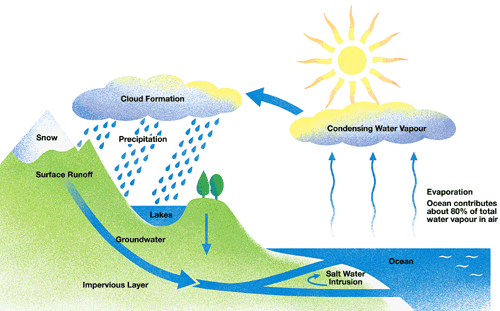
IELTS Water Cycle Diagram:

IELTS_Writing_Sample_Task_1_Water_Cycle

Source: Diagram not designed by IELTS Liz.

Questions 

Learn to analyse and organise your IELTS diagram by answering the following questions:

  1. How many paragraphs would you have in your report?
    1. Tips: Never have only one body paragraph.
  2. What information would you put in each paragraph?
    1. Tip: Use the arrows and always organise the information logically.

Answers

Read the answers very carefully and look at each point given in the diagram. Click below to reveal the answers:

Answers

1. There should be 4 paragraphs for this report.

2. You should put the following information in each paragraph:

  • Introduction: You need to introduce the content of the diagram (the process of the water cycle).
  • Overview: Put the key stages in this statement (a continual cycle of evaporation, cloud formation, rain and water returning to the sea).
  • Body paragraph A: Water in the ocean, evaporation, condensing water vapour and cloud formation.
  • Body Paragraph B: Precipitation, rain or snow, lakes, surface run off, ground water, impervious layer and salt water intrusion. You also need to note that at the water cycle starts again as the water returns to the ocean.
    • For the body paragraphs, you need to describe each stage in detail using full sentences linked together. You should divide the body into two or three paragraphs for all diagrams.

Example Introduction and Overview

The diagram illustrates the key stages in the water cycle.

Overall, the water cycle is a continual process of water evaporating and forming clouds which then return the water to the land and sea in the form of rain.

  • Note: You can see that the introduction is short and brief. You can see that the overview contains the key words as well as the key stages in summary.
  • It is possible to put these two sentences into one paragraph.

.

IELTS Writing Task 1

For writing task 1 model answers and more tips, see this page: IELTS Writing Task 1 Model Answers & Tips

All the best

Liz

FREE SUBSCRIBE

Subscribe to get new lessons & tips by email.

.

Migrating Birds: IELTS Synonyms Practice

Finding Synonyms: In IELTS reading, you need to develop the skill of spotting synonyms in the reading passage.

This lesson helps you develop this skill. There is no specific question like this in the IELTS reading test, but all question types require this skill. So, I have made this lesson to help you practice spotting paraphrases.

Bird Migration Synonyms Practice

Birds migrate to move from areas of low or decreasing resources to areas of high or increasing resources. The two primary resources being sought are food and nesting locations.

While short-distance migration probably developed from a fairly simple reason such as for food, the origins of long-distant migration patterns are much more complex. They’ve evolved over thousands of years and are controlled at least partially by the genetic makeup of the birds. They also incorporate responses to weather, geography, food sources, day length, and other factors.

Migrating birds can cover thousands of miles in their annual travels, often travelling the same course year after year with little deviation. First-year birds often make their very first migration independently. Somehow they can find their winter home despite never having seen it before, and return the following spring to where they were born.

The secrets of their amazing navigational skills aren’t fully understood, partly because birds combine several different types of senses when they navigate. Birds can get compass information from the sun, the stars, and by sensing the earth’s magnetic field. They also get information from the position of the setting sun and from landmarks seen during the day. There’s even evidence that sense of smell plays a role, at least for homing pigeons.

Notice: This article has been adapted from this page: The Basics of Bird Migration. It is always useful to read original articles.

Find the Synonyms

Find the word(s) in the reading passage above that have the same meaning as the words below. Answers will come in the order of the questions. This means you find the answer to question 1 first and the other answers will follow in order.

  1. breeding sites
  2. relatively
  3. developed gradually
  4. include
  5. departing from an established course
  6. on their own
  7. distinct feature noticeable from a distance

Answers

Click below to reveal the answers:

Answers

  1. breeding sites = nesting locations
  2. relatively = fairly
  3. developed gradually = evolved
  4. include = incorporate
  5. departed from an established course = deviation
  6. on their own = independently
  7. distinct feature noticeable from a distance = landmark


I hope you found this lesson useful 🙂

All the best

Liz

Get my free lessons by email

Subscribe for free to get my new IELTS lessons sent to your email inbox.


Prepositions Practice Sept 2018

Complete the sentences below using the following prepositions.

Prepositions:

  • A = down
  • B= for
  • C = on
  • D = with
  • E = over
  • F = in
  • G = no preposition required

Questions 1-6

Which of the above options can be used to complete these sentences.

  1. Smaller family units have become more common ………. recent decades.
  2. One of the main reasons ………. family units becoming smaller is finances.
  3. There has been a fall ……….. in the number of families with more than four members.
  4. Many children do not have a close relationship ………… their grandparents.
  5. Nowadays, less emphasis is placed ……….. close relationships between the generations.
  6. Children of working parents are often left alone ……. extended periods of time.

Answers

Click below to reveal the answers:

Answers

  1. F = in
    1. Smaller family units have become more common in recent decades.
  2. B = for
    1. One of the main reasons for family units becoming smaller is finances.
  3. G = no preposition needed
    1. There has been a fall in the number of families with more than four members.
  4. D = with
    1. Many children do not have a close relationship with their grandparents.
  5. C = on
    1. Nowadays, less emphasis is placed on close relationships between the generations.
  6. B = for
    1. Children of working parents are often left alone for extended periods of time.


All the best

Liz

IELTS Reading: Choosing a Title: Practice & Tips

Choosing a title for IELTS reading. This is another question type that appears in the IELTS Reading test which many people overlook because it isn’t a common one. However, it does appear and each answer you get write is a valuable point so it is worth preparing and training for this type of question.

Choosing a Title Tips

  • This is about choosing a title, not matching information
  • This reading exercise has only one question – to choose a title. However, normally this question would be given as the final question of the reading passage. This means you would already have answers over 10 questions on the passage before you come to this one.
  • The best title is the one that matching the whole aim of the passage.

IELTS Reading Choosing a Title Practice Lesson

Reading Passage:

Coffee is one of the most popular hot drinks in the world. Almost a third of the world’s population drinks coffee. People often meet at cafes or coffee shops for a coffee break during the middle of the morning or stop work in the afternoon to drink coffee.
About 7 million tons of coffee is produced every year. Brazil is, by far, the world’s largest coffee producer. About a third of the world’s production comes from this South American country. Other coffee producing countries include Vietnam, Indonesia and Colombia.
The United States is the biggest coffee consumer in the world. About 1.2 billion kilograms of coffee are consumed there every year. Drinking coffee is extremely popular in European countries, like Italy, France and Germany, as well as in Brazil.

Question: Which is the best title for the passage above?

Choose the correct letter A – C

A.  Coffee – a popular hot drink
B.  Coffee – the main consumers
C.  Coffee – the main producers

ANSWER

To see the answer, click below:

ANSWER

The correct answer is A

Explanation:

The opening paragraph and closing line both stress the same point which is about the popularity of coffee. While the first line alone or the last line alone might not themselves indicate aim, to have them both stressing the same point with so much detail in the first paragraph is something you can’t ignore.

There are no fixed rules about choosing a title. But you must remember that information for all options will be given in the passage. So, your aim is not to match information, but to decide what the whole aim of the passage is. You need to ask yourself – Why did this author write the passage? What was the aim of writing the passage? What was the key message that the author wanted to deliver?

So in this lesson, information about the producers and consumers was just extra information given in the passage for interest. But the main aim was to explain the popularity.

.

RECOMMENDED FOR YOU

FREE SUBSCRIBE

Subscribe to get new lessons & tips by email.

.

Desertification Reading Exercise & Useful Vocab

Reading lesson on Desertification to develop ideas and vocabulary for IELTS.  This lesson will provide you with ideas and vocabulary for IELTS writing task 2, speaking part 3 and the reading test.

Desertification: IELTS Environmental Topic

Before, you start your reading exercise. Let me explain a word to you relating to this topic. Desertification is a type of land degradation in which a relatively dry land region becomes increasingly arid, typically losing its bodies of water as well as vegetation and wildlife. It is caused by a variety of factors, such as climate change and human activities. Desertification is a significant global ecological and environmental problem.

The questions below are called Matching Headings Questions which are common in IELTS reading. They require you to match the heading title to a paragraph in the passage. The titles are to summarise the main aim of the paragraph.

Matching Headings Reading Practice

The reading passage below has 8 paragraphs (A-H).

Choose the correct heading for each paragraph from the list below.

Questions 1 – 8

Match each paragraph below to a title from the list. Not all letters will be used.

  • I     Overgrazing
  • II    Mass migration
  • III   Overpopulation
  • IV   Polluted drinking water
  • V    Famine
  • VI   Extinction of species
  • VII   Deforestation
  • VIII  Poverty
  • IX   Unsustainable agriculture techniques
  • X    Soil infertility

Reading Passage: Desertification Causes and Effects

Causes of Desertification

A  Trees are being cut down at much larger scale than ever before to be used as fuel, to provide products we use in our daily life, or to simply create more space for agriculture to sustain growing human population. Once the trees and other vegetation in an area are gone, there is nothing left to hold the soil in place.

B   Our planet’s ecosystems sustain life only when balanced. They can cope with incremental challenges and adapt but beyond a certain tipping point they collapse. A rapid increase in the number of people demands higher amounts of natural resources and expands more and more over the landscape, leading to increased desertification.

C   Improper irrigation methods used in arid areas, such as canal irrigation, lead to a buildup of salt in the soil and make it difficult for crops and other plants to grow, increasing desertification. Similarly harmful is cultivation of already deteriorated lands. Through inconsiderate farming methods, farmers only speed up the process of desertification in exchange for poor quality crops with low economic value.

D  In arid regions, grass and other vegetation is necessary to keep the soil in place. If such vegetation is used as feed for cattle without sustainable control, there is nothing that remains to prevent soil from blowing or washing away, and if this process occurs long enough, it can lead to desertification.

Effects of Desertification

 As desertification occurs, the soil can be blown or washed away, and valuable soil nutrients are lost. As the soil dries out, it hardens and it becomes difficult for any rainfall that does occur to penetrate below the soil’s surface. And what remains left is a lifeless pile of dust instead of a life-giving medium.

F   Due to drought conditions and a loss of productive land, local people find themselves and their livestock experiencing starvation.

 Desertification events have been a major driver behind the movement of large human populations throughout history. When soils are not able to support their civilisation, people set on the move to look for better locations.

H   Species that once lived in a fertile and productive climate may not survive in a newly desertified region.

ANSWERS

The answers are now available for this reading lesson. Click below for Answers:

Answers

Please remember that in the real IELTS test, if you are asked to write a letter, you must write the letter and not the word. Always following instructions very carefully for IELTS.

  • A  = VII
    • Deforestation. Keywords: Trees are being cut down
  • B  =  III
    • Overpopulation. Keywords: A rapid increase in the number of people
  • C  =  IX
    • Unsustainable agriculture techniques. Keywords: Improper irrigation methods / inconsiderate farming methods
  • D  =  I
    • Overgrazing. Keywords: feed for cattle without sustainable control
  • E  =  X
    • Soil infertility. Keywords: valuable soil nutrients are lost /  soil dries out / lifeless pile of dust
  • F  =  V
    • Famine. Keywords: people find themselves and their livestock experiencing starvation.
  • G  =  II
    • Mass migration. Keywords: movement of large human populations
  • H  =  VI
    • Extinction of species. Keywords: Species …………………. may not survive …

.

This reading exercise was easier than a normal Academic reading passage and is similar in level to a GT passage section 3. However, it is a great starting exercise for Academic candidates to get used to Matching Headings Questions. Now try something more difficult. See below:

RECOMMENDED FOR YOU

Matching Headings Practice with Essential Tips

ALL READING PRACTICE LESSONS & TIPS

FREE SUBSCRIBE

Subscribe to get new lessons & tips by email.

.

Listening Practice Blue-Footed Boobie Birds

Listening Practice for IELTS preparation. This topic was actually reported in the IELTS Reading Test. But, I have used it to create a listening exercise for you. There’s a funny video if you want to see these birds in action at the bottom of this article.

Blue-Footed Boobies Listening Exercise

Blue-footed Birds

Questions 1-9: No more than two words and/or a number.

  1. Strutting and showing off feet is part of the mating …………
  2. When a male boobie has very blue feet, he is considered ……………..
  3. Their name comes from the Spanish word for …………..
  4. On land, blue-footed boobies move  in a ………. manner.
  5. Blue-footed boobies fish in ……………….
  6. They eat small fish, for example ………….
  7. Their bodies are ………..  which is advantageous when diving.
  8. Adult boobies warm their chicks with their ……………….
  9. They usually have a maximum of ………. chicks.

Notice: Based on Article from National Geographic

Answers

The answers are now available for this lesson.

Click here for the answers: ANSWERS FOR BIRD LISTENING EXERCISE


All the best

Liz

The Blue-Footed Boobie Video

Sorry this is not an educational video, but it is great fun to watch 🙂


error: Content is protected !!