IELTS Cue Card Meaning

IELTS Speaking Part 2: Cue Card Topics

Many students have written to me about whether or not they can ask the examiner to explain the cue card topic in IELTS speaking part 2. Other students ask if they can change the topic of the cue card.

Understanding IELTS Cue Cards

  1. Do you think you can change the cue card topic?
  2. Can you ask the examiner to explain the topic if you don’t understand?

Answers

The examiner will give you the cue card with the main topic and prompts underneath. Here is an example:

An outing that didn’t cost anything. You should say:

  • when it was
  • where you went
  • who was with you
  • what you did
  • how you felt about it

You will also be given a piece of paper and a pencil to make notes. You will have one minute to prepare. During that 1 min, the examiner will remain silent. At the end of 1 min, the examiner will ask you to start speaking. You should aim to speak for 2 mins.

Can you change the cue card?

No, you can’t. You are given the IELTS cue card and then you start preparing. There is no chance to change it.

Can you ask the examiner to explain it?

No, you can’t. The examiner is not allowed to help you at this time. The cue card is given to you for your preparation time and also for your talking time. At no point, can the IELTS examiner explain in part 2 speaking.

What if you don’t understand?

  1. Then you must try to speak about something you think is similar. You can explain your choice when you start speaking. Also follow the prompts so that the examiner doesn’t think you are trying to change the topic completely.
  2. Most cue cards are simple topics. They rarely contain language that is complicated. Common cue card topics: a meal you enjoyed, a book you read, an item of clothing you like, your favourite season, a place near water etc. Very easy to understand.
  3. You are not marked on your choice of subject. If you get “a place near water”, you could talk about a place near the sea, a place near a river or just a place near a swimming pool. It really doesn’t matter. The examiner is only interested in your spoken English.
  4. The topic above “an outing that didn’t cost anything” is similar to “an activity that was free”. This is about leisure time activities that do not cost money (no fee was paid) – going to the park, having a picnic, playing badminton in the garden, going to the beach etc.

All the best

Liz


IELTS Speaking Topic: Films

The topic of films is common for IELTS speaking part 1, part 2 and part 3.

IELTS Questions for Films

Part 1

  • Do you often watch films?
  • What kind of films do you like?
  • Are foreign films popular in your country?
  • Do men and women usually like the same kinds of films?

Part 2

Talk about a film you enjoy

  • what type of film it is
  • when you first saw it
  • what it is about
  • why you like it

Part 3

  1. Do you think subtitles are better than dubbing for foreign films?
  2. Why do some people prefer watching a film in the cinema rather than at home?
  3. What makes a film successful?
  4. Do you think film stars are more important than special effects?
  5. What kinds of films are not suitable for children?

Film Vocabulary

It is important that you learn different genre of film.

How many genre do you know?

Click here: FILM TYPES  to get a listening practice lesson and learn the different film types.

All the best

Liz

Dakshita’s Tips for Band Score 8 in IELTS

Dakshita’s Tips for IELTS 8

Dakshita has generously written some useful tips to help all IELTS aspirants with their test. Dakshita has some great advice to share and I think you can benefit greatly from reading it.

I have added some links that Dakshita has mentioned in the list of tips 🙂

Dakshita Says: I am a doctor, just finished my undergrad course and wanted to qualify for IELTS in the first attempt to apply for PLAB 1 as early as possible.

Dakshita’s IELTS Results May 2018

Overall IELTS Band Score 8

  • Listening: 8
  • Reading: 9
  • Writing: 7
  • Speaking: 8

Dakshita’s Tips & Experience

Coming to my preparation tips :

READING :

Honestly, I couldn’t believe I scored a 9 in reading! I was very tensed about my answers because I got stuck in the last sentence completion task of the third passage and the clock was ticking away fast. I didn’t get to re-check any answers because of this and just prayed I’d hit a 7.5 in reading. My weakness was the TRUE/FALSE/NOT GIVEN task and I went through Liz’s video on the tips for this which made me mindful of my mistakes and avoid repeating them.

I would say practice would be essential, after being aware of the different question types, of course. I went through all the tasks on Liz’s website and then did tests from other free websites with a timer. I didn’t score more than 7.5 on most of my reading practice tests because I’d get impatient and try to finish the tasks as fast as I could. The recommended division is 20 minutes for each passage, but I would suggest 15 + 15 + 20 respectively so there’d be some time left over. I also want to reiterate that you should read the whole passage! Sometimes there are answers which are hidden in a few simple sentences which may be missed while skimming the passage. It’d be easier to have an idea of the passage and then see then questions, as they can be tricky. Always circle the questions that you may have doubts about so you can go back to them at the end. Make sure to attempt every question (check the question number properly) and don’t leave the answer space blank!

Links: TFNG Video Lesson   /  TFNG Extra Practice

LISTENING :

As most people (and Liz) have said, its vital to concentrate and pay attention to every single sentence in this task. Do not try to look at more questions than instructed (Ex. Look at only Q 1-5 and not beyond, etc) and make quick notes about the conversation if you’re not sure about the answer. I felt a couple of sections were a bit tricky so I noted some key points from the speakers so I could ponder over the answers later. You have to keep going with the recording so don’t get stuck and don’t worry if you don’t get an answer immediately! As soon as the recording stops, make sure to enter all the answers immediately in the answer sheet; changes can be made later. You’re instructed to stop writing as soon as the timer stops so please don’t leave any answer blank.

Link: Listening Tips

WRITING :

Ah, the dreaded task!! I must say, my heart was pounding for this one, as I needed a minimum score of 7. I am more than satisfied with my score because I made mistakes in my tasks and was slightly below the word limit in Task 1. I expected to lose points for that and hoped my second task would make up for it.

Task 1 : We were given a diagram of a process to be described. Personally, the mistake I made in the practice sessions was not being mindful of the tense while writing my report. Simple past, people! I reminded myself on the morning of the exam to make sure the tense was correct in Task 1. Overview in simple present, process/description in simple past. Please remember this while practicing. I spent the last 10 minutes fixing the tense and counting words when I realized I was under the word limit. And it was too late to add any more sentences.

Task 2 : Yes, it is important to spend time planning the points to be discussed in the essay. While you’re in the midst of the exam its usually a high stress situation but force yourself to stick to two points only. You wouldn’t be able to expand on more points anyway. I think Liz’s videos of the writing task are VERY HELPFUL, refer to them multiple times. Even though its been said that there isn’t a prescribed structure,  and introduction, opinion (if asked), examples and conclusion have to be clearly present. A very useful tip I got was to keep in mind your examiner has no idea what you’re talking about or explaining. So make sure they have no doubts by the end of your concluding paragraph.

Finally, you must print out the task sheets and practice writing on them to have an idea of the word limit and the size of your handwriting. It’ll help save time if you need an extra sheet during the exam.

Links: Answer Sheet for Writing with tips  /  Introduction Video   / Diagram Model Answer

SPEAKING : This was nerve wracking no matter how many times I was assured that the examiners are usually friendly and there was nothing to worry about. I went through all the speaking tasks on the ieltsliz website and spoke out loud about them to have an idea about what I was going to say. During this task, my examiner was extremely friendly and engaging, smiling and nodding at the things I said. I had immensely enjoyed speaking to her even though I slipped up a little in the second section. Just keep talking and smile through it! Most of us speak English on a daily basis anyway.

Links: Speaking Topics, Tips & Model Answers

I spent about 10-12 days of focused preparation for the exam and most of it was going through every single bit of ieltsliz.com. Thank you so much again Liz, you’re doing gods work here and helping thousands of us every day. I hope these points will help at least one person. Cheers!

Comments to Dakshita: Very well done with your results!! And a big thank you for sharing your tips and experience – very useful for everyone! I’m really pleased my lessons were helpful 🙂


IELTS Writing Task 2 Band Descriptors

Hi guys,

When you prepare for IELTS writing task 2, you need to understand the scoring system for your essay.

IELTS have published the IELTS Writing Task 2 Band Score Descriptors which show you the four marking criteria (each 25% of your marks) and also the requirements for each band score in those criteria. As you know the four marking criteria are:

  1. Task Response (your answer, position, ideas, relevancy and ability to develop ideas)
  2. Coherence & Cohesion (organisation, paragraphing, linking)
  3. Grammar (this is both your range and accuracy)
  4. Lexical Resource (the range and accuracy of your vocabulary)

To see a copy of the band descriptors for writing task 2 published by IELTS, click here: IELTS Band Descriptors WT2

I have also made my own page which explains the scores and also gives you tips for improving your score. Click here: Liz’ Band Score Information & Tips for Improving

Take your time to get to know the differences between the band scores. Most people who do not get the score they want, often do not fully understand the scoring and requirements.


Answers to Bar Chart Model Lesson

Here are the answers to the lesson about Bar Chart model.

Organising Sentences

D, G, C, B, A, I, E, J, H, F

Full Model Answer

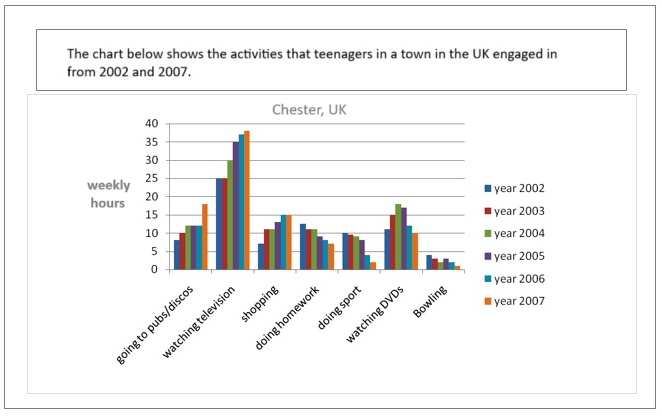
The bar chart illustrates how many hours adolescents in Chester spent on seven activities each week between 2002 and 2007.

Overall, the most popular activity over the period given was watching TV, whereas bowling was the least favourite. Going to pubs and discos, watching TV and shopping all showed an increase in the number of hours teenagers spent on these activities. The other pursuits showed a decrease in hours, except watching DVD’s which fluctuated.

Teenagers spent 25 hours on watching television in 2002 which increased to almost 40 hours in the final year. Both going to pubs and discos, and shopping more than doubled in hours from over 5 to over 15 and from over 5 to exactly 15 respectively.

While teenagers occupied 10 hours doing homework in 2002, this figure dropped to just over 5 in 2007. Playing sport fell more dramatically from 10 hours to around 3 hours. Bowling was under 5 hours throughout the entire period declining by about 4 hours in total. The number of hours teenagers dedicated to watching DVD’s was only 10 hours in first and final years, but reached a peak of over 15 hours in 2004 and 2005.

Word count = 194 (you do not need to write this in your real test)

Paragraphing Tips

  • It is possible that the last sentence about DVD’s could be written as a separate paragraph.
  • Always have an introduction and overview. They must be separate statements.
  • Always divide your body paragraphs into two (or sometimes three) paragraphs.
  • Your body paragraphs should be logical and help to highlight similarities and differences.
  • Learn an empty line between paragraphs to make them clear and easy to see. This is not a requirements, it is a recommendation. If your paragraphs are not easy to see, your score might be lower.


Full Model Answer to Bar Chart Lesson

Creating a Model Answer for IELTS writing task 1.

Many students asked me to write a full model answer for this bar chart which was used in my lessons last week. 

IELTS Complex Bar Chart


Source of Bar Chart: https://www.english-in-chester.co.uk

IELTS Bar Chart Model: Sentence Ordering

Put the 10 sentences below in order to make a full band 9 model answer for IELTS writing task 1.

  • A) Teenagers spent 25 hours on watching television in 2002 which increased to almost 40 hours in the final year.
  • B) The other pursuits showed a decrease in hours, except watching DVDs which fluctuated.
  • C) Going to pubs or discos, watching TV, and shopping all showed an increase in the number of hours teenagers spent on these activities.
  • D) The bar chart illustrates how many hours adolescents in Chester spent on seven activities each week between 2002 and 2007.
  • E) While teenagers occupied 10 hours doing homework in 2002, this figure dropped to just over 5 in 2007.
  • F) The number of hours teenagers dedicated to watching DVDs was only 10 hours in first and final years, but reached a peak of over 15 hours in  2004 and 2005.
  • G) Overall, the most popular activity over the period given was watching TV, whereas bowling was the least favourite.
  • H) Bowling was under 5 hours throughout the entire period (declining by about 4 hours in total).
  • I) Both going to pubs or discos, and shopping more than doubled in hours from over 5 to around 15 or slightly above.
  • J) Playing sport fell more dramatically from 10 hours to around 3 hours.

Notice how many sentences are used to create a full model answer. IELTS writing task 1 does not require many sentences. There are NO fixed number of sentences for writing task 1, but you can see that you do not need many to write a high score answer.

Answers

Answers are now available. Please remember the answers also contain the full model answer in the right order. This isn’t just a lesson to complete an exercise, it is a method of helping you understand model answers and to learn from them. Take your time to review your answers and also review the full model.

Click below for the Answers

Answers

D, G, C, B, A, I, E, J, H, F

The bar chart illustrates how many hours adolescents in Chester spent on seven activities each week between 2002 and 2007.

Overall, the most popular activity over the period given was watching TV, whereas bowling was the least favourite. Going to pubs or discos, watching TV, and shopping all showed an increase in the number of hours teenagers spent on these activities. The other pursuits showed a decrease in hours, except watching DVDs which fluctuated.

Teenagers spent 25 hours on watching television in 2002 which increased to almost 40 hours in the final year. Both going to pubs and discos, and shopping more than doubled in hours from over 5 to 15 or slightly above.

While teenagers occupied 10 hours doing homework in 2002, this figure dropped to just over 5 in 2007. Playing sport fell more dramatically from 10 hours to around 3 hours. Bowling was under 5 hours throughout the entire period declining by about 4 hours in total. The number of hours teenagers dedicated to watching DVDs was only 10 hours in first and final years, but reached a peak of over 15 hours in 2004 and 2005.

Word count = 194 (you do not need to write the word count in your test)

Paragraphing Tips

  • It is possible that the last sentence about DVDs could be written as a separate paragraph.
  • Always have an introduction and overview. They must be separate statements.
  • Always divide your body paragraphs into two (or sometimes three) paragraphs.
  • Your body paragraphs should be logical and help to highlight similarities and differences.
  • Learn an empty line between paragraphs to make them clear and easy to see. This is not a requirements, it is a recommendation. If your paragraphs are not easy to see, your score might be lower.

.

All the best, Liz

Recommended for You

ALL MODEL ANSWERS & TIPS FOR WRITING TASK 1

……………………………….

FREE SUBSCRIBE

Subscribe to get new lessons & tips by email.

Unsubscribe Instructions

Hi guys,

If you have subscribed to receive emails from ieltsliz.com and wish to unsubscribe, please follow these instructions:

To unsubscribe to this blog,

  1. go to any email you have received from ieltsliz.com
  2. click on the unsubscribe button
  3. then you must click “confirm” to cancel your subscription
  4. If you fail to click “confirm”, the subscription won’t be cancelled – so remember to click “confirm”

All the best

Liz

Answers to Organising Bar Chart Paragraphs

I can see that some of you are not clear about paragraphing and organising information in writing task 1.

Paragraphs

You must have an introduction and an overview. They are usually separate paragraphs.

You CANNOT have one body paragraph and you CANNOT have four or more body paragraphs.

Your structure should be:

  • Introduction
  • Overview
  • Body Paragraph 1
  • Body Paragraph 2
  • Body Paragraph 3 (optional and not common)

Can the overview go at the end of the report? See this page: Paragraph Structure

Can you have a conclusion? See this page: Conclusion or Overview

Organising Details in Body Paragraphs

When you organise your body paragraph details, you must choose a simple, logical system. It should be easy for the examiner to understand your organisation. Your body paragraphs should help highlight main features.

The bar chart below shows the hours per week that teenagers spend doing certain activities in Chester from 2002 to 2007.

Source of Bar Chart: https://www.english-in-chester.co.uk

Option 1 Body Paragraphs

Body Paragraph 1 = categories that increased over time

  • going to pubs/ discos
  • watching TV
  • shopping

Body Paragraph 2 = categories that decreased over time

  • doing homework
  • doing sport
  • bowling

Body Paragraph 3 = categories that fluctuated

  • watching dvds

Option 2 Body Paragraphs

Body Paragraph 1 = highest and lowest

  • watching TV
  • bowling

Body Paragraph 2 – all other categories

  • going to pubs/discos + shopping = increase
  • doing homework + doing sport = decrease
  • watching dvds = fluctuate

Which is best?

Both options are excellent. They both highlight key features and are organised logically.

Paragraphs do not need to be equal in length. This is not an essay, it is a report.

Model Writing Task 1

If you would like to see model answers for different writing task 1 as well as tips, click here: Main Writing Task 1 Page

All the best

Liz

error: Content is protected !!