Brain Drain Listening Practice

This listening lesson has two different types of questions: list selection and sentence completion. This will also test your ability to know when to move from one question to the next. Make sure you use this lesson to also learn useful vocabulary because the brain drain is a common topic in writing task 2.

IELTS Listening Multiple Choice: Long List Selection Practice

As you can see, this multiple choice practice listening does not have the usual three answer options. Instead you are given a long list and must choose a number of options from the list. The first list is for three questions.

The recording covers all questions from 1 to 5, so be ready to move quickly to the next set of questions.

Questions 1-3

Which three reasons are given for the brain drain? Choose the correct letters A-G.

  • A) money
  • B) promotion opportunities
  • C) working with other professionals
  • D) quality of life
  • E) state-of-the-art equipment
  • F) political advancement
  • G) unemployment

Question 4

What problem does the brain drain cause developing countries? Choose one letter.

  • A) resentment
  • B) loss of facilities
  • C) conflict between remaining professionals
  • D) loss of reputation
  • E) loss of money
  • F) loss of materials

Question 5

Complete the sentence using no more than one word and/or a number.

In 2000, …….. million people, who were living outside their country of origin for more than one year, were employed.

RECORDING:

.

TRANSCRIPT & ANSWERS

Answers
  1. A
  2. D
  3. E (answers to questions 1-3 can be given in any order)
  4. E
  5. 65
  Transcript
Brain drain is the migration of skilled human resources for trade, education, health care and other sectors. Trained health professionals are needed in every part of the world. However, better standards of living draw many of them to more developed countries. Others decide to make the move because of better remuneration or for access to advanced modern technology.  For some the stable political conditions in the developed countries attract talent from less developed areas. The majority of migration is from developing to developed countries. This is of growing concern worldwide because of its impact on the health care systems in developing countries. These countries have invested in the education and training of young health professionals. This translates into a loss of considerable resources when these people migrate, with the benefit accruing to the recipient states who have not forked out to educate them. The intellectuals of any country are some of the most expensive resources because of their training in terms of material cost and time, and most importantly, because of lost opportunity. In 2000 almost 175 million people, or 2.9% of the world’s population, were living outside their country of birth for more than a year. Of these, about 65 million were economically active. This form of migration has in the past involved many health professionals: nurses and physicians have sought employment abroad for many reasons including high unemployment in their home country. (read more about this)

.

RECOMMENDED FOR YOU

Multiple Choice Listening Practice with Essential Tips

ALL LISTENING PRACTICE LESSONS & TIPS

FREE SUBSCRIBE

Subscribe to get new lessons & tips by email.

.

Camping Topic: Vocabulary with Pronunciation

Camping is a topic which can appear in IELTS speaking part 1. Learn some useful words to be able to talk about this topic. Listen to the recordings to improve your pronunciation.

Camping Vocabulary

Basic camping equipment
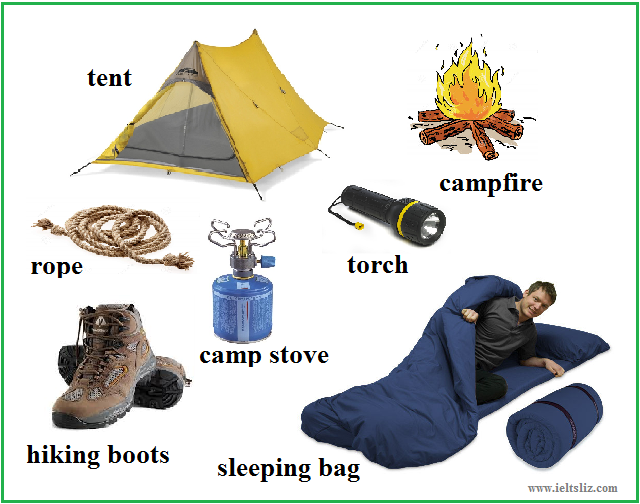
camping vocabulary pictures


Listen for the missing word

Listen to the recording below. There is one word in the recording which is not in the picture – what is that word? Words will not come in order so write them down as you listen. Answer

The missing word is “map”.

More Camping Vocabulary

  • bug spray = insect repellent
  • compass = equipment for navigation
  • backpack = a bag which you carry on your back
  • air mattress = a bed mattress that is filled with air
  • hat = for protection against weather, particular the sun or rain
  • raincoat = a jacket which is waterproof
  • wildlife = wild animals
  • campground = the place for camping
  • path = a track or way to walk (people follow paths in the forest)
  • firewood = wood used for campfires
  • cramped  = not enough space, too small
  • being close to nature = spending time near wildlife and in natural areas
  • camping gear = a collection of camping equipment

Listen to the recording below to improve your pronunciation.


Get my free lessons by email

Subscribe for free to get my new IELTS lessons sent to your email inbox.

How to Prepare for IELTS: Essential Steps

Learn how to start preparing for your IELTS test by following the 15 most important steps. This video lesson will explain exactly what steps you must take before you enter the exam room and how to prepare successfully for your IELTS test.

IELTS Preparation Steps

Learn about the IELTS Test

Academic or General Training Test?

Having Realistic Goals

  • decide which band score you want
  • get your English level assessed
  • check that your level of English is enough for the band score you want
  • if your level is too low, you must work to improve it
  • develop your IELTS skills
  • make sure you have enough time to get the right level of English and strong exam skills

Know the Requirements of Your Band Score

Questions and Topics for IELTS

Practice and Develop

Practice Tests

  • Buy the Cambridge IELTS books 1-9 (use the most recent books 7-9)
  • Practice tests under exam conditions as well as to develop skills

Assessment

  • Get your speaking and writing assessed by an experienced IELTS teacher
  • Get feedback on technique and language problems

Get Professional Training

  • Either get training online or in an IELTS school
  • All students need to be trained in IELTS to fulfill the requirements of the test

When to Take your Test

  • Take your test when your English level matches your required band score
  • Take your test when you fully understand the IELTS test
  • Take your test when you are frequently scoring your required band score

Get my free lessons by email

Subscribe for free to get my new IELTS lessons sent to your email inbox.

IELTS Speaking Part 3: Environment

Below are some questions for the topic of the environment for IELTS speaking part 3.

IELTS Speaking Part 3 Questions: Environment Topic

  • Are there many environmental problems in your country?
  • Are people concerned about environmental problems in your country?
  • Do you think enough is being done to deal with them?
  • What can  individuals do to help?
  • Do you think older people have as much awareness of environmental problems as the younger generation?
  • Do you believe that climate change is a serious problem?
  • What causes climate change?
  • Do you think recycling is important?

Model Answers for Speaking Part 3: Environment Questions

Use these model answers to learn from. Do not memorise them. Just use them to learn ideas, useful words and technique. I’ve provided recordings so you can listen to the answer as well. This is a good way to hear now naturally the speaker gives the answers. You can use these recordings to improve your pronunciation.

  • Question) Are people concerned about environmental problems in your country?
  • Answer) Well, it’s hard to say for sure. I think some people are concerned but probably not enough of them. There are people who take environmental problems seriously enough to actually recycle their rubbish appropriately but I don’t think there are enough people who concern themselves with resource depletion which I consider to be a pressing issue. So many people are using energy and buying products without any thought to the impact of their actions. We all know that the world’s resources are being used at an alarming rate but no one seems to actually feel it’s their responsibility to change the way they live. So, I guess, although there are some people who are concerned, it’s not enough and more people in my country need to change the way they live.

Recording: Model Answer

.

  • Question) Do you believe climate change is a serious problem?
  • Answer) Yes, I do. The issue of climate change has been growing over the past few decades and we are now witnessing serious changes in global weather patterns. While some countries are suffering heat waves, other countries are suffering from terrible snow storms. But that isn’t the worst of the problem. The changes in the climate are also causing extreme weather such as typhoons, earthquakes and tsunamis, which are devastating many countries. On top of that, there are also concerns about rising sea levels, which although not a problem now, will be a serious concern to any low lying country in the future. So, I feel that climate change is something which needs to be taken very seriously.

Recording: Model Answer

.

RECOMMENDED FOR YOU:

FREE SUBSCRIBE

Subscribe to get new lessons & tips by email.

.

How many words for IELTS writing? Rules & Advice

How long should your IELTS writing task 1 &  task 2 be? Learn how the examiner counts your words and the recommended length of your IELTS essay. This page contains information about:

  • IELTS Writing Word Count Rules
  • Recommended Essay Length
  • Word Count Warning
  • Will you get a higher score for a longer essay?

IELTS Writing: Word Count Rules

  1. IELTS have set a task of writing OVER 150 words for IELTS writing task 1 and OVER 250 for writing task 2.
  2. However, there is no upper word limit. But that doesn’t mean a long essay is a good idea.
  3. While the under word count penalty has been removed, writing an essay that is too short will lower your score. Click here: penalty removal and short essays

Recommended Length of an IELTS Essay

  1. The instructions given by IELTS state write at least 150 words (task 1) / at least 250 words (task 2).
  2. The words “at least” mean you should not go below 150 words for task 1 and not write under 250 words for task 2.
  3. Always write over the least recommended word count.
  4. For writing task 1, aim for between 170 words and 190 words. Try not to go over 200 words (max 210 for complicated charts).
  5. For writing task 2, aim for between 270 words and 290 words. Try not to go over 300 words. IELTS essays are designed to be written in 40 mins and to be highly focused with each sentence crucial to the essay.
  6. Writing under 150 words for task 1 and under 250 words for task 2 will not allow you to develop your points enough for a high score.
  7. Aim for quality rather than quantity. This means focus on writing excellent English and organising your information rather than writing a long essay in task 2. The also applies to your report in task 1 academic or your letter in task 1 GT.

How Long Should Your Essay Be? 

Note: This video was made years ago but is still 100% relevant today. Scroll down below the video to keep reading about word count in IELTS writing.

.

Will you get a higher score for a longer essay in IELTS?

The answer is very simple = no. IELTS is look for a highly relevant, focused essay. If you try to add information that is not 100% relevant to your task, you will get a lower score.

IELTS writing task 2 essays are designed to be written within 40 mins and to be highly focused. This means each sentence is 100% relevant and critical to the essay. There is no sentence which contains padding (extra, unnecessary information). For writing task 1, if your report gets too long, you will be marked down for getting lost in detail and not focusing on key features.

You do not get a higher score for a longer essay.

Warning for IELTS Writing Word Count

  1. If you copy the information given by IELTS for your introduction, the examiner will not count those words. This means you might be under the word count. So, always paraphrase your introductions. This lesson shows you how to write an introduction for IELTS writing task 2 by paraphrasing.
  2. How to check how many words you have written – you don’t have time to count each word you have written, so you should count the lines instead. Knowing the length of your handwriting on the official writing answer sheet will help. Watch this video lesson to learn about practicing with the official writing answer sheet.
  3. All words are counted. This means each individual word, just the same as word count in a Word Document. For example, “The most important part of a test is understanding the marking system and the requirements” = 15 words.

More IELTS Writing Tips & Lessons

10 Sentences to Avoid in IELTS Writing Task 2

How many Paragraphs for an IELTS Essay

How to use the Official Answer Sheet for IELTS Writing

All IELTS Writing Task 2 Lessons, Model Answers, Tips & Free Videos

………………………………………………..

FREE SUBSCRIBE

Subscribe to get new lessons & tips by email.

.

IELTS Essay Ideas: Female Staff in Senior Positions

Here is an IELTS writing task 2 essay about management positions and gender with ideas given below.

Most high level positions in companies are filled by men even though the workforce in many developed countries is more than 50 per cent female. Companies should be required to allocate a certain percentage of these positions to women.
To what extent do you agree?

Why companies should give a percentage of senior positions to women

  • equal rights and opportunities for men and women
  • it avoids discrimination
  • it creates a pleasant work environment to have a better balance of the genders in management and senior levels
  • it creates a supportive work environment for other female employees to know that a certain percentage of management is also female
  • women have valuable skills of communication and diplomacy for high level positions

Why companies should not give a percentage of senior positions to women

  • it is unrealistic to stipulate a certain percentage of one gender
  • companies cannot be sure that they will receive suitable female applicants to fill a certain percentage of senior positions
  • this forces companies to fulfill percentages even though it may be to their detriment
  • senior positions should be allocated based on experience, skills and qualifications not gender

Recommended

Collection of Essay Ideas

Get my free lessons by email

Subscribe for free to get my new IELTS lessons sent to your email inbox.

Listening Practice for Numbers

This lesson focuses on listening for numbers. There are three sections of listening and each section has 10 questions. Make sure you have a pencil and paper ready.

Write down the numbers you hear. Each listening has 10 or 9 numbers.

Numbers 1 to 100

Listen to the recording and write down the numbers you hear between 1 and 100.

.

For answers, click below:

Answers
  1. 8
  2. 13
  3. 50
  4. 24
  5. 47
  6. 86
  7. 19
  8. 97
  9. 17
  10. 29

.

Numbers from 100 to 1,000

Listen to the recording and write down the numbers you hear between 100 and 1,000.

.

For answers, click below:

Answers
  1. 116
  2. 196
  3. 332
  4. 480
  5. 390
  6. 830
  7. 901
  8. 642
  9. 589
  10. 772

.

Numbers from 1,000 to 1,000,000

Listen to the recording and write down the numbers you hear between 1,000 and 1,000,000.

.

For answers, click below: 

Answers
  1. 2,350
  2. 6,719
  3. 10,300
  4. 80,500 (this one is missing from the audio)
  5. 65,000
  6. 12,450
  7. 15,000
  8. 28,560
  9. 990,999

.

Recommended

Get my free lessons by email

Subscribe for free to get my new IELTS lessons sent to your email inbox.

World Environmental Problems: Vocabulary Exercise

The top ten world environmental issues with vocabulary, listening practice and pronunciation for IELTS test preparation. Learn useful vocabulary and pronunciation to be able to talk and write about these issues. These issues are likely to appear in IELTS Speaking Part 3 and Writing Task 2.

Top Environmental Problems in the Modern World

Below is a list of the worst environmental problems facing the world today. The list is in no particular order and there are still many problems missing from the list, such as microplastics and antibiotic contamination.

  1.  acid rain = rain which is polluted by chemicals
  2. deforestation =  rain forests and wooded areas being cut down
  3. loss of biodiversity = species becoming extinct
  4. ozone layer depletion = the ozone layer is being destroyed and becoming thinner
  5. land degradation = soil and land pollution as well as desertification
  6. resource depletion = lack of natural resources worldwide
  7. climate change = negative changes to the world weather patterns
  8. air pollution = air that contains pollutants
  9. marine pollution = the pollution of our oceans and seas
  10. overpopulation = the increasing population of the world

Listen to Recording:

.

Vocabulary, Pronunciation and Listening: Environment Topic

Learn more about the top 10 environmental world issues facing us today so you can talk and write confidently about them to maximise your band score. These exercises aim to help you improve your vocabulary, your pronunciation, your listening skills, and also your awareness of these issues for your IELTS test. Listen to the recordings and fill in the gaps. You may use no more than 3 words and/or numbers to complete the sentences.

Acid rain

  • Rain that contains large amounts of (1)………………. This can cause serious health problems as particles of pollution can enter people’s (2)…………………..
  • Acid rain can (3)……………. into the ground causing soil pollution.
  • As rain falls into lakes and river this can cause water pollution.
  • Acid rain can also be responsible for damaging (4)……………

Listen to Recording:

ANSWERS – Click below:

Answers
  1. chemicals
  2. lungs
  3. seep
  4. buildings

.

Deforestation

  • Deforestation is the destruction of forests and the cutting down of trees on a large scale.
  • As forests are cut down, it affects the atmosphere and (1)………………… as trees play a large part in the water cycle.
  • Another problem is the loss of (2)……………………. Some species of plants and animals have already been lost while others remain endangered. This is due to the loss of their (3)………..
  • This process affects climate change. Trees (4)……………… CO2 and give off oxygen. By destroying forests more CO2 remains in the atmosphere affecting the climate.
  • In the area where the trees have been removed, (5)……………….. occurs as the earth is exposed to the sun’s heat. This evaporates much needed nutrients contained in the soil and is very difficult to reverse.

Listen to Recording:

ANSWERS – Click below:

Answers
  1. ecosystem
  2. biodiversity
  3. habitat
  4. absorb
  5. soil erosion

.

Loss of Biodiversity

  • Each species, no matter how small, has a role to play in the (1) …………………
  • A larger number of plant species means a greater variety of (2)………………..
  • Greater species diversity ensures (3) …………………. for all life forms; and healthy ecosystems can better withstand and recover from a variety of disasters.
  • The loss of biodiversity can affect our (4)………………, access to clean water and also the range of raw materials.

Listen to Recording:

ANSWERS – Click below:

Answers
  1. ecosystem
  2. crops
  3. natural sustainability
  4. food security

.

Ozone Layer Depletion

  • The ozone provides essential protection from the (1)……….. ultraviolet radiation.
  • Certain industrial compounds (2)…………. the ozone layer.
  • This reduces the ability of the ozone to protect (3)……………… from UV radiation.
  • This is a global issue as the compounds affecting the ozone come from other parts of the world to where the problem lies.

Listen to Recording:

ANSWERS – Click below:

Answers
  1. sun’s
  2. break down
  3. surface life

.

Land Degradation

  • This relates to changes in the land which reduces its (1)………………………………
  • Factors that have contributed to land degradation include soil erosion, (2)……………………, desertification and loss of vegetation cover.
  • Many of these factors are (3)………………… by human activities.
  • With a growing world population, land degradation can have serious effects on our ability to feed everyone due to reduced (4)…………….. in major food crops.

Listen to Recording:

ANSWERS – Click below

Answers
  1. productive potential
  2. loss of fertility
  3. exacerbated
  4. yields

.

Resource Depletion

  • Humans are using (1)……….. more resources than the Earth can replenish each year.
  • This leads to pollution, land degradation, soil erosion and (2)………………
  • This problem is worsening as populations and consumption keep growing.
  • (3)………………….. are unable to keep up with the rate of resource depletion.
  • Some scientists believe that by 2030 we will need two planets to provide our wants.
  • The US and China account for more than (4)…………… of the planet’s ecological footprint, with 21% each.

Listen to Recording:

ANSWERS –  Click below:

Answers
  1. 30%
  2. deforestation
  3. Science and technology
  4. two-fifths

.

Climate Change

  • The build up of (1)……………… into the atmosphere have led to changes in the world’s climates.
  • The cause of this can be found in carbon emissions and the combustion of (2)………………..
  • Climate change can be felt in the rise in temperatures and the changes of (3)……………….. on a global scale.
  • As a result droughts, floods, wildfires and storms are becoming more frequent.
  • With the increase in temperatures comes the rise in sea levels which threaten (4)…………………. lands.
  • The future consequences are potentially devastating.

Listen to Recording:

ANSWERS – Click below:

Answers
  1. greenhouse gases
  2. fossil fuels
  3. weather patterns
  4. low lying

.

Air Pollution

  • Combustion, mining, factories, (1)………………., farming, fires and automobiles all pose threats as potential air pollutants.
  • This endangers our health and ecosystem.
  • Smog, mainly from factory smoke, is (2)……………… and can produce chronic problems such as lung disease, asthma and heart disease, resulting in an estimated 200,000 (3)………… deaths per year.

Listen to Recording:

ANSWERS – Click below:

Answers
  1. power plants
  2. hazardous
  3. premature

Marine Pollution

  • The main contributor of ocean pollution begins on land, namely non-point pollution from septic tanks, sewage sludge, car oil leaks, boats and (1) …………………., which make their way to the sea.
  • Other reasons for the pollution is that some boats and even countries (2)………….. their waste directly into the ocean.
  • Water covers approximately (3)…………… of our globe, it would seem that it is an (4)…………… resource but it is not.
  • Humans are destroying the homes of millions of (5)………………………, some of which we know little to nothing about.
  • Ocean pollution is not only devastating for the sea creatures, it can also be devastating for (6)……………….. as well.

Listen to Recording:

ANSWERS – Click below:

Answers
  1. farm chemicals
  2. deposit
  3. 70%
  4. abundant
  5. aquatic creatures
  6. humans

.

World Population

  • The world population is currently 7 billion and is estimated to be (1)………………. by 2024.
  • This is due to improved living standards and medicine which results in a (2)………………… and lower infant mortality.
  • Over population will result in (3)……………………… and an increase in carbon emissions worsening climate change.
  • In urban areas it may result in lower standards of living and increasing (4)……………………
  • Feeding such a large population will also create challenges.
  • Safe, environmentally friendly (5)………………. will also become a problem as the world population grows which can result in growing pollution.

Listen to Recording:

ANSWERS – Click below:

Answers
  1. 8 billion
  2. longer life span
  3. draining world resources
  4. crime rates
  5. waste disposal

.

Recommended for you:

Information for this lesson was collected from various sources including hubpages.com, globalissues.org, and greenliving.

FREE SUBSCRIBE

Subscribe to get new lessons & tips by email.

error: Content is protected !!