IELTS Listening for Plurals: Tips & Practice

In the IELTS listening test, you often need to listen for plurals. If the answer is “projects” and you write only “project”, your answer will be marked wrong.

This IELTS listening video lesson looks at tips and practice to help you listen for plurals.

IELTS Listening for Plurals: Video Tutorial

Main IELTS Pages

Develop your IELTS skills with tips, lessons, free videos and more.
Get my free lessons by email

Subscribe for free to get my new IELTS lessons sent to your email inbox.

IELTS Invitation Letter for GT Writing Task 1

Below is a model answer for an IELTS invitation letter. This particular invitation letter was reported in the IELTS exam last week. The aim of the invitation is a public event. Other invitations can sometimes include holiday invites, private celebration invites or even formal invites from a business perspective.

Instructions:

Writing Task 1: Write a letter to your friend who lives in another country and in your letter:

  • a. Invite him/her to a public event in your country.
    b. Describe the public event.
    c. Explain about other plans you have for your friend when he/she will visit.

IELTS Invitation Letter Model Answer

Hi Dave,

How have you been since we last met?

I thought I’d drop you a line and see if you fancy coming over for Bonfire night which is on November 5th.

Bonfire night is a great event in England, particularly in my hometown. It starts as soon as the sun has set because the event is held around a huge bonfire. As the weather is cold, the bonfire adds wonderful warmth. On the fire, there’s a guy which represents Guy Fawkes, a man who once tried to blow up Parliament. On top of that there’s also fireworks and a chance to cook your own food on the fire, which I’m sure you’ll love.

While you’re over, we’ll be able to do a trip to London as I know you’ve always wanted to visit. The Christmas lights will have been switched on by then and they are amazing. You’ll also be able to visit the Christmas markets and do all your Christmas shopping.

I really hope you’ll be able to come over. It won’t be the same without you.

Write back soon,

Sandra

Words = 183

More IELTS Letters:

Model Complaint Letter

Essential Tips for IELTS Letter Writing

All Writing Task 1 Lessons


Main IELTS Pages

Develop your IELTS skills with tips, lessons, free videos and more.

Get my free lessons by email

Subscribe for free to get my new IELTS lessons sent to your email inbox.


IELTS Water Supply Diagram Process

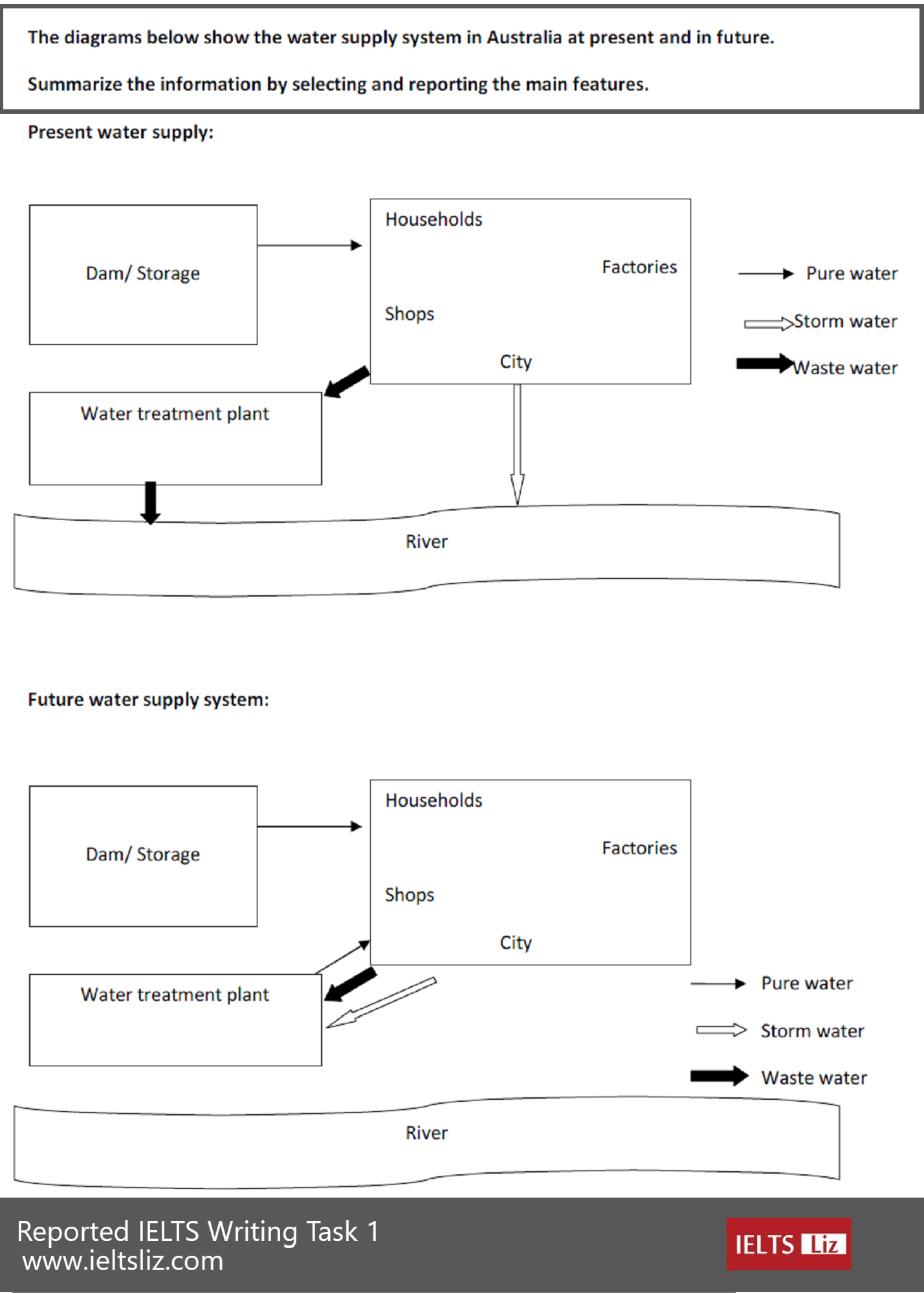
The IELTS diagram below shows two diagram processes in two different time periods – present and future. The diagram was reported in the test twice and will likely appear again as IELTS do recycle writing tasks. This is also known as an IELTS Process.

For diagrams, you must pay attention to key stages of the process. All IELTS writing task1 reports will have an overview and this includes diagrams. The overview is the key paragraph and must summarise the key stages but without writing a list. See the model answer below to learn about this.

IELTS Diagram Process: Water Supply Systems

Below you will find a band score 9 model answer for an IELTS Diagram/Process.

IELTS Diagram Process Water Supply Writing Task 1

IELTS Diagram Model Answer

Note: When you read the model answer below, pay attention to the different tenses used. See if you can spot the future passive voice.

The diagram illustrates the way the water supply system currently works in Australia and how the system will be changed in the future.

Overall, although both systems use the dam as a water supply, the present system returns both storm and waste water directly or indirectly to the river, whereas the future system plans to recycle both forms of water.

The current water supply system shows that water is stored in a dam before being transferred to a city to be used by households, shops and factories. From the city, storm water is directed straight into the river, by contrast waste water is sent to a water treatment plant to be processed. After the waste water is treated, it is safe to be released into the river.

Regarding the future water supply system, water will be brought from the dam for the same uses as in the present. However, both the storm water and waste water from the city are to be directed to the water treatment plant for processing after which they will both be recycled for use in the city. It is planned that no water will be released back into the river.

195 words

Three Key Points:

  1. The introduction provides a paraphrase of the rubric given. It is a short, functional paragraph.
  2. The overview summarises the diagram without getting lost in detail and without forming a list of stages. The overview is sufficiently developed for a high score.
  3. The body paragraphs are well organised with flexible linking which allows for accurate, complex sentence structures as well as a logical order of information. Tenses are used flexibly to show present and future information. As with most diagrams, the passive voice is used alongside the active voice. Vocabulary and collocations are used with accuracy and flexibility.

RECOMMENDED FOR YOU

FREE SUBSCRIBE

Subscribe to get new lessons & tips by email.

.

Insect Blog: Develop your vocabulary and reading

Hi guys,

I’d like to introduce you to a new blog about insects. It’s written by a guy called Chris who is an entomologist, which is a person who studies insects.

As you know insects is a topic that has appeared in IELTS reading quite a few times and is very difficult because of the academic vocabulary involved. So, this blog can help you become more familiar with this topic. Some of the posts  on Chris’s blog are very high level with a lot of technical language for other entomologists. However, other posts are written for people without knowledge of insects and are very interesting to read, particularly for band score 7, 8 and 9 level students.

The aim of his blog is to share information and teach people about insects that pollinate and insects that are pests. Here’s a link: pests and pollinators by Chris

Liz

IELTS Diagram Recently Reported in the Exam

The IELTS diagram below was reported by a student called Fay in her IELTS test, Oct 10th in the USA. The diagram has been drawn by Fay. This is for the IELTS academic test, not the GT test.

Please note:

This diagram has been altered and is now available to see on this page: IELTS Rainwater Diagram

A model answer is currently available on this page: IELTS Rainwater Diagram

The diagram shows how rain water is collected and prepared for use as drinking water for an Australian town.

IELTS Diagram Reported 2015

I will post a model for this diagram soon. Meanwhile, feel free to post your own writing.


Tips:

  • You must introduce the diagram by paraphrasing the information given in the rubric.
  • Your overview must contain the key stages of the process.
  • You must divide the detail into two body paragraphs if you are aiming for a high score.
  • You should use linking devices to show the order of stages.
  • There is no need to compare information. IELTS ask you to compare where relevant and diagrams do not contain information that needs comparing. Your task is to report what is presented in the diagram.
  • You should not express your opinions.
  • You should use the vocabulary given to you. Collocations are important to get right.

Recommended

Main IELTS Pages

Develop your IELTS skills with tips, lessons, free videos and more.
Get my free lessons by email

Subscribe for free to get my new IELTS lessons sent to your email inbox.

IELTS Writing Scoring: Are task 1 and task 2 equal value?

Learn about how your IELTS writing test is scored. Many students ask me if writing task 1 and task 2 are worth the same points and how the examiner gives a final total score. This page will explain how your score is calculated for IELTS writing.

Are IELTS writing task 1 and task 2 marked individually?

Yes. The marking criteria for task 1 are slightly different to task 2. The same examiner will mark both your task 1 report and your task 2 essay. After that, your final IELTS writing band score is calculated.

Are IELTS writing task 1 and writing task 2 worth the same points?

No, they are not. Writing task 2 is worth more than writing task 1. You get twice the points for writing task 2 than you get for writing task 1. In other words, writing task 2 is about 66% of your marks and writing task 1 is about 33%. For this reason, you are advised to spend about 20 mins in task 1 and about 40 mins on task 2. However, even though task 1 is worth a lot less, it is often the marks for task 1 that can cause you to fail to get the score you want. So, task 1 is still crucial to prepare for.

Example of IELTS Writing Scoring:

For example:

  • Writing task 1 = band score 8
  • Writing Task 2 = band score 6
  • Total Writing Score = 6.5

Please note that these scores are only estimated calculations. Your estimated score will be accurate within 0.5 band score.

Will IELTS tell you your score for task 1 and task 2?

Almost all test centers do not offer a break down of your scores. However, I have heard of one or two centers that do in some countries. So, it is worth checking with your test center.

Are writing task 1 and writing task 2 marked using the same criteria?

No. Each writing task 1 is scored using 4 assessment criteria. Each of the criteria is worth 25% of your marks for that task. 3 of those marking criteria are the same for task 1 and task 2. But one of the marking criteria is different See below:

  • Task Achievement (Writing Task 1 Only): Information, Overview, Key Features
  • Task Response (Writing Task 2 Only): Ideas, Addressing the Task, Conclusion, Developing Ideas
  • Coherence & Cohesion: Paragraphing, Linking and Referencing
  • Grammatical Range & Accuracy: Sentence Structures, Tenses, Punctuation, Number of Errors
  • Lexical Resource: Vocabulary, Collocations, Spelling, Number of Errors

Differences between Band Scores 5 to 8 & How to Improve your Scores:

IELTS Writing Task 2 Scoring & Tips

IELTS Writing Task 1 Scoring & Tips

All IELTS Band Scores Explained

FREE SUBSCRIBE

Subscribe to get new lessons & tips by email.

.

IELTS Writing Task 1 Reported 19 Sept 2015

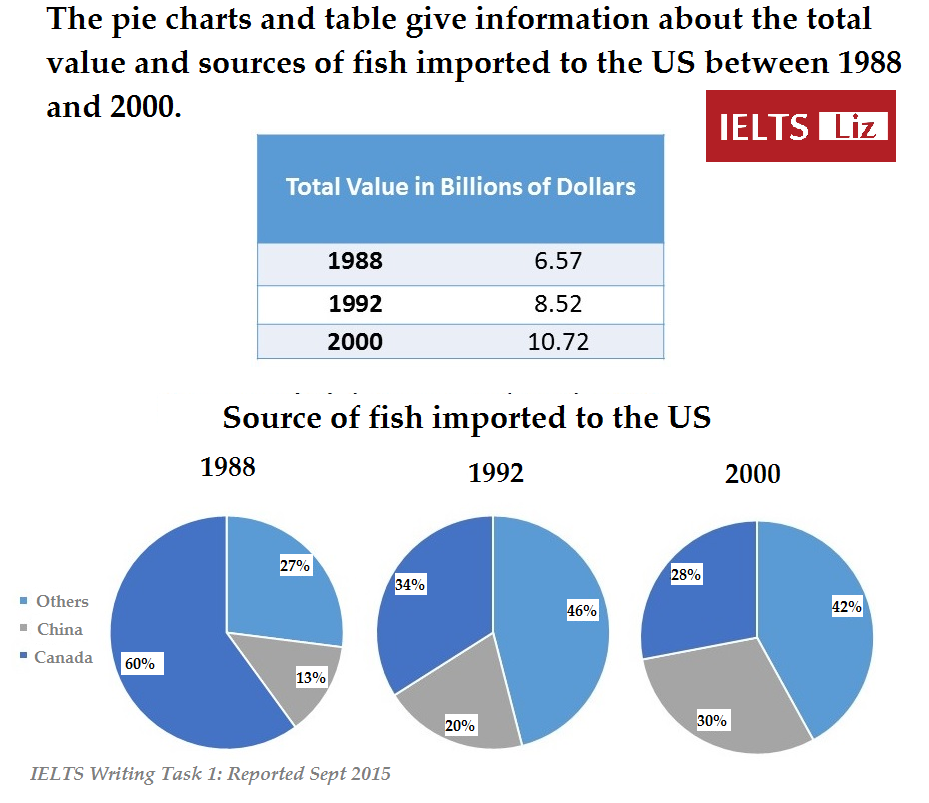
Below is an IELTS writing task 1 table and 3 pie charts reported last week on 19th Sept. I will post a model answer later this week. Follow the link to see a model of the task 1 below: table with 3 pie charts.

IELTS Writing Task 1 Table 3 Pie Charts 2015

Main IELTS Pages

Develop your IELTS skills with tips, lessons, free videos and more.
Get my free lessons by email

Subscribe for free to get my new IELTS lessons sent to your email inbox.

IELTS Speaking Part 1: Reported Topic of Snacks

Below are the IELTS speaking part 1 questions with some model answer for the topic of snacks currently being used in the speaking test. As with all topics in IELTS Speaking, they are recycled most years.

IELTS Speaking Part 1: Snacks Questions

The word snacks does not mean junk food. A snack is any food that is eaten between a meal. A snack might be something healthy, such as fruit, or it might be unhealth, like biscuits. So, this topic opens up various directions for you when you give your answer.

  • Do you like snacks?
  • How often do you eat snacks?
  • How do you choose what snacks to eat?
  • Did you ever eat snacks when you were a child?
  • If you had a child, would you allow your child to eat snacks?
  • What kinds of snacks are popular in your country?
  • Do you think snacks are healthy?
  • Do you think all snacks are junk food?
  • Do you think eating snacks is good for your health?
  • Have the types of snacks people eat changed over the last few decades in your country?

IELTS Speaking Part 1: Snacks Model Answers

There are two optional answers for each question. If you want to post your own answers, put them in the comments box below.

Q) Do you like snacks?

A) No, not really. I generally prefer to eat at meal times rather than graze between meals.

A) Yes, I do. Around mid morning I usually have some fruit and then about 3pm I have some biscuits or something like that.

Q) What kinds of snacks are popular in your country?

A) Well, I guess that most people eat junk food like crisps, chocolate and biscuits for their snacks.

A) I suppose official workers mainly eat junk food like biscuits but other people sometimes eat fruit or something healthier.

Q) Do you think eating snacks is good for your health?

A) I think that if you’re hungry, it’s perfectly fine to have some fruit but if people eat junk food between meals, then it’s really unhealthy.

A) I think all kind of snacking between main meals is bad for your health. If people avoided snacking, they would be much healthier and less over weight.

IELTS Speaking Part 1 Tips

  • You can’t ask the examiner to change the topic.
  • Even if you don’t like snacks, the examiner will continue to ask you questions about the topic.
  • Try to give examples of snacks.
  • Snacks are any type of food that is eaten between meals – they might be healthy or unhealthy depending on what the person chooses to eat.
  • Snack is both a noun and a verb.
  • Part 1 answers can’t be very long but you should at least try to give one long complex sentence in your answer.

IELTS Speaking Recommended Pages:

Speaking Part 1 Topics and Questions

IELTS Speaking Test Practice Video with Model Answers

IELTS Speaking Tips: How long should my answer be?

All IELTS Speaking Lessons, Tips, Model Answers & Free Videos

FREE SUBSCRIBE

Subscribe to get new lessons & tips by email.

,

error: Content is protected !!