Practice your Essay Writing with March Question

Hi guys,

Below is an IELTS essay question which was used this month, March 3rd, in writing task 2. The essay question below is one of a few questions that were used on March, 3rd. You can see other essay questions from March 3rd on my Recent Exam Questions page.

Post your essay by writing it in the comments box below. This is a chance for you to compare your essay with other students. This is not an offer of free marking – it is a chance for you to practise and compare. I’ll post a model answer tomorrow.

IELTS Essay Question March 2018

In many countries plastic shopping bags  are the main source of rubbish, causing pollution on land and in the water, so people think they should be banned. To what extent do you agree or disagree?

I will post a model answer tomorrow.

All the best

Liz
 

IELTS Diagram: Model Answer Band Score 9 with Tips

This IELTS diagram model answer is estimated at band score 9. It is possible to have a diagram in your IELTS writing task 1 academic paper. A diagram is also known as a process. The diagram shown below is from IELTS Cambridge Book 8, Test 3.

IELTS Diagrams

IELTS Diagrams come in two types:

Type 1: Diagram about a Cycle

This could be about a nature cycle or a life cycle.

Type 2: Diagram about a process

This could be a process of how to make something or how something works.

They both have the same techniques, the same layout, the same language, the same linking devices – everything is the same.

How to Tackle an IELTS Diagram

  1. Write an introduction from the description given. This is a short, factual introduction.
  2. The overview summarises the key stages of the diagram.
  3. The body paragraphs should be organised with stages in a logical order.
  4. Don’t miss any stages. You will be marked down for missing a stage.
  5. Paraphrase only when necessary and only when you know the word you plan to use is perfect. The biggest reason for vocabulary errors in IELTS writing is over-paraphrasing and poor paraphrasing. You don’t need to change all words.
  6. Using linking words to connect stages and to highlight the order that things happen.
  7. The instructions tell you to write over 150 words, but to get a high score, you should aim for about 170-190 words depending on the task given. If you write over 210 words you are likely to be marked down for getting lost in detail instead of focusing on key features.

IELTS Diagram Model Answer

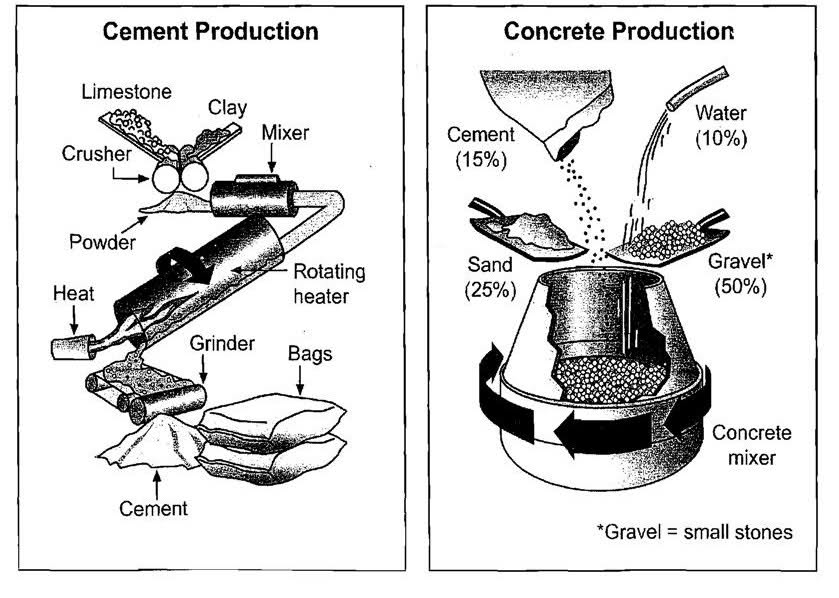
The diagram below shows the stages and equipment used in the cement-making process, and how cement is used to produce concrete for building purposes.

IELTS Diagram Process

  • Source: IELTS Cambridge English Test Book

Diagram Model Answer

The diagrams illustrate the steps and equipment involved in the production of cement and the way in which cement is then used to make concrete.

Overall, limestone and clay pass through four stages before being bagged ready for use as cement. Cement is then combined with three other materials to create concrete. While the process of making cement uses a number of tools, the production of concrete is simpler and requires only a concrete mixer.

In the first stage of making cement, limestone and clay are crushed together to form a powder using a crusher. This powder is then combined in a mixer before passing into a rotating heater which has constant heat applied at one end of the tube. The resulting mixture is ground in order to produce cement. The final product is afterwards put into bags ready to be used.

Regarding the second diagram, concrete consists of mainly gravel, which is small stones, and this makes up 50% of the ingredients. The other materials used are sand (25%), cement (15%) and water (10%). These are all poured into a concrete mixer which continually rotates to combine the materials and ultimately produces concrete.

Comments: This diagram gives a concise introduction. The overview contains key features of both diagrams and also highlights the connection between them. The body paragraphs are organised well and linking devices are used flexibly and accurately. Each body paragraphs explained the steps of each process in a logical order. Complex sentences are accurate and there is also passive voice used. Collocations are well used.

RECOMMENDED FOR YOU

……………………………………………………………………..

FREE SUBSCRIBE

Subscribe to get new lessons & tips by email.

.

How Nilay Scored IELTS 8.5 Overall

Nilay scored 8.5 Overall in the IELTS Academic test this month. Below are his tips for his great score in IELTS.

Nilay’s Scores: Overall 8.5

  • Listening: 9
  • Reading: 9
  • Writing: 8
  • Speaking: 8

Nilay’s Tips for IELTS 8.5

Nilay here. I am an orthopedic surgeon from India and currently trying to specialize in spine surgery. I appeared for the IELTS to register with the Canadian medical boards for which I needed minimum 7 in each of the four categories. This was the academic version.

To summarize the prep, I gave it around 12-14 days part time. I had been aware of your videos and thought to just concentrate on that during last 3 to 4 days and I attribute a large part of my writing score to your tips. I didn’t opt for paid tutorials but I feel that the content you generously provide is more than enough in most cases. Having said that, I was planning to get your paid tutorials if I couldn’t cross the required threshold of 7/9 in writing; I was reasonably certain I would cross 7 in RW and S. My tips are summarized here.
Reading Tips- As a compulsive reader, I was a bit overconfident when I started out the prep and expected to score a perfect 9 each time. My behind was handed back to me promptly by the No/Not Given dilemma. Your tips on that cleared out the webs and I highly recommend that video to polish the reading score. One thing I realized in the exam is that the reading paragraphs can be difficult and must not be underestimated even if you are good at reading to begin with. I consider myself a very fast reader and still had only 8-10 mins left at the end. I would advise underlining key words and phrases as it makes it easier to fish out the answers.  I wrote in all caps as advised.
Listening Tips – Tricky proposition. I feel that IELTS listening section doesn’t evaluate your listening capability but rather evaluates your presence of mind and multi-tasking ability to listen, note and paraphrase at the same time. I am very well versed with major accents and still made mistakes in answers due to missing plurals, not catching the exact words and sometimes missing paraphrases at the end of tests. I would really advise going through Cambridge practice tests to refine this. They are the real counterparts to the exam. I can’t stress enough on scanning the questions in advance, predicting answers and using the 30 seconds given to go over your last batch of answers to scan the questions ahead instead.  Presence of mind is really important or you would make a mess of it. Also, all caps again.
Speaking Tips –  Didn’t prepare much for it except for going through your tips and speaking to a local instructor I knew. I am fluent but I speak too fast and maybe that reflected on what I consider a lower score on my speaking test. Also, this is a live interaction test and your score will depend upon your rapport with and impression upon the examiner even if they are trained to disregard those factors. I more or less had  a friendly conversation and was asked questions about skilled and unskilled jobs in last part. I think the trick here is to fill up the time allotted and keep on speaking. I attribute the shavings in my score to speed and my roundabout answer to a bizarre question about soft and hard skills. I could have done better here.
Writing Tips – Last but not the least. I have BAD handwriting which live up to all the cliches about illegibility of doctors. This was a big issue for me with IELTS being a written exam. I realized that all my writing skills would be for naught if it looked like someone dipped ants in ink pot and let them loose on the paper. So I ditched the cursive, zoomed in the fonts and increased the space between words and made several people go through it till their satisfaction. I was confident about my vocabulary and grammar, so that helped but this exam is all about sticking to the format.  I can not stress enough how helpful your writing section videos are. I stuck to the outline stressed upon by you for both the tasks and I was rewarded. I made sure to follow the cite-support-example format for body paragraphs on task two; it really eased the though organization process. Task one is straightforward but it’s important not to get mired into details and just focus on major trends and data points. I didn’t have problem with time and word count. But even if you do, I really suggest taking 2 minutes to read the task and then a minute or so to jot down writing points on paper; paragraph wise. Also keep a minute or two at the end to go over your writing. Do not try to correct or improve large sections of a sentence but concentrate on spell check, grammatical gaffes and punctuation marks.
  To conclude [the format ,the format!], I am satisfied with my result and would thank you for your generous online help. I really stress upon test takers to go through your videos which I consider the best resource available online for this test. I hope my experience helps future test takers. Best of luck to you all!
Nilay 
Message to Nilay: Thanks so much for sharing your tips! I know students will be inspired by your results and also grateful for the experiences you have shared. Well done again with your excellent score 🙂

Essay Questions for February

Hi guys,

I have added the list of essay questions for February to my list on this page, click here: Jan & Feb Topics for IELTS WT2.

Please remember that I am still on holiday until May and won’t be answering questions.

Thanks

Liz

Dealing with Natural Disasters: Listen and Write

This lesson is about listening to a recording, taking notes and then reproducing the full written text. This is not an IELTS test practice. It is just a practice exercise to develop sharper listening skills and check your accuracy of written English. Many people preparing for IELTS say they don’t know if their grammar is accurate or not. This is one way to check.

In this lesson, you will check your ability to:

  1. listen for keywords such as nouns
  2. take notes at the same time as listening
  3. recreate what you hear in writing – produce a written script of what you hear
  4. check your grammar
  5. check your spelling
  6. check your punctuation

How to use this lesson:

  1. listen and make notes at the same time
    1.  write down all the nouns you hear. Nouns are always the most important words to write down when you want to reproduce what you hear on paper.
  2. listening again and add more nouns to your list – make sure you keep the order of nouns correct so that you can create the sentences afterwards. You will use those nouns to recreate the full script.
  3. if you need to listen a third time, do so
  4. using the nouns you have written down, try to write the whole script on your paper. Don’t listen at this point. Just look at the nouns on your paper and recreate the passage. You will need to add verbs, adjectives, adverbs, articles (a/the) and any other words to make your writing grammatically accurate.
  5. review what you have written and put in full stops, commas and capital letters.
  6. when you think your writing is accurate, listen one more time to see what  words you have missed.
  7. after those steps, when you are sure your writing is an accurate reproduction, check the answer.
    1. Check which words you are making mistakes with  – are they plurals, articles, verb agreement – which aspects of grammar do you make the most mistakes with
    2. check your spelling and punctuation

This is NOT an IELTS test. It is an opportunity to develop note taking skills at a high level and check the accuracy of your written language.

Listen and Write: The Best Way to Deal with Natural Disasters

.

Natural Disaster = tsunami, typhoon, earthquake etc

CLICK HERE: ANSWER TO THIS LESSON

IELTS Writing Task 1 – Step by Step Guide (Pie Charts)

This lesson takes you step by step through an IELTS Writing Task 1 sample answer. Learn in easy steps how to describe IELTS Pie Charts for writing task 1. Below are easy techniques to help you write each paragraph: introduction, overview, body paragraph 1 and body paragraph 2.

How to Tackle IELTS Writing Task 1

This lesson focuses on two pie charts. As you see, below, pie charts can have a lot of categories. Most people think the best way is to organise information by describing one pie chart at a time. However, this is not usually the most effective way to tackle them if you are aiming for band score 7 and above.

IELTS Pie Charts – Example Task

IELTS pie chart lesson

Source: The above pie charts were not created by IELTS Liz.

Describing Pie Charts Step by Step

Below you will find easy to follow advice on how to describe your IELTS pie chart paragraph by paragraph.

Introduction

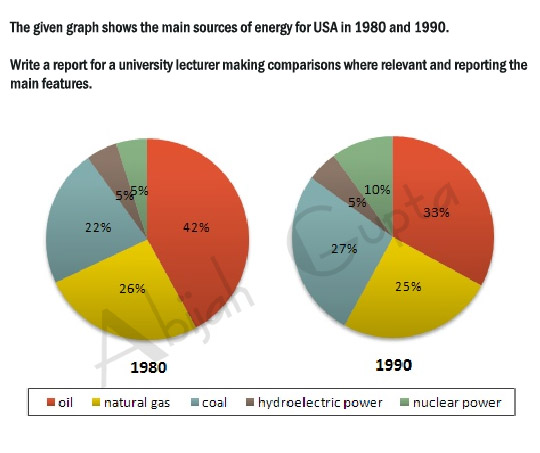
You must paraphrase the information given at the top of the charts “The graph shows the main sources of energy for the USA in 1980 and 1990”. You cannot copy this, you must use your own language and then add any extra information needed from the charts.

Tips

  • the graph = the pie chart
  • shows = illustrates
  • main sources of energy = energy production from different sources
  • for the USA = don’t change this
  • in 1980 and 1990 = in two different years (1980 and 1990)

Try writing your introduction before checking the model answer. To see model introduction, click here: Model Answer

The pie charts illustrate the changes in energy production from five different sources (oil, natural gas, coal, hydroelectric power and nuclear power) for the USA in two years (1980 and 1990).

Overview

The overview contains the key features of the charts. Answer the questions below to find the key features.

  1. What was the main source of energy in 1980?
  2. What was the main source of energy in 1990?
  3. Which produced the least energy in 1980?
  4. Which produced the least energy in 1990?
  5. Did the amount of energy produced by each source change a lot or just a little between the years?
  6. Did all types of energy increase by 1990?

Now write your overview before you check the model. To see model overview, click here: Model Answer

Overall, oil  constituted the main source of energy production in both years, while hydroelectric power  produced the least energy. There was a slight decrease in production from oil and natural gas, whereas an increase can be seen in the figures for coal and nuclear power.

Body Paragraph 1

This paragraph will give details about oil and hydroelectric power, which we highlighted in the overview above.

Tips

  • You will need to write one sentence about oil comparing the percentage each year and then one sentence about hydroelectric power comparing the years.
  • You must add data (percentages and dates) to support each sentence

Here are two example sentences. Fill in the gaps with the right words.

The amount of energy produced by oil in the USA 1. ………………. 42% in 1980 and this, then, 2. ………………….. to a third (33%) in 1990. The proportion of energy from hydroelectric power, 3………………, remained constant in both years ………a mere 5%.

For answers, click here: Answers

  1. accounted for / comprised of / made up / was
  2. fell / declined / dropped / went down / decreased
  3. on the other hand / by contrast / in contrast ( we use a linker to highlight that this is opposing information to the previous sentence)
  4. at

Body Paragraph 2

This paragraph will give detail about the other sources of energy in the pie charts.

Tips

  • which sources increased?
  • which sources decreased?
  • what were the percentages for each source?

Again, fill in the gaps in these model sentences.

The energy generated by natural gas, which was the second 1. …………… source of energy in the USA in 1980, fell 2. ………. 1% to a quarter of all energy produced in 1990. In contrast, production by coal 3. ……………… from 22% to 27% in 1990 4. …………….. there was a 5% rise in energy from nuclear power to reach 10% in the second year.

For answers, click here: Answers

  1.  largest / major
  2. by (this is used when writing about differences in amounts)
  3. increased / rose / went up / climbed / grew
  4. while / whereas

Recommended Lessons

FREE SUBSCRIBE

Subscribe to get new lessons & tips by email.

.

Answers to Reading Practice Caral City

Below are the answers to the reading practice lessons about the ancient city of Caral. If you have not completed this reading lesson, please finish it before looking at the questions below. Click here to complete the lesson: Reading Lesson Caral City

Questions: Are the following statements True False or Not Given based on the passage above?

  1. The city did not include housing for its citizens.
  2. As far as the eye could see, the landscape was arid.
  3. The largest pyramid is 60 feet in height in Caral.
  4. Caral had a bigger population than most cities at that time.
  5. Caral is thought to have provided a prototype for subsequent civilisations.

Answers

  1. FALSE
    1. The passage clearly states there were “residential areas”. This means areas for citizens to live = housing.
  2. FALSE
    1. It does not matter where the person is in the city to view the surroundings. The passage shows that the city was “overlooking” a “lush valley”. This means a green, fertile valley was visible from the city. Arid means “dry” so the passage shows the opposite.
  3. TRUE
    1. “six large pyramids (platform mounds) …. The largest of the mounds … is 60 feet high”
  4. NOT GIVEN
    1. There is no information in the passage that compares the population of Caral with other cities.
  5. TRUE
    1. “Researchers believe the model of the city was used by many civilizations that came after the Norte Chico.”.

I hope you found this reading lesson useful. For more reading lessons, click here: IELTS Reading Main Page

All the best

Liz

Reading Practice: Ancient City Caral

True False and Not Given reading practice for IELTS students based on a topic that was reported by students in their reading test in January 2018. To see all my reading lessons, click here: Main Reading Page. Other main pages are accessed through the red bar at the top of the website.

Passage: Pyramid City Caral

The Norte Chico civilization of Supe, Peru, was the first known civilisation of the Americas. Their capital was the Sacred City of Caral – a 5,000-year-old metropolis complete with complex agricultural practices, rich culture, and monumental architecture, including six large pyramidal structures, stone and earthen platform mounds, temples, amphitheatre,  sunken circular plazas, and residential areas.

Caral is situated on a dry desert terrace overlooking the lush valley of the Supe River. Exceptionally well-preserved, the site is impressive in terms of its design and the complexity of its architecture. The city’s plan and some of its features, including pyramidal structures and residences of the elite, show clear evidence of ceremonial functions, signifying a powerful religious ideology.

The centre of the Caral complex consists of a central public area with six large pyramids (platform mounds) arranged around a huge plaza. The largest of the mounds, located in a dominating position within the urban plan of Caral, is 60 feet high and measures 450 x 500 feet at the base, covering an area nearly the size of four football fields. From the top of the great pyramid, the rulers of Caral would have been able to monitor the entire city. In total, it is estimated that Caral was home to a population of about 3,000 people. Researchers believe the model of the city was used by many civilizations that came after the Norte Chico. In 2001, the Sacred City of Caral in Supe was inscribed on UNESCO’s World Heritage List.

Notice: This passage has been adapted from the website ancient-origins.net. You can read the full passage here: Pyramid City of Caral. The picture above is also from the same article.

Questions: Are the following statements True False or Not Given based on the passage above?

  1. The city did not include housing for its citizens.
  2. As far as the eye could see, the landscape was arid.
  3. The largest pyramid is 60 feet in height in Caral.
  4. Caral had a bigger population than most cities at that time.
  5. Caral is thought to have provided a prototype for subsequent civilisations.

Notice from Liz: I will be taking a break from posting lessons in Feb, Mar and Apr. I will post a notice when my holiday begins. Some pages will be kept open during my break.

Answers

The answers to this lesson are now available:

Click here for the answers: Answers to Caral Reading Lesson

All the best

Liz


error: Content is protected !!