Saying Umm Ahh in IELTS Speaking: Using Fillers

Should you use Umm and Ahh Fillers in your IELTS Speaking? This is a good question. Fillers play an important part in speaking and it is important to understand how the IELTS speaking examiner will mark such words. Do you think you will get a lower score if you use “umm” or “aahh” in your IELTS Speaking Test? Are fillers ok to use?

Are fillers good to use in IELTS Speaking

Yes, they are, but it depends on what you think a filler is. The problem is that umm and ahh are only sounds and do not represent language. Whereas real fillers, which are words, are great to use and don’t have a bad impact on your Fluency band score.

Fluency

Fluency is 25% of your marks for IELTS Speaking. There are a number of aspects relating to this marking criterion and one of them is the ability to speak without hesitation. It is about a natural flow of language. Umm and Ahh disrupt the flow of speaking and lower your score for Fluency.

What are good fillers in IELTS Speaking?

Fillers are words that we can use to fill gaps while we think. It means that we can continue speaking by filling in gaps. Here is an examples of a filler:

Q. Do you think men and women like the same kinds of holidays.

A. Well, to be honest, it isn’t something I’ve thought about before. Let me see… I guess men and women do like different kinds of holidays. I suppose that on the whole men prefer more active holidays etc etc…..

I have underlined the fillers. When you use fillers, it means you are still using words to fill in the space while you think of an answer. Your language does not stop, it doesn’t breakdown and your fluency continues strong. This is good for IELTS speaking.

How do umm and ahh affect your IELTS Speaking Score?

Umm and Ahh represent a breakdown in language. It shows the examiner that you are not able to continue speaking. Now let’s look at two possible answers to a question, which answer do you think shows the best English?

Q. How would you improve your home if you had the chance?

A. Ummmm, ahhhh, ummmm,  I supposed that ummm ahhh I think ummm ahhh well, I guess I would add a garden outside or a balcony for outside space.

A. Well, let me see…I haven’t actually considered improving my home before. I’m not exactly sure what I would do to be honest. But I guess, if I had to choose, I would add a garden or a balcony so that I had some outdoor space.

As you can see, the second answer contains lots of language. The examiner isn’t actually interested in your plans for your home. Your ideas are not marked in IELTS speaking. All the examiner wants is to hear your English language. You can also see that the second answer contains a bigger range of tenses, grammar features and vocabulary.

Native Speaking Umms and Ahh’s

It is true that it is natural to produce the “ummm” sound while we are thinking, and even native speakers will do so. Pauses in speaking are accepted in IELTS speaking if a) they are rare b) they are because you are thinking of an idea, not a word. Everyone has the odd pause when they think about an ideas – even native speakers. But these pauses are not language related, they are not frequent and they don’t interrupt fluency.

If you are using “ummm” because you are stuck for a word and need to think more about language, it will definitely lower your score. Any pauses which are language related will lower your score. So, learn to use fillers or ask the examiner to repeat the question so you have thinking time.

Asking to repeat the question

If you need thinking time in part 1, ask the examiner to repeat the question. You can do this a couple of times and it won’t affect your score.

In part 3, you can ask the examiner to repeat or explain the question (one is probably enough) and it won’t affect your score.

Prepare Ideas for Topics to Avoid Umm & Ahh

To help avoid ummms and aahhs, prepare ideas for more topics. The more prepared you are, the more you have to say. The more you have to say and the more you practise the questions, the fewer ummms and aahhhs you will produce. For topics and also tips about IELTS Speaking click here: IELTS Speaking Tips, Lessons etc.

I hope this was useful for you 😊

All the best

Liz

FREE SUBSCRIBE

Subscribe to get new lessons & tips by email.

.

New Online Store

Hi guys,

I have updates for you:

  1. I wanted to let you know that I will be releasing a new IELTS Grammar E-book in May this year. See chapters and sample pages below.
  2. I have set up a new online store that takes card payments for Advanced Lessons & E-books.
  3. ieltsliz.com will continue to be free for everyone and I will continue to post more lessons, tips and model answers this coming year 🙂

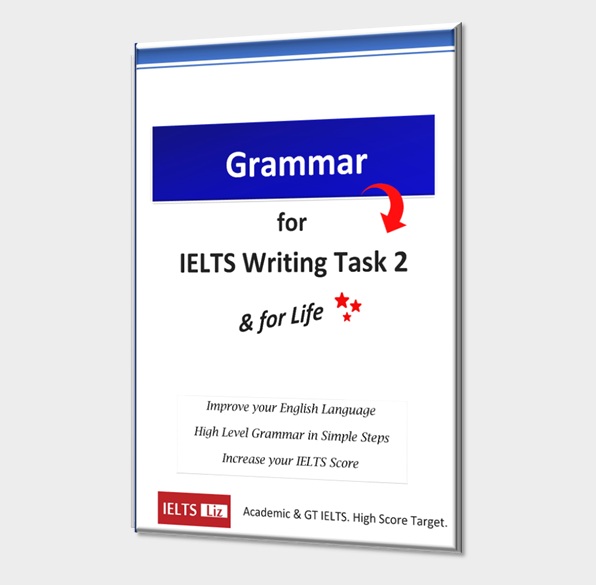
Grammar E-book Coming soon…

In May 2020, I will be releasing my Grammar for IELTS Writing Task 2 E-book. It will help you increase your grammar score for your essay as well as improve your overall level of English. It is one the best grammar books on the market. Below you will find preview sample pages:

Grammar E-book Information:

  • Over 200 pages
  • Target band 7, 8 & 9
  • High level grammar in easy steps
  • Simple explanations & illustrations for complex grammar
  • Understanding what grammar features will push your score higher
  • Linking words with sample sentences
  • Sentence structures to show range & flexibility
  • Hundreds of model sentences
  • Learn about common errors that lower your score
  • Advice & tips for IELTS writing task 2 – learn what the examiner wants
  • Workbook: Exercises to help you develop and test yourself

See a list of chapters and a few sample pages:

New Online Store

I’ve set up a new online store which can accept both bank card payments from major cards (visa, amex, mastercard) as well as paypal. This means people from all countries will be able to use my store. Paypal is still available for those who want to use it. I hope you all find this more useful. Click here to visit store: Liz’s Store.

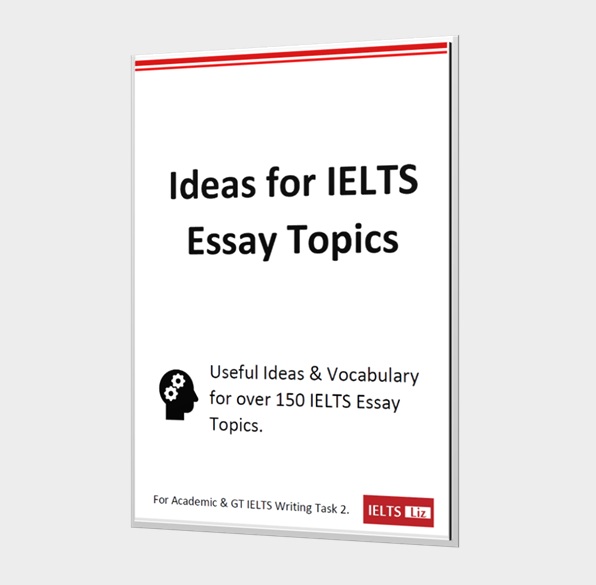
My store at present contains Advanced Lessons for Writing Task 2 and an Ideas for Topics E-book. My Advanced Lessons are professionally designed to help you push your score up to band 7 and above.

All the best

Liz

Water Sports: IELTS Speaking Part 2 Topic

The topic of Water Sports appears quite regularly in IELTS Speaking part 2. While the general topics of Sport can be answered easily by most candidates, Water Sports is a topic that can be very challenging.

It is important in Speaking Part 2 that you use your 2 mins to your advantage. It is a time for you to plan what language to showcase and to demonstrate fluency by being able to speak at length without effort.

Part 2 Cue Card: Water Sport

Describe a water sport you would like to try. You should say:

  • what the sport is
  • when and where you would do it
  • what preparation and equipment you would need

Model Answer & Tips

Below I have given a link to a model answer and tips from highly experienced and qualified IELTS teacher (an ex-examiner) called Keith O’Hare. You will also find lots more tips, model answers and videos on his site – enjoy!!

Click here: Model Answer by Keith O’Hare

Also remember:

You do not need to cover all prompts. That is not your aim because task achievement is not a marking criterion for IELTS speaking. Your aim is to showcase language in a natural way.

Also remember that “equipment” is uncountable = no “s” (it can’t be plural).

Subscribe for Free to get New Posts by Email

Useful Links for IELTS Essays

Hi guys,

I’ve put together a list of some useful pages on my website to help you with your writing task 2 essays. Click below:

Writing Answer Sheet: Learn how to use the official IELTS answer sheet in a useful video lesson and download it for practice at home.

Paragraphing: Tips on how many paragraphs your essay should have. You will be marked on the use of paragraphs. Make sure they are logical. Also remember the body paragraphs should be equal in length for writing task 2.

Finding Ideas for Essays: How to find your own ideas or get them in a convenient e-book. It also provides a useful link for essay planning tips.

When to give your opinion: If you fail to give your opinion when it is asked for, you will get a low score. Learn about different instructions.

Linking Words: Get a useful list of linking words for your essay. They are easy to learn and easy to get right, but so many people lose marks because they don’t pay attention.

Quotes, Idioms & Proverbs: Learn whether it is a good ideas to use them in your essay or not.

100 Essay Questions: Use these questions to practise writing at home. You will soon see the full range of topics that IELTS like to use.

Advanced Essay Lessons: If you need help pushing your score higher or you don’t understand why you are not getting the right score, learn the best techniques in easy steps with my Advanced Lessons for Essays. Visit my Store to get them.

All the best

Liz


Subscribe for free to get new posts by email

Linking Words for IELTS Writing Task 2

The linking words list below is essential for IELTS writing task 2 for high score. The examiner needs to see a range of linking words in your essay to award you a high score for the criterion of Coherence and Cohesion which is 25% of your marks. You will be checked on your range, accuracy and your flexibility of linking words in IELTS writing task 2. These connecting words are suitable for all types of essay writing as well as GT IELTS writing task 2
IELTS Writing Linking Words

Listing

These words are often used to either put your paragraphs in order or used inside the paragraph to highlight and organise your supporting points. However, using “Firstly” and “Secondly” to start each body paragraph is considered “mechanical” which means it is like a machine and this isn’t good for people aiming for band 7 and above. So, being flexible using a combination of linking words is better.

  • firstly
  • secondly
  • another point to consider
  • a further consideration
  • another issue
  • lastly /last but not least / finally

Adding Information

You will need to support your main points in your IELTS essay. These linkers inform the reader that extra information is about to be presented.

  • in addition
  • additionally
  • furthermore
  • moreover
  • also
  • not only … but also
  • as well as
  • and

Giving Examples

It is often useful to give examples to support your ideas in IELTS writing task 2. Make sure you use this range of linking words to do so.

  • for example
  • one clear example is
  • for instance
  • such as
  • namely
  • to illustrate
  • in other words

To learn how to put examples in sentences for essay writing, please follow this link: How to Add Examples to Essays.

Results and Consequences

These linking devices can be used for solution essays or any essay when you need to explain the consequences of something.

  • as a result
  • consequently
  • therefore
  • thus
  • hence
  • so
  • for this reason

Highlighting and Stressing

It is important to be clear about what you mean in your essay. These linking words help you stress particular points.

  • particularly
  • in particular
  • specifically
  • especially
  • obviously
  • of course
  • clearly

Concessions and Contrasts

You often need to give opposite ideas, particularly for discussion essays so the linking words below will help you show the reader when you want to introduce an opposite point. Also you might want to give exceptions to a rule for a concession.

  • admittedly
  • however
  • nevertheless
  • even though
  • although
  • but
  • despite
  • in spite of
  • still
  • on the other hand
  • by contrast
  • in comparison
  • alternatively
  • another option could be

Reasons and Causes

These connecting words will help you explain reasons and causes for something which is very common in IELTS writing task 2, especially for cause / solution essays.

  • because
  • owing to
  • due to
  • since
  • as

Giving your Opinion

  • in my opinion
  • I think
  • I believe
  • I admit
  • in my view
  • I concur / agree
  • I disagree / I cannot accept

Don’t make a mistake with the way you express your opinion. Watch this video for useful tips on giving your opinion and how to avoid mistakes: IELTS ESSAY: WHEN & HOW to give your opinion

.

Linking Words for Conclusion

Which is the best?

In a nutshell,

To sum up,

To conclude, 

In conclusion,

Rounding off,

Practice with Linking Words

Improve your use of linking words by fill in the gaps below with linking words from the above list.

  • .(1) …………………….. of the popularity of Facebook, there has been a rise in online crime, (2) ………….. fraud and identify theft. 
  • There are a number of drawbacks to people using Facebook as a way of communicating (3)………………… it is (4)…………….. one of the most common social networking platforms for both individuals and businesses.
  • (5)……………………….. the lack of exercise taken by average people, obesity and other weight related problems are on the rise.
  • Unemployment and poverty, (6) ………….. in urban areas, is often deemed to be the cause of the rising crime rate.
  • (7) …………… the rise in urban crime, more and more people continue to relocate to cities looking for a better life.
  • More children are becoming obese and (8)…………….. schools should be encouraged to provide more sports lessons and outdoor activities.

ANSWERS

Click below to reveal the answers:

Answers
  1. Regardless
    • You cannot have despite because the preposition of in the sentence prevents this being used.
  2. such as / for instance / namely
    • like is not possible because it is not suitable for formal writing in IELTS.
  3. even though
  4. admittedly
  5. Due to / Owing to
    • ( you can’t have “because of” because it is at the beginning of a sentence. Never use but or because at the start of a sentence in formal IELTS writing.)
  6. particularly / especially / specifically
  7. despite
    • If you wanted to use the word “although”, you would have to change the sentence structure:
    • Although the urban crime rate is rising, more and more people are continuing to relocate to cities looking for a better life.
  8. therefore / so / for this reason

.

RECOMMENDED FOR YOU:

FREE SUBSCRIBE

Subscribe to get new lessons & tips by email.

.

Capital Letters in IELTS: Will it affect your score?

When to use capital letters in your IELTS Listening, Reading and Writing test. Will you get a lower score if you make a mistake with capital letters? Can you write your answers in all capital letters? What are the rules for capital letters in IELTS? What about using capital letters in the computer based IELTS test? Read below to learn about this.

Using Capital Letters for IELTS Answers: Rules & Advice

Below you will find advice for using capital letters for writing your answers in IELTS Listening, Reading and Writing.

Capital Letters in IELTS Listening and Reading

In IELTS listening and reading, you can write all your answers in capital letters if you want. You can do this for the paper based test and the computer based test. It is completely up to you. There is no rule stating whether you should use capital or lower case.

  • You can write your answers in small letters if you want.
  • You can write in all capital letters.

Examples of capital letters in listening and reading:

  • HOSPITAL = correct / hospital = correct / 9am = correct / 9AM = correct 

Which is best? Capital letters or lower case?

I recommend writing your listening and reading answers in capital letters for the paper based test. This avoids any problems of markers struggling to read your handwriting. For the computer based test, it doesn’t matter. Both lower case and upper case will be easy to read. 

Transferring Answers in Listening & Reading

In IELTS listening, you will be given 10 mins extra to transfer your answers to your answer sheet in the paper based test. Check your answers and check your spelling – then write your answers on the answer sheet.  If your handwriting is poor, write using all capital letters so it is easy to read. For the computer based test, you do not need to transfer answers. You only need to check what you have already put into the computer. For this reason, you will be given only 2 mins to check your answers after the recording ends.

In IELTS reading, you will not get 10 extra mins to transfer your answers. You must write your answers directly on your answer sheet. But it is completely your choice how to write your answers. The most important factor is clear writing for the paper based test. Use all capital letters if your handwriting isn’t clear.

Capital Letters in IELTS Writing

In IELTS Writing, you can choose to write your essay in capital letters. But I would not recommend it because:

  1. you WILL be marked on punctuation so the use of capital letters and lower case is important to show. You must have a capital letter at the start of a sentence, for example.
  2. you have a strict time limit and it takes too long to write in capital letters

So, write your essay in lower case and remember to use capital letters when grammatically appropriate. The examiner will mark you down if you use capital letters incorrectly. Here is a list of typical words that use capital letters:

When to use capital letters in English grammar

  • Days/ Months = Thursday / September
  • Names and Titles = Mrs J Blogs / Dr Author Jones
  • Countries / Cities = India / Vietnam / Paris / Hong Kong
  • Names of Places = University of London
  • Acronyms = BBC (British Broadcasting Corporation)
  • Start of a Sentence = “The majority of people use cars to go to work these days. However, it would be better if they used healthier means of transport such as the bicycle.”

Biggest Mistake with Capital Letters

  • but / because / and
    • These linking words should NEVER be used to start a sentence in formal writing. See my page of linking words for writing task 2 to learn tips and get a useful list: IELTS Writing Task 2 Linking Words

What about speaking part 2? Well, the notes you make for your talk are not marked and only you see them. The examiner will not check them or mark them. So, don’t write sentences or bother with punctuation, just write words, ideas and tips to help you present a good talk.

More IELTS Tips

What about using a pen or pencil? Click on this link: IELTS Pen or Pencil

How are words counted in IELTS Listening? Click on this link: How Words are Counted in IELTS

Can I use “I” or “my” in writing task 2? Click on this link: How to express your opinion in IELTS WT2

Tips & Practice for Listening, Reading, Writing and Speaking:

……………..

Free Subscribe to get New Posts by Email

IELTS Test Tips & Advice On the day

Below are some tips for the day of your IELTS exam. This tips are to guide you before your IELTS test and also during your test. These tips are for both GT and Academic tests. 

On this page, you will find:

  1. Last Minute Listening Tips
  2. Last Minute Reading Tips
  3. Last Minute Writing Tips
  4. Last Minute Speaking Tips
  5. “On the day” – tips for your test day

It is important that everyone reads this page before the test day and also on the morning of the test day. 

IELTS Test Tips: Last Minute Before Your Test

The following IELTS test tips for each part of the IELTS exam will help you focus on the right things during your test. Don’t lose marks by not being prepared.

1) IELTS Listening Exam Tips

  1.  Make sure your headphones are working. Raise your hand if you have a problem.
  2. If loud speakers are used instead of headphones, make sure you can hear the recording. If you need the volume increasing, raise your hand immediately and someone will come to ask what the problem is. Explain that you need the volume increasing.
  3. Use the time given to prepare the questions. Always read through all questions before the recording starts and note keywords. Thet keywords will help you keep track of the information and listen for answers.
  4. Answers to questions come in order (question 1 and then question 2 etc)
  5. Underline keywords in the questions. You should practice speed reading questions and spotting keywords at home as part of your preparation. For the computer test, you can highlight words on the screen.
  6. Focus on listening for answers rather than trying to understand everything. You win a point for each question you answer correctly.
  7. Write your answers on your question paper while you listen. For the computer test, you put the answers directly into the computer – through clicking, dragging or typing.
  8. Pay attention to how many words and/or a number or numbers you can have for each answer. Many people forget to check this. For example, “15 workmen” is one word and one number, “driving test” is two words.
  9. You will be given 10 mins after the recording has ended to transfer your answers to the answer sheet for the paper based test. For the computer test, you’ll only get 2 minutes to check your answers. Always check your spelling – any spelling errors and the answer will be marked wrong.
  10. It is recommended to use ALL CAPITAL LETTERS FOR YOUR ANSWERS for the paper based test to avoid problems with handwriting. This is not an issue with the computer test.
  11. For 25 essential tips for listening, watch this video: IELTS Listening Essential Tips 

2) IELTS Reading Exam Tips

  1. Read the instructions carefully and make a note of how many words you can use for your answer. Each word is counted, for example “university reception hall” is three words and “workbook” is one word.
  2. Each answer is worth one point so don’t waste too much time finding one particular answer when you could spend the same amount of time finding two easier answers. You decide when to move on to the next question.
  3. Keep your eye on the clock. Make sure you have enough time for the final passage.
  4. You can tackle the passages in any order you want. This is the same for the questions – you can skip questions and come back to them later if you want.
  5. Write your answers directly on to your answer sheet for the paper based test. There is no extra time for transferring later. For the computer test, your answers will be put directly into the computer.
  6. Always spend time analysing the questions before looking for an answer. If you don’t analyse the question enough, you’ll end up jumping from question to passage so many times, getting confused, which wastes valuable time.
  7. Look out for paraphrasing. Find the keywords in the question and pay attention to paraphrases in the passage.
  8. Your aim is to find answers – not to understand the whole passage. Focus on your goal – find as many answers as you can.
  9. It is recommended to use ALL CAPITAL LETTERS FOR YOUR ANSWERS for the paper test to avoid problems with handwriting. This isn’t an issue with the compute test.
  10. Spelling is essential to get right or the answer will be marked wrong.

3) IELTS Writing Exam Tips

Click on red links to access more pages:

  1. Don’t spend more than 20 mins on task 1. Keep checking the time so you don’t make this mistake. You need 40 mins for task 2 as this task carries more marks and requires more words.
  2. Always write over 150 words for task 1 and over 250 words for task 2. See this lesson about the recommended word count.
  3. Don’t count the number of words you have written. You won’t need to total up the words and you won’t need to mention them at the end of your essay. If you are concerned about word count, just quickly count the lines and multiple by the usual words you see on a line with your writing. See this lesson to learn about using the official IELTS writing answer sheet properly. For the computer test, there is the advantage of seeing how many words you have written appear on the screen.
  4. You can plan your essay on the question paper. No extra paper is given for planning. The examiner will not look at your planning, only at your essay. Planning is essential because the examiner will be marking the structure, organisation etc, not just your language. For a quick overview of the writing task 2 marking criteria, click here: Band Scores & Tips for Writing Task 2
  5. Always write a clear overview for task 1 academic. See here about the conclusion/overview issue. The overview must contain all key features collected into one paragraph. It is the most important paragraph of your task 1 report.
  6. For GT writing task 1, cover all bullet points given and follow the order they are presented. Use them as guidelines for your body paragraphs. 
  7. Always write your conclusion for task 2. Never miss it out. If you only have 3 mins left, use it to write your conclusion. See this video: Using the last 5 minutes
  8. Always organise your writing for both tasks into body paragraphs. Paragraphing will be marked. Body paragraphs should be of equal length.
  9. Check your spelling. You can use either American or British spelling but don’t mix them.
  10. Keep all information focused and relevant. More does not mean better. Quality, not quality.
  11. If you run out of paper, put up your hand and you can get more. Do not remove any paper from the exam room.

4) IELTS Speaking Exam Tips

  1. Practice speaking English before your test. Practice expressing your opinions on different topics and talking about your past experiences.
  2. This is an informal interview/chat with an examiner. So be friendly and open. Also explain what you mean in your answers, particularly in part 3.
  3. Be chatty. Show the examiner you are willing to chat.
  4. Listen to the question and answer it directly. Be direct. This applies for part 1 and part 3. For part 2, you will have a chance to prepare your answer.
  5. Add more information (details, examples, description) to all answers.
  6. Keep talking until the examiner stops you. Let the examiner guide you with time.
  7. Don’t ever be silent. There is never a reason for your English to completely stop working.
  8. Don’t focus only on vocabulary. Vocabulary is only 25% of your marks. However, do make sure you use relevant topic based vocabulary. For example, if your topic is Happiness” then you should use words such as “smile, laugh, giggle, contentment, joyful, fulfilment” as well as antonyms (opposites) such as “sad, depressed, feeling low or feeling down”.
  9. Idioms are not the key to a high score. Most candidates overuse idioms that are too common or outdated. The examiner will note if you use idiomatic language but that doesn’t necessarily mean idioms. Instead use phrasal verbs – calm down, bring up, work out, get over etc. Phrasal verbs are the best types of idiomatic language to use in IELTS.
  10. The questions are not aimed to test your knowledge. Each question is just a chance to show your English. So use each question to your advantage.
  11. You can wear anything you want. This is not a job interview. Clothing does not affect your score. Aim to be comfortable. And be relaxed with your body language – this is informal.
  12. Use a range of grammar tenses in your test. Even if the question is in the present tense, you can add extra information comparing with the past to show flexibility with tenses.
  13. American or British English pronunciation can be used. A mixed accent is also fine. The key is to make sure your words are easy to understand.
  14. Ask the examiner to repeat the question if you need it. See this lesson about asking the examiner questions.
  15. If the examiner interrupts you, don’t worry about it. It’s a normal part of the speaking test. Just focus on the next question.
  16. The examiner will provide a pen and paper to prepare your talk for part 2. The examiner will not look at your plans and will only mark your talk. It is fine to look at your notes and at the cue card during your talk, but also try to make eye contact.
  17. May people are worried they won’t understand the cue card. Don’t be. The cue card is always written in simple English and topics are common topics. Review Misunderstanding the Cue Card page if you are concerned.

5) On the Day IELTS Exam Tips:

Be prepared for your IELTS exam by making sure you know exactly what will happen in the day of your test. Some of these tips will depends on whether you are taking your test at home or not. But read them all anyway. 

  1. Sleep & Eat Well
    • The IELTS test is long. It takes 2 hours and 40 mins to do the listening, reading and writing test. There is no break between the tests. Make sure you are well rested and have eaten in order to keep your concentration during your test.
  2. Clothes
    • Wear comfortable clothing. You are not marked on your appearance for any part of the test, including the speaking test. So, wear something that you are comfortable in and that gives you confidence.
    • The test room might be cold if the aircon is on, so take an extra layer of clothing with you. Or if you are worried it might get hot, wear layers that you can take off.
  3. Drink
    • You can take a drink into the exam room as long as it is in a transparent bottle.
  4. Arrive Early.
    • Make sure you know how long it takes to get to your IELTS test center and exactly where your test will be held. Don’t be late or you won’t be allowed to enter the exam room. You will need to check in so make sure you arrive with plenty of time to spare.
  5. Toilet
    • The listening, reading and writing tests take 2 hours and 40 mins. There is no break, so make sure you go to the toilet before you enter the exam room. If you need the toilet during the test, put your hand up and the invigilator will let you go. But you will lose valuable time by doing this and it could affect your score.
  6. No Phones
    • You will not be allowed to take your phone or any other electronic items into the test room.
  7. Pen, Pencil & Eraser
    •  You should take at least two pencils and one pen – just in case one of them stops working. You should also take an eraser as well. You can’t take a dictionary or extra paper into the test room. For your speaking test, you can take nothing into the room except your ID.
  8. ID
    • Check with your test center exactly what ID you need to take with you. Don’t forget it. The ID you take with you should match the details on your registration form.
  9. Listen to Instructions
    • Listen carefully to all instructions given before your test starts.
  10. Clock
    • There will be a clock on the exam room. You cannot take a watch into your test. Make sure you know where the clock is before your test starts so you can keep checking it in your reading and writing test. If you are taking the computer test, you’ll find a clock at the top of the screen.
  11. Disability
    • If you have any form is disability that will affect your test, you must speak to the test center well before your test date.
  12. Focus & Be Calm
    • Make sure you go into your test with a clear aim and an understanding of the techniques you need to use. Be calm and confident at all time.

Don’t 

  • Don’t cheat
    • This is an international test and cheating or copying is not allowed.
  • No dictionary
    • You are not allowed to use any form of learning aid in your test.
  • Don’t take the test paper home
    • You are not allowed to take any part of the question paper home with you.
  • Don’t continue writing after the invigilator tells you to stop. If you continue writing even one word or one sentence, you could have your whole test invalidated. In the computer based test, you won’t have the chance to continue writing as the screen with shut down at the precise time the test finishes.

The exam tips above contain tips from the official IELTS sites as well as my own from two decades of experience. I hope you find them useful.

IELTS.org test tips on the day

BC test tips

IDP Test Tips

Always check with official sources in case of any changes in rules.

IELTS Speaking: Should I correct myself or keep speaking?

IELTS Speaking test – it is good to correct yourself or should you keep talking? It is common that people might make mistakes with vocabulary and grammar during the IELTS speaking test. But what should you do if you make mistakes? Should you ignore your speaking mistakes or correct yourself?

Should you correct your mistakes in IELTS speaking?

The answer is NO. You should not stop to correct an error.

Why? Read below to have a full understanding why. IELTS Speaking success really does depend on understanding more about how the test is marked and how to maximise your score.

Minor Grammar and Vocabulary Errors

You should definitely ignore these errors. You won’t get extra points for correcting your mistake. You will only show the examiner that you struggle with fluency and need to keep stopping to correct your English. This shows a weakness of English. It is best to keep talking and get a strong score on fluency.

If you make a mistake in the past tense, for example, it doesn’t matter because there will be lots of opportunities for you to show the examiner your past tense ability in English. The examiner is looking at your overall English, not a single sentence or word. So, if you make a mistake, ignore it and keep talking to retain a strong fluency score.

Mistakes in Meaning

If you have made a mistake in the meaning of what you have said, then it is fine to correct yourself. This type of mistake is not a language mistake but an accident that you gave the wrong meaning. IELTS allows for this type of correction.

But you should not repeat word for word what you have just said – you need to re-phrase and continue to show flexibility in English. Below are examples:

Example Answer 1: I really think that people should force their children to do homework because it puts too much pressure on them. Sorry, I mean – I really think that people should not force their children to do homework because it puts too much pressure on them”.

This is not a good self-correction regarding your meaning. It would lower your score because it is a full repetition and breaks fluency.

Example Answer 2: I really think that people should force their children to do homework because it puts too much pressure on them. Sorry, I mean – they should not force them because it could cause mental health problems for the child like chronic stress.

This is the right way to correct a mistake based on meaning. You are paraphrasing and useful different language as well as altering the meaning to be precise. Native speakers do this and it’s fine in IELTS. Your fluency is still strong.

Using Words from Your Own Language in IELTS Speaking

It is best to avoid using words that are not English in an English language test. You are being marked on your ability to communicate in English and you should remember that at all times.

However, sometimes words from your own language sometime pop into the answer without you thinking. Particularly when you are referring to something that is unique to your own language such as sari, guzheng or bibimbap. In such cases, it is best to immediately explain the meaning of the word (paraphrase it in English) in a natural way. Below are examples of how you can do that.

Question: Do people ever wear traditional clothes in your country?

Answer: Yes, they do. Many women in India still enjoy wearing a sari, particularly at weddings. A sari is a long piece of fabric, often silk, which is wrapped around the body and then draped over the shoulder. It’s very flattering to wear. 

Question: Did you ever play a musical instrument as a child?

Answer: Yes, I did. When I was young, I had lessons on the guzheng which is a large stringed instrument made of wood. The sound it produces is rather mystical and reminds me of misty mountains. I stopped playing when I left school.

Question: What is your favourite food?

Answer: Without doubt, bibimbap. It’s a rice dish with a variety of vegetables, such as carrot, cabbage, courgette and many more,  served in a hot stone bowl with chilli paste. It’s a really popular food here in South Korea.

As you can see from the example answer above. The paraphrased explanation of the word adds really high band score vocabulary to your answer. Also when you use “x, which is …”, you are also adding a clause and that will help your grammar score. So, never miss the opportunity to immediately explain any word you accidentally say in your own language. Although the rule really ought to be to avoid doing so in the first place.

RECOMMENDED FOR YOU

—————–

FREE SUBSCRIBE

Subscribe to get new lessons & tips by email.

.

error: Content is protected !!