Positive or Negative Development: IELTS Model Essay

An IELTS model essay for positive or negative development questions. It is common in IELTS writing task 2 to be asked to choose either something is a positive or negative development/trend. Your task is to answer the question in the introduction and explain your answer in the body paragraphs.

These instructions are asking for your opinion so it is important that you give it clearly. If you fail to present a position of your own (a view point), you will have failed to complete the task and that will affect your score.

IELTS Positive Negative Essay Question

Nowadays, more people are choosing to socialise online rather than face to face. Is this a positive or negative development?

IELTS Model Essay: Positive or Negative Development?

An increasing number of people meet and talk to their friends online instead of in person. In my opinion, this is a negative development which can lead to isolation, potentially harmful situations and also problems later on in life.

One serious problem that can arise from people socialising online is that it can lead to isolation. Before the internet, people would frequently go out to meet friends, for example in cafes, bars or restaurants, whereas now people prefer to stay at home alone, chatting online. As a result, people are starting to spend the majority of their time alone at home in their room without meeting others. Isolation of this kind is not healthy and can sometimes lead to depression and other issues.

Another issue is that meeting people online can be risky. In other words, people can assume fake identities online as well as hide their true characteristics. This is particularly concerning for teenagers who are impressionable and can easily be led into dangerous situations. Furthermore, as this interaction is online, parents have no way of monitoring it and protecting their children.

Finally, socialising online can end in difficulties years later as conversations and shared photos that had been forgotten reappear. This situation is currently critical for many people, again especially for teenagers who do not think carefully before posting online. That is to say, information which is put online can remain there forever and while people may share intimate communications with close friends, these words can then resurface later on leading to much embarrassment.

In conclusion, although it has become more popular for people to socialise through the internet, it has brought about too many problems for this to be considered a positive trend.

Examiner’s Comments: This essay provides a clear answer to the essay question. The position is clearly presented in the introduction and also explained and supported throughout the essay. Linking devices are well used and ideas are organised logically. Language is flexible and accurate. This would reach band 9. (Word count = 286)

More IELTS Model Essays:

FREE SUBSCRIBE

Subscribe to get new lessons & tips by email.

.

IELTS Essay Questions Jan & Feb 2019

Below is a list of IELTS essay questions reported 2019 (Jan & Feb). These essay questions are not prediction. They are essay questions that IELTS candidates reported in their tests. Topics are often repeated with essay questions reworded and with a different focus.

You should use these essay questions to prepare ideas for topics. Your aim is NOT to memorise an essay. You cannot use memorised sentences or paragraphs in your essay.

IELTS Essay Questions Jan & Feb 2019

  1. People sleep less than before in many countries. Why do people sleep less? What effect does it have on an individually and  on society?
  2. Some people think that government is wasting money on the arts, and that this money could be spent elsewhere. To what extent do you agree with this view?
  3. Many people try to look younger than their age. What are the reasons people do this. Do you think this is a good thing or a bad thing?
  4. Some countries spend a lot of money to make bicycle usage easier. Why is this? Is this the best solution to traffic congestion?
  5. Plastic shopping bags contribute to the pollution of land and sea. Some people think they should be banned. Do you agree or disagree?
  6. Some people think that watching sport is a waste of leisure time. Do you agree or disagree?
  7. If a product is sold and people buy it, then advertising is not necessary and can be considered a kind of entertainment. Do you agree or disagree with this?
  8. Economic growth is the only way to end world poverty. However, some people says it leads to environment damage and should be stopped. To what extent do you agree?
  9. Eating too much sugar is harmful for our health. Some people think that it is government responsibility to limit people’s sugar consumption, while others think that it is an individual’s responsibility to limit the amount of sugar they eat. Discuss both views and give your opinion.
  10. Nowadays, many people spend less and less time at home.
    What are the causes of this? What are the effects of this on individuals and on society.
  11. Some people believe that children should be given lessons on how to manage money in the school. Do you agree or disagree?
  12. Some people think that a good diet and exercise are not necessary for a health and long life. To what extent do you agree or disagree?
  13. Some people say that schools do not do enough to teach young people about health. Do you agree or disagree?

  14. Some people believe that in order for a hobby to be enjoyable, it needs to be difficult in some way. Do you agree or disagree?
  15. Some people say that holding sport competitions can cause problems for the host country. Others disagree. Discuss both views and give your opinion.
  16. Some people think that public libraries are no longer important, while others disagree. Discuss both views and give your opinion.
  17. The government should make people take responsibility for their actions to the environment. To what extent do you agree?
  18. Some people think watching movies is a waste of time. Do you agree or disagree?
  19. Recently, it is common for people not to know their neighbours. What is the cause of this problem?  What can be done to solve this problem?
  20. Some people believe that the museums and historic sites should be open for free for children under 18. Do you agree or disagree?
  21. Some parents think that advertisements are misleading for children, while advertisers claim that they provide knowledge. Give your opinion.
  22. Films and games can be accessed at any time from mobile devices, like smartphones, tablets and laptop computers. Do the advantages of such developments outweigh the disadvantages?
  23. The gap between rich and poor is increasing. What problems does it cause? What solutions can you suggest?
  24. Some people prefer to buy local products, while others prefer international products. What is your opinion of this?
  25. Many people are choosing to find information online rather than in books. Is this development positive or negative?
  26. Some people say that children given pocket money every week will have fewer money problems when they become adults. Do you agree or disagree?
  27. Some people say that family is the most powerful influence in a child’s development. Other’s say that other factors such as ( television friends music etc. ) play a greater role today. Discuss both views and give your opinion
  28. Most people prefer ready to eat ready meals rather than homemade food these days. What are the advantages and disadvantages of this?
  29. For many people, the reason they work hard is to earn money. To what extent do you agree or disagree?
  30. Many people believe that advertising can have negative effects on customers. To what extent do you agree or disagree?
  31. Some young people are leaving the countryside to live in cities and towns, leaving only old people in countryside? What problems does this cause? What can be done to solve this problem?
  32. Some people think high-end technology can prevent and cut down the rate of committing crime. Do you agree or disagree?
  33. People should be responsible for the pollution problems caused by transportation, while others think the government should be held accountable. Discuss both views and give your own opinion.
  34. People doing different jobs enjoy different amount of holiday time. Should people have the same amount of holiday time? Give your opinion.
  35. Some people say students of different age groups in school should be put in same class.What is your opinion?
  36. Some people feel that teacher training courses can make anyone a teacher, while others feel an excellent teacher cannot be made by pursuing a course. Discuss both views and give your opinion.
  37. Money should be spent on creating new public buildings, such as museums and town halls, rather than renovating existing ones. To what extend do you agree or disagree?
  38. Some people think the money spent in developing technology for space exploration is not justified. There are more beneficial ways to spend this money. To what extend do yo agree or disagree?
  39. Some people think that the best way to learn is from a newspaper. Others think that the best way to learn is through media.
    Discuss each views and your opinion.
  40. Some people said that with the help of parenting and child development courses parents can improve the life of children.
    To what extent do you agree or disagree?
  41. Today people are living longer so they should have to work longer. Do you agree or disagree?
  42. Many people think that we have to focus on the extinction of certain animal species, while others think that we should pay attention to the problem of human beings. Discuss both sides and give your opinion.
  43. Some people think that a high salary is important when choosing a company to work for, while others think that a good working atmosphere is more important. Discuss both views and give your opinion.
  44. Lots of people are throwing away food. What are the reasons for this and how can food wastage be reduced?
  45. Sometimes people think that young people should be encouraged to leave their family at certain age, while others think that it’s better for them to remain with their families. What is your view?
  46. Employers should focus on personal qualities over qualifications and experience when choosing someone for a job. To what extent do you agree with this?
  47. An increasing number of people are buying what they need online. What are the advantages and disadvantages.

Topics Review

Below you will find the list of topics relating to the questions above. You can see that some topics appear more than once in the IELTS writing task 2 test. This means topics can be repeated, but the essay question is phrased differently. 

  1. People x 3
  2. Art
  3. Transport
  4. Buildings 
  5. Environment x 3
  6. Sport x 2
  7. Advertising x 2
  8. World Issues & Society x 3
  9. Food x 3
  10. Society x 3
  11. Health x 2
  12. Money & Business x 3
  13. Leisure Time x 2
  14. Reading & Books
  15. Media x 3
  16. Tourism 
  17. Technology x 2
  18. Work x 5
  19. Crime
  20. Education x 2
  21. Space 
  22. Family x 2
  23. Animals

All the best

Liz


IELTS General Training Reading: Information & Tips

Learn about the IELTS General Training Reading Test. The IELTS GT reading is different to the academic reading in a number of ways but mainly due to the language and difficulty level of the texts. Similar to the academic reading, the general training reading test is 60 minutes in length and has 40 questions.

General Training Reading Sections

There are three sections in the IELTS GT reading. However, sections one and two might have more than one text. The sections get increasingly difficult.

Section 1

: This section is based on one, two or three texts about English life and could be, for example, an advertisement for a hotel,  sports center facilities or educational courses. The texts are not long and are factual rather than descriptive.

Section 2

: This section may also consist of more than one text and often relates to work about pay schemes, work conditions or machinery instructions.

Section 3

: The final section is usually one text which is quite long and it is the hardest.

IELTS General Training Reading Band Scores

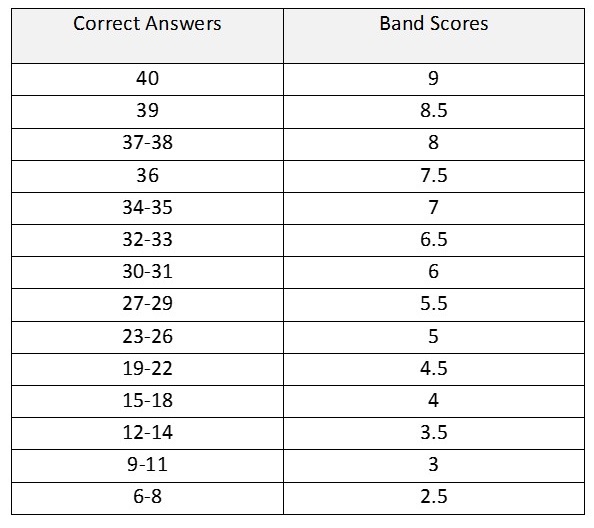
Below is a list of the scores from band 2 to 9 for the GT reading test. The scores are not the same as the academic reading test. Click on the table to enlarge.

general training reading scores

IELTS Reading Question Types for General Training

The types of questions you will be asked in the GT reading test are the same as the academic test. Here is a list:

  • matching headings
  • true false not given / yes no not given
  • matching paragraph information
  • summary completion
  • sentence completion
  • short answer questions
  • table / flow chart completion
  • diagram labeling
  • multiple choice / list selection
  • choosing a title
  • categorisation
  • matching sentence endings

You can click here for: Tips on the Different Types of Reading Questions. You can find free practice lessons for most of these types of questions in the reading section:  IELTS Reading Lessons. However, must practice exercises are on the level of section 3. Also learn: How to Improve your IELTS Reading. For one full GT IELTS practice reading tests, please visit the BC IELTS page of practice tests.

GT writing. For information about GT writing, see this page: GT Writing Information

IELTS True False Not Given Questions

….

FREE SUBSCRIBE

Subscribe to get new lessons & tips by email.

Computer Delivered IELTS: Pros & Cons

Advantages and Disadvantages of the Computer Based IELTS test (CBT). Comments below come from various IELTS candidates. This known as CD IELTS (computer delivered IELTS) or CBT (computer-based test).

Is the computer based IELTS test different?

No. It is the same test but you put your answers on the computer rather than on to paper.

Is the marking the same?

Yes, it is 100% the same. It is the same test with the same marking. All that i different is that you type your answers on a screen.

Are there any differences between Computer and Paper IELTS?

Just one difference. In the listening of the paper-based recording, you have 10 mins to transfer your answers from the question paper to the answer sheet. In the computer-based test, this is not the case. You will type your answers directly into the computer and at the end of the recording you will be given only 2 mins to check your answers.

For reading, writing, and speaking, the timing is the same. Every other aspect of the test is the same regardless of whether it is on computer or paper.

Why take Computer Delivered IELTS?

The aim of offering CD IELTS is for people who are more accustomed to typing than to writing. If you prefer to type and can type at speed, this is the best way to take IELTS. If you are poor or very slow at typing, you should stick with the paper-based test. It also allows for people to take the test online at home.

Pros & Cons of Computer IELTS

Pros  
  • Easy to write/type your answers if you are good at typing
  • Screens provided are a good size which is useful for reading
  • A timer is given on the screen
  • Less crowded – fewer people take it at one time (at the moment)
  • Quick results (3-5 days)
  • More slot availability
  • You can take the test at home
  • You can still make notes and highlight on the screen.
Cons – 
  • You need to be very good at typing. If you are not a good typist, you should consider the paper based test instead.
  • Screens will get locked exactly at the mentioned time (at the precise second) so you will not be able to make any last minute changes.
  •  However, the timer will not display seconds in the last one minute. so you don’t know when the screen will get locked precisely.
  • The computer will not check your spelling or grammar. This is understandable because spelling and grammar are part of the marking.

IELTS Computer Test – General Advice (Must Read)

  • Make sure you practise a CBT sample test before you try the real one so that you know how answers are put into the computer and the type of keyboard/mouse movements you need to be familiar with (drop, drag, click etc). You can find free practice questions for the computer test on the BC website and IELTS Official website and IDP. Use all of them.
  • DO NOT practice for the computer test using tests from other websites, particularly for listening and reading. You’ll find the answers don’t match the answer key properly and that other aspects are also not accurate.  This is why so many people say – the computer marked my answer wrong and I don’t understand – this is because you are using materials provided by another website who are not careful with putting all possible answers into their system. ALWAYS use authentic materials given directly from IELTS or practice materials created by an IELTS specialist/ teacher who you know.
  • The answer keys are the same for the paper test and computer test. Don’t think that the computer test is a different test. It isn’t. It’s the same test done on a computer with only very, very, very, slight variations, such as a checking time instead of transfer time for answer. Everything else is 100% the same.
  • So, use the paper tests for practice from the IELTS Cambridge test books and pay attention to the answer keys to learn about the variety of answers possible.
  • If your typing isn’t good, take the PBT (paper based test). But remember, your handwriting does need to be readable so that the examiner doesn’t struggle.

IELTS Computer Listening Pros and Cons:

  1. Pro: You can highlight text.
  2. Con: Even though you are given a pen and paper, you need to type your answer directly into the computer. This means you need to be able to listen and type at the same time.
  3. Con: Some questions require you to type an answer others require you to drag words from one place to another and others require you to select boxes. You really need to get used to the different ways questions can be answered on the computer for IELTS listening.
  4. Con: Transfer time – you have only 2 mins to check answers, not 10 mins to transfer answers.
  5. Con: If you don’t know how to move from one section to the next, you might waste valuable time figuring it out.
  6. Pro: The tab key works to move from one part to another.
  7. Note: One candidate had an example conversation played at the start of the listening test, another did not. So be aware of this.
  8. Advice: Please get familiar with the Page look and feel on CBT exam for each question type. You can get a sample for each question type in IDP, BC or IELTS.org website.

IELTS Computer Reading Pros and Cons:

  1.  Pro: The best thing with CBT is that you can have passage on left-hand side and questions on the right-hand side. It is really easy and convenient to read and answers the questions.
  2. Pro: You can increase the font size.
  3. Pro: You can highlight the text as needed. Right click and select highlight. In the PBT, you can’t use a highlighter pen and can only underline or circle using your pencil.
  4. You can also make notes, for example you might want to note down some synonyms relating to a word. To do this, right click and select “make notes”.
  5. Pro: Another advantage for the reading exam: you can copy/paste from the text using CTRL+C and CTRL+V which reduces the chances of typos.
  6. Con: You cannot use a search function to look for words. This is understandable to make the test fair and equal to the paper test. You are also being tested on your ability to scan for words and information.
  7. Advice: Get used to scrolling up and down long articles to get used to reading passages and navigating passages on a screen.

IELTS Computer Writing Pros and Cons:

  1. Pro: You do not need to count your words. The computer will show the word count.
  2. Pro: It is easier to edit your writing. You can cut, copy and paste.
  3. Pro: You can move paragraphs and sentences around to reposition them.
  4. Con: The major disadvantage with CBT is we unintentionally make typo errors. Though we know how to spell a word we make mistakes when we type. Practise your proofreading on a word doc.
  5. Con: There will be a lot of people typing for one hour all at the same time. This means it can be very noisy which some people find distracting.
  6. Con: Your typing speed needs to be adequate.
  7. Note: You will be given a pen and paper. You can use it to plan your essay.

IELTS Speaking Test

The speaking test is still face to face with an examiner. If you take IELTS online using your laptop, you will get a video call with an examiner on the screen. Always make sure your audios are working well and your volume is at the right level. Also make sure you have a good mic.

Comments above come from various IELTS candidates, particularly from Kumar = “Thanks, Kumar!”

If you took the CBT, can you post more pros and cons so I can add them to the list above? I would like to make this page as useful as possible. Can you think of more advantages to the CBT writing?

Thanks

Liz

FREE SUBSCRIBE

Subscribe to get new lessons & tips by email.

.

IELTS Table Band Score 9 Model Answers with Tips

Below is an IELTS table with model answer for Writing task 1. The tables below are typical of what you will get in your IELTS test. The model answers help you understand how to structure your table writing and organise data into paragraphs. Getting lost in too many numbers is the biggest challenge for IELTS tables. All model answers are estimated at band 9 and are written as a safe guide to learn from for all band scores.

How to Approach IELTS Table Questions

Useful strategies for IELTS Tables in Writing Task 1: Below are useful steps to ensure that you approach your IELTS table correctly. Try not to get lost in detail and instead look for patterns, similarities and differences to group information together.

  1. Analyse the key information in each category.
    • look for key features (highs/lows/usual data/ changes)
  2. Think about grouping information and categories together
    • if numbers are all below 5%, group them together as one but avoid writing them as a list and instead refer to them collectively
        • group information together with similar trends is essential for an IELTS table because of the volume of data given.
        • you get a lower score if you give too many small details
        • you get a lower score if you miss out information
    • if a number or a category is unusually high, single it out as an individual feature
  3. Plan your paragraphs and content. Each paragraph has a unique and clear function. Use the model table answers above to review them.
    1. Introduction
    2. Overview
    3. Body Paragraph 1
    4. Body Paragraph 2
    5. Body Paragraph 3 (not usual but possible at times)
  4. The introduction should be short and factual.
    1. For a free video lesson, click here: How to Write an Introduction for Writing Task 1
  5. The overview is the most important paragraph. Make sure it contains all key features for a high score.
  6. Divide your body into paragraphs.
    1. In most tables, you will have categories along the top and the side. You must decide the best way to divide categories into body paragraphs. Always choose the most logical.
    2. The time to give data in the body paragraph. Each statement must be supported with numbers from the table given. If you don’t give numbers, you’ll get a lower score for Task Achievement which counts for 25% of your marks.
    3. You don’t have to give all details. You can group details together by giving averages or ranges.
    4. Be selective. Don’t put too many details in your report.
  7. Make sure you write over 150 words but aim for less than 200.
  8. Try to avoid being repetitive with your sentence structures.
  9. Pay attention to what type of information the table gives (static figures or changes over a period of time). This will help you decide what kind of language to use.
  10. Do not try to paraphrase all words, all the time. This leads to vocabulary mistakes. Choose wisely which words to change and which to keep the same.
  11. All information and language should be accurate for a high score

IELTS Table Model Answers

IELTS Table: Question 1

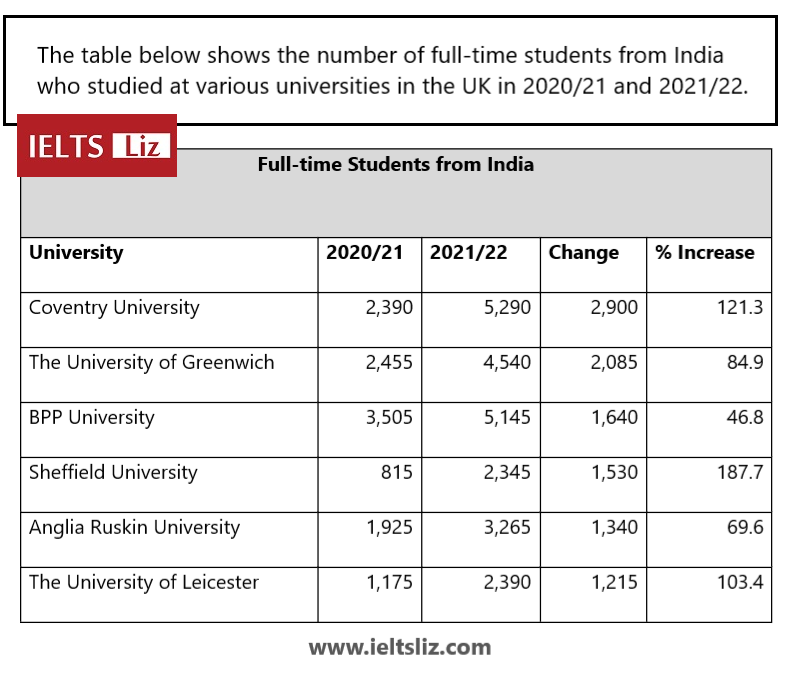
As you see, this IELTS table shows  change over two time periods with four categories in total.

IELTS Table

IELTS Table Model Answer 1

The table gives information about how many full-time students coming from India studied in six British universities in two academic years (2020/21 and 2021/22) as well as the change in numbers and percentage increase.

Overall, the greatest increase in Indian students could be seen in Sheffield University, while BBP University showed the lowest increase over the two years. The university with the most students from India was BBP University in the first year and Coventry University in the second year.

Sheffield University saw a dramatic rise of 187.7% in India students reaching 2,345 in 2021/22. Likewise, the number also climbed considerably for Coventry University by 2,900 students (121.3%) to hit 5,290 students in 2021/22. Another significant increase was seen in Leicester University from 1,175 to 2,390 students, a rise of 103.4%.

All other universities saw an increase of under 100% in the number of Indian students over from 2020/21 to 2021/22. The number of students going to University or Greenwich and Anglia Ruskin University rose by 2,085 students (84.9%) and 1,340 (69.6%) respectively. Regarding BBP University, the number of students remained high in both years at 3,505 and 5,145, which was a growth of only 46.8%.

IELTS Table: Question 2

This IELTS table is slightly easier because it contains less data. You can also see trends for each category more easily.

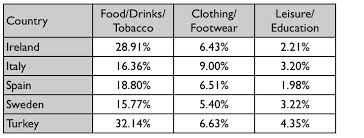
 The table below gives information about consumer spending on different items in five different countries in 2002.

IELTS Table Question Writing Task 1

(Source: IELTS Cambridge English Test Book

IELTS Table Model Answer 2

The table illustrates the proportion of consumer expenditure in Ireland, Italy, Spain, Sweden and Turkey on three types of consumer goods in 2002.

Overall, the category of consumer goods that all countries spent most on was food, drinks and tobacco, which was three times higher than on the other types of goods. The lowest spending could be seen in the category of leisure and education in all five countries. The outlay of Turkey was generally higher than the other four countries.

In terms of food, drinks and tobacco, Turkey spent the most at 32.14%. The expenditure of Ireland was also high (28.91%) compared to Sweden which spent the least (15.77%). Spain and Italy spent 18.80% and 16.36% respectively. On the other hand, the lowest expenditure was on leisure and education which accounted for under 5% in all countries. Turkey spent most on these items at just 4.35% of their national expenditure which is around double that of Spain (1.98%).

Clothing and footwear was the third category of consumer goods and outlays for those items were between 9% in Italy and 5.40% in Sweden.  The national spending in this area for the remaining countries averaged around 6.5%.

Note: in most writing task 1 reports, body paragraphs do not need to be a similar length. In report writing, it is common to very some long paragraphs and others quite short. Tables are no different to other task 1 charts.

RECOMMENDED FOR YOU IN WRITING TASK 1:

FREE SUBSCRIBE

Subscribe to get new lessons & tips by email.

.

Answers to Paragraphing Options for Writing T1

I’ve posted the answers on the original page, click here: https://ieltsliz.com/writing-task-1-paragraphs-review/

All the best

Liz

Paragraphs Review for IELTS Writing Task 1?

Lets check your understanding of IELTS writing task 1 paragraphing. This is for academic writing task 1.

Below are a number of options for how to structure your writing task 1. Are all these options good for IELTS writing task 1?

Option A

  • Paragraph 1 = introduction & overview
  • Paragraph 2 = body 1 detail
  • Paragraph 3 = body 2 detail

Option B

  • Paragraph 1 = introduction
  • Paragraph 2 = overview
  • Paragraph 3 = body 1 detail
  • Paragraph 4 = body 2 detail

Option C

  • Paragraph 1 = introduction
  • Paragraph 2 = body 1 detail
  • Paragraph 3 = body 2 detail
  • Paragraph 4 = overview

Option D

  • Paragraph 1 = introduction
  • Paragraph 2 = overview
  • Paragraph 3 = body 1 detail
  • Paragraph 4 = conclusion

Questions for You

  1. Which paragraphing options are suitable for writing task 1? 
  2. Is there an option above which will get you a higher score?
  3. Which structure is not acceptable?

Paragraph Options Explained: Answers

Options A, B, & C are all possible to be used in Writing Task 1 and get a high score. Option D will not give you a good score. Read the details below to learn more:

Option A

When the introduction is very short, such as with diagrams, I sometimes put my overview statement with the introduction. I feel it gives a better balanced of paragraphs. Although the introduction and overview are in the same paragraph, they MUST be separate statements. The introduction presents the information (paraphrases the description) and the overview contains all key features.

Option B

This is my personal favourite. Writing task 1 is not an essay. It is a report. The overview contains all the key features and I prefer to present that before giving all the smaller details. I like the reader to understand the gist of the chart, before seeing small examples of data. 

Furthermore, the overview is THE MOST IMPORTANT PARAGRAPH IN WRITING TASK 1. For this reason also, I like to put it early on in the writing. The overview needs to be both clear and contain information well selected.

Option C

It is also 100% fine to put the overview at the end of the report. However, if you choose this option, make sure you manage your time well – your overview is the most important part and needs to be thought about carefully and written very very well.

Option D

There are two very serious problems with this structure.

  1. The body must be divided into a minimum of two paragraphs. You are being marked on how you take the detail and divide it into logical sections. Most writing task 2 will have two paragraphs for the body, but occasionally you might have three. 
  2. You cannot have both an overview which contains the key features and a conclusion that summarises the key features. This would mean in a short report, you would have repeated the key features twice. This will lower your score. There is no reason to repeat anything at all. Once you state the key features in the overview, your body paragraphs (plural) will present all main details. You never repeat it all again. This means you do not need a conclusion. 

I hope you have found this useful 🙂 My main writing task 1 page has lots of model answers which show both option A and B. CLICK BELOW:

IELTS Writing Task 1 Tips, Model Answers & More

If you want letter writing tips for GT writing task 1, see this page: https://ieltsliz.com/ielts-letter-writing-essential-tips/

All the best

Liz


IELTS Reading: Matching Headings

Practice and useful tips for tackling IELTS reading matching headings questions. These are one of the most challenging types of question in the reading test. They are certainly the most lengthy and time consuming. Below you will find tips for what these questions require and how to approach them. And there is a reading practice lessons as well.

IELTS Reading Matching Headings Tips

Below are a list of useful tips to tackle these types of matching questions. You definitely need a strategy and familiarity to answer these questions correctly and to do it quickly. Even if you are at native speaker English level, you need practice and develop strategy, otherwise you will waste valuable time.

  1. You can choose whether to skim read (read for gist, not detail)  the passage first or the headings. There is no right or wrong way. You decide what works for you. Most teachers will recommend you read the headings first.
  2. One advantage to the computer reading test is that the headings and passage are side by side on the screen. For the paper test, they are on different pieces of paper.
  3. Count how many headings you have and how many paragraphs. You will usually have more headings than paragraphs.
  4. There is only ever one heading that works for each paragraph.
  5. The headings are basically titles for the paragraph. This means the heading summarises the aim of the entire paragraph.
    • This isn’t about matching words or just locating information in the paragraph, it’s about the aim of the whole paragraph.
  6. Pay attention to headings that are similar in meaning or contain similar words. Some headings can appear very similar so you’ll have to pay attention to the way in which they differ.
  7. Spend time paraphrasing keywords in the possible headings. You will use keywords and key paraphrases to decide which paragraphs or headings are possible. Then you analyse deeper meaning before deciding your answer.
  8. Read the paragraphs to find the main idea – what is the direction and aim of the paragraph?
  9. Distinguish between main ideas and extra information or examples in the paragraph.
  10. There might be a heading which does match some information or one sentence in the paragraph, but that doesn’t mean it is the answer. Your aim is to find the heading that matches the aim of the whole paragraph, not just one sentence. So, look out for that when you choose your heading.
  11. Not all headings will be used.
  12. Your answer will be a roman numeral, for example, I or VI. Do not write words.
  13. Remember one correct answer is only worth one point so think about how much time you are spending on these questions. They do take time to answer.
  14. In the paper test, you’ll see the list of headings first (similar to the reading lesson below). On the computer test, the headings and passage will be side by side, which is easier. Don’t forget the paper test and computer test are not different tests. They are the same test whether you type or write your answers.

IELTS Reading Matching Headings Practice Lessons

Reading Practice 1

Try this reading passage below. 

Reading Passage: The Greenhouse Effect

Choose the correct heading (I-IX) for paragraphs A, B, C and D in the passage below.

  • I     Changing temperatures
  • II    The greenhouse
  • III   Global warming
  • IV   Use of a greenhouse
  • V    Werne’s research
  • VI    Earth’s atmosphere
  • VII   Our choices
  • VIII  Effects of carbon dioxide
  • IX     Climates around the world

A.   A greenhouse is a house made entirely of glass: both walls and roof are glass. One of the main purposes of a greenhouse is to grow tomatoes, flowers and other plants that might struggle to grow outside. A greenhouse stays warm inside, even during winter. Sunlight shines in and warms the plants and air inside. But the heat is trapped by the glass and cannot escape. So during the daylight hours, it gets warmer and warmer inside a greenhouse, and stays quite warm at night too.

  The Earth experiences a similar thing to a greenhouse. Gases in the atmosphere such as carbon dioxide do what the roof of a greenhouse does. During the day, the Sun shines through the atmosphere. Earth’s surface warms up in the sunlight. At night, Earth’s surface cools, releasing the heat back into the air. But some of the heat is trapped by the greenhouse gases in the atmosphere. That is what keeps our Earth a warm and comfortable 59 degrees Fahrenheit, on average.

C   However, gas molecules, called greenhouse gases, which absorb thermal infrared radiation, are rising and this is what is altering the climate system. Carbon dioxide (CO2) and other greenhouse gases act like a blanket, absorbing IR radiation and preventing it from escaping into outer space. The greenhouse effect, combined with increasing levels of greenhouse gases, produces climate change on a global scale, which is expected to have profound implications for all countries around the world.

D   Many scientists agree that the damage to the Earth’s atmosphere and climate is past the point of no return or that the damage is near the point of no return. Josef Werne’s, an associate professor at the department of geology & planetary science at the University of Pittsburgh, told Live Science that we have three ways to move forward. Firstly to do nothing and live with the consequences. Secondly, to adapt to the changing climate (which includes things like rising sea level and related flooding protection). Thirdly, mitigate the impact of climate change by aggressively enacting policies that actually reduce the concentration of CO2 in the atmosphere.

The above article was adapted from wiki and livescience.com

MATCHING HEADINGS ANSWERS

Click below:

ANSWERS

Paragraph A = II

  • The answer can’t be IV. The paragraph did contain information about how the greenhouse was used, such as growing vegetables. But that information was not the main aim of the paragraph, it was additional information. If the aim was about it’s uses, there would be more information about using it for various purposes – but that isn’t the aim.
  • The answer can’t be I, about Changing Temperatures. Although temperature is often mentioned, it is only to illustrate how the green house works. The aim isn’t to discuss temperatures and how they change.
  • The paragraph actually talked about what it was made of, what it was used for and how it works. The best title would be “The greenhouse” because the paragraph gives a clear overview of it.

Paragraph B = VI

  • The answer isn’t I  because the paragraph actually explains that this natural effect keeps the temperature of Earth stable.
  • The answer is VI which explains how Earth’s atmosphere works to keep our planet at a stable temperature.

Paragraph C = III

  • The answer isn’t VIII (Effects of carbon dioxide) because the paragraph isn’t aimed at explaining carbon dioxide and in fact only mentions it along side other greenhouse gases.
  • The answer isn’t  IX (Climates around the world) because although climates are affected around the world, the whole paragraph aim isn’t to discuss climates in different countries.

Paragraph D = VII

  • The answer isn’t V because the paragraph doesn’t actually discuss Werne’s research (which means how he did his studies and the problems with his studies), but rather his opinion about what options we have to deal with our changing world climate.

.

************************

Reading Practice 2

Reading Passage: The History of Pasta 

Choose the correct heading (I-VIII) for paragraphs A, B, C and D in the passage below.

  • I       A theory dismissed
  • II      Marco Polo in China
  • III     Is pasta really a popular Italian dish?
  • IV     China is the origin of pasta
  • V      The real roots
  • VI     An Arabian taste sensation
  • VII    The common belief of the origins of pasta
  • VIII   How about China?

A    Worldwide, pasta has become synonymous with Italian cuisine. Italian immigrants themselves brought pasta everywhere they went. While it is true that the most famous varieties and recipes of cooking pasta really do come from Italy, surprisingly, the actual origin of pasta lies elsewhere!

B    One of the more popular theories of the arrival of pasta in Italy was published in the ‘Macaroni Journal’ by the Association of Food Industries. It states that pasta was brought to Italy by Marco Polo via China. Polo ventured to China in the time of the Yuan Dynasty (1271-1368) and the Chinese had been consuming noodles as early as 3000 B.C. in the Qinghai province. There is even some evidence there of 4,000-year-old noodles made from foxtail and broomcorn millet.

C    Unfortunately, there are problems with this theory, least of which is that the noodles they were making in China aren’t technically considered pasta. Polo also described Chinese noodles as being like “lagana”, which implies he was possibly already familiar with a pasta-like food before going to China. Further, in 1279, there was a Italian Genoese soldier that listed in the inventory of his estate a basket of dried pasta. However, Polo did not come back from China until 1295. Furthermore, the modern pasta we know today was first described in 1154 by an Arab geographer, Idrisi, as being common in Sicily. So Marco Polo could not have brought pasta to Italy via China. It was already in Italy at that time.

D   Most food historians believe that Arabs (specifically from Libya) are to be credited for bringing pasta, along with spinach, eggplant and sugar cane, to the Mediterranean. In the Talmud, written in Aramaic in the 5th century AD, there is a reference to pasta being cooked by boiling. It is thought, then, that pasta was introduced to Italy during the Arab conquests of Sicily in the 9th century AD, which had the interesting side effect of drastically influencing the region’s cuisine. It also known that by the 12th century, the Italians had learned from the Arabs methods for drying pasta to preserve it while traveling. Further support for this theory can be found by the fact that, in many old Sicilian pasta recipes, there are Arab gastronomic introductions. One example of cross cultural recipes is Barida, which is an old Arab recipe with Roman clear roots.

Source: Passage was adapted from: todayIfoundout.com.

MATCHING HEADINGS ANSWERS

Click below:

ANSWERS
  1. A = VII
    • This paragraph is all about what we think is the origins of pasta. It opens up the topic of where pasta really comes from.
    • The answer cannot be III (Is pasta really a popular Italian dish?) because it is not about how popular pasta is as a dish within Italy.
    • The answer isn’t I (A theory dismissed) because the paragraph isn’t about a theory, but about a common belief – a common opinion or thought.
    • The answer cannot be V (The real origins of pasta) because the paragraph aim is not to talk about the real origins but instead just to introduce the idea that is isn’t Italy.
  2. B = VIII
    • This paragraph offers yet another common belief which is that pasta comes from China. For this reason, “How about China” which means is China the real origin fits with the whole aim of the paragraph.
    • The answer isn’t I (A theory dismissed) because although the paragraph does present a theory, it does not aim to dismiss it.
    • The answer isn’t II (Marco Polo in China) because although it mentions Marco Polo, the aim isn’t not to discuss his time in China.
    • The answer isn’t IV (China is the origin of pasta) because the paragraph isn’t aimed to convince us that China is the origin but rather to introduce the theory that it could be.
  3. C = I
    • This paragraph is all about dismissing the theory that was introduced in the previous paragraph – that pasta was introduced to Italy by Marco Polo when he came from China.
  4. D = keep reading:
    • There are two possible headings for this paragraph
      • V      The real roots
      • VI     An Arab taste sensation
    • We do see the word “roots” used in the paragraph.
    • We do see the paragraph is about an Arab food.
    • But which heading works? The key is meaning:
      •  – taste sensation – means a powerful, incredible, delicious experience of flavour in an ingredient or dish. This paragraph give no description of this and it certainly isn’t an aim of the paragraph to talk about something full of amazing flavour.
      •  – roots – we need to look more carefully at this word. We use the word “root” to talk about an origin of something. This paragraph really does talk about the origin of pasta. It is about the real roots of pasta. In the paragraph, the word “root” as in reference to one particular dish that had Roma roots with Arab influence. This word acted like a distractor – to confuse the reader about the real heading.
    • The answer is V (The real roots)

.

I hope you enjoyed the lessons. All the best, Liz

**********************

RECOMMENDED FOR YOU

FREE SUBSCRIBE

Subscribe to get new lessons & tips by email.

.

error: Content is protected !!