Sample Answers for Speaking Topic: Charities

These model answers are for IELTS speaking part 3, which is the most difficult part lasting 4 to 5 minutes. The topic of charities usually comes under the topic of unpaid work / volunteer work.

Before you read the sample answers, try to answer the questions yourself.

1. Do you think charities are important? Answer

Yes, I do. In some countries, there is no welfare system so the only form of assistance which poor people or disabled people can get is from charities. For example, some of the local charities around here provide food, clothing and even education support for needy people which really helps to get them back on their feet. So, without help from charities, these people would have very serious problems.

2. Do you think children should be made to do volunteer work as part of their school curriculum? Answer

That’s an interesting question. I think it is great for children to take part in charity work as they can learn about helping people and also understand what it means to be part of a community. However, I don’t think it should be obligatory for them. When children are forced to do something, they often become resentful which would result in them possibly not doing that kind of work later in life. If schools could encourage them to do charity work as an out of school activity, which is not compulsory, that would be better and would encourage them to continue helping others when they’re older.

3. Which do you think are more important, local charities or domestic charities? Answer

Well, I think they each have a different role to play so I can’t say that one is more important than the other. For example local charities are better at helping with the day to day needs of local people because they know exactly what it is they lack and what they need. Large international charities, on the other hand, are good at tackling natural disasters or sending aid to the third world as they have the financial means to help on a big scale. So, they are definitely both very important.

4. If you could donate a large amount of money to any charity, what would it be? Answer

I suppose I would go for an international charity that either deals in providing much needed medical care to developing countries or a charity that champions human rights on a global scale such as Amnesty International. These types of charities are able to help so many people around the world and for me it would be rewarding to think that my money has helped so many. Also these charities deal in the fundamental needs of life, which I think everyone is entitled to, so I would certainly choose them.

Recommended

Speaking Part 3 Model Answers: Health Topic

Get my free lessons by email

Subscribe for free to get my new IELTS lessons sent to your email inbox.

IELTS Advantage Disadvantage Model Essay With Useful Tips

Below is an IELTS advantage / disadvantage model essay about having one language in the world. The essay is estimated at band score 9. You will also find tips about this kind of IELTS essay.

What is an IELTS Advantage Disadvantage Essay?

Many teachers teach the advantage/disadvantage essay as a discussion essay because it tackles two sides of an issue or topic. However, I like to keep this essay type separate because it has specific language relating to advantages and disadvantages, such as

  • benefits
  • gains
  • positive points
  • advantageous
  • negative points
  • problems
  • downside
  • drawback

Two Types of Advantages Disadvantage Essay

  1. What are the advantages and disadvantages?
    • This essay is asking directly for you to state the benefits of something and the drawbacks of something. The question isn’t asking you for your opinion. It is just asking for X and Y. 
    • The biggest issue people have with this type of essay is going off topic. This mainly comes from not spending enough time analysing the issue or issues presented in the question and taking time to think deeply. 
  2. Do the advantages outweigh the disadvantages?
    • This is a different type of essay which is asking for your opinion.
    • The question is basically asking you: are the advantages more important than the disadvantages OR do you think the disadvantages are more important than the advantages? You must decide what you think and present your view.
    • This essay question can also be paraphrased as “Are the advantages more important than the disadvantages?
    • This essay also requires you to use language relating to advantages and disadvantages so make sure you are expressing your ideas appropriately.
    • You can see a model essay for this type of task at the bottom of this page.

Paragraphing & Structure

Regardless of which type of essay, the paragraph structure will be the same:

Introduction with Background Statement and Thesis statement. You do not require more for an introduction. A long introduction does nothing for your score. All IELTS introductions are function and quite short (usually between 45 and 55 words).

Body Paragraphs which have a topic sentences and supporting points. All body paragraphs start with the main theme or idea for the paragraph. If the whole paragraph is about advantages, then you make it clear in the first sentence. This helps both with Task Response and Coherence & Cohesion. Always make sure support points explain your ideas – keep them highly focused and relevant.

Concluding paragraph – this is the shortest paragraph and its function is to restate the main ideas. The biggest mistakes with this are 1) using inappropriate linking words  2) stating a different main point that hasn’t been given in the essay  3) running out of time to write the conclusion. See this video lesson about using the last 5 mins of your writing test: Last 5 Mins Tips

IELTS Advantage Disadvantage Model Essay

The development of tourism contributed to English becoming the most prominent language in the world. Some people think this will lead to English becoming the only language to be spoken globally.

What are the advantages and disadvantages to having one language in the world?

It is thought by some people that English, which is now the most widely spoken language in the world, may one day predominate over all other languages and result in their eventual disappearance. Having one language would certainly aid understanding and economic growth but there will also be some drawbacks.

One evident benefit to having one global language is that it would enable greater understanding between countries. In other words, if everyone spoke one language, there would be complete understanding between not only countries but all people throughout the world which would promote learning, the flow of information and ideas. Another reason that one language would be advantageous is that it would help economic growth. With all people speaking the same language, there would be fewer barriers and therefore trade would flourish between countries, resulting in a healthier world economy.

On the other hand, there are obvious downsides to having only one global language. Firstly, it would mean that all other languages would eventually disappear and, along with them, their cultures. The diversity of cultures is one of the joys this world has to offer. Each culture is unique with its own way of life and own perspectives of the world which would all be lost if there were only one language.  Secondly, it would result in the collapse of tourism because there would be no reason to travel for pleasure and interest if all countries had the same language and similar cultures. This would devastate many countries economically that rely on tourism as a source of income.

In conclusion, while there are plus points to having one global language, too much would be lost as a result. Maintaining local languages and cultures should be prioritised to ensure a rich world heritage for future generations.

Examiner Comments: This essay addresses the task fully and provides relevant, well extended ideas. All aspects of cohesion is well managed. Paragraphing is logical and the use of linking words flexible. There is a wide range of vocabulary which allows for precise meaning. Grammar structures are accurate and complex with a range of grammar features.

RECOMMENDED FOR YOU

FREE SUBSCRIBE

Subscribe to get new lessons & tips by email.

.

**************

Advanced Lessons & E-books for IELTS Writing Task 2

Click below to visit my store:

.

Pie Chart and Bar Chart for IELTS Writing Task 1

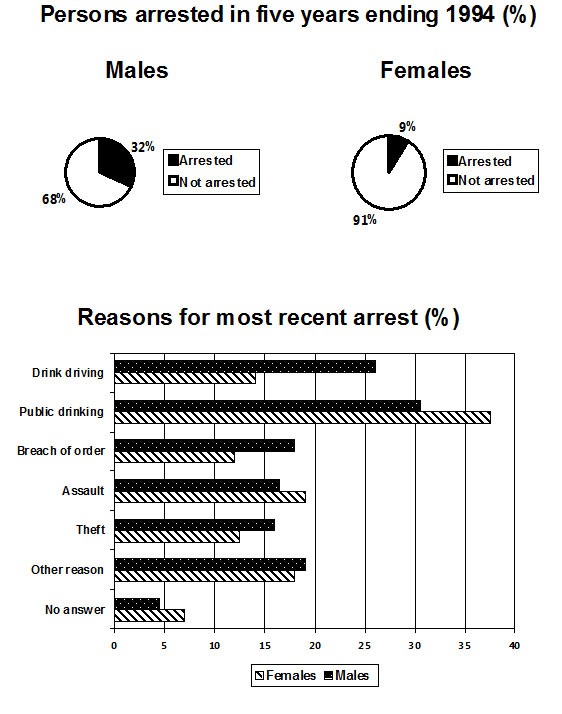
It is possible to be given two charts together in IELTS writing task 1. Below you will see two pie charts followed by a bar chart. This exercise will focus on how to structure your report and how to highlight the key features of both charts in one overview.

The charts below show the males and females arrested over 5 years and the reasons for the most recent arrests.

two IELTS charts

Source: The above charts were not created by IELTS Liz.

Two Charts: Structure and Overview

Answer the questions below in order to decide your paragraphing for your task 1 report.

  1. Will you put the introduction separately?
  2. Will you have an overview or conclusion?
  3. How many body paragraphs will you have?
  4. What order will you put your paragraphs in?
  5. Will your body paragraphs be equal lengths?

Answers

  1. Yes, the introduction should go in a separate paragraph.
  2. You must have an overview not a conclusion. The overview can go after the introduction.
  3. You should have 4 paragraphs in total.
  4. You should have an introduction, an overview, one body paragraph for the pie chart detail and one body paragraph for the bar chart detail.
  5. The body paragraph with pie chart detail will be shorter than the body paragraph with details about the bar chart


Now write your overview. this paragraph must contain key features from both charts. This means you must write one sentence about the key features of the pie charts and one sentence for the key features of the other chart. After you have written your overview, check the sample overview. Model Overview

Overall, over the five year period finishing in 1994, there were significantly more males arrested than females. The majority of arrests were due to public drinking while no answer was given for the least number of arrests for both genders.


Recommended

Get my free lessons by email

Subscribe for free to get my new IELTS lessons sent to your email inbox.

Common English Names for Boys

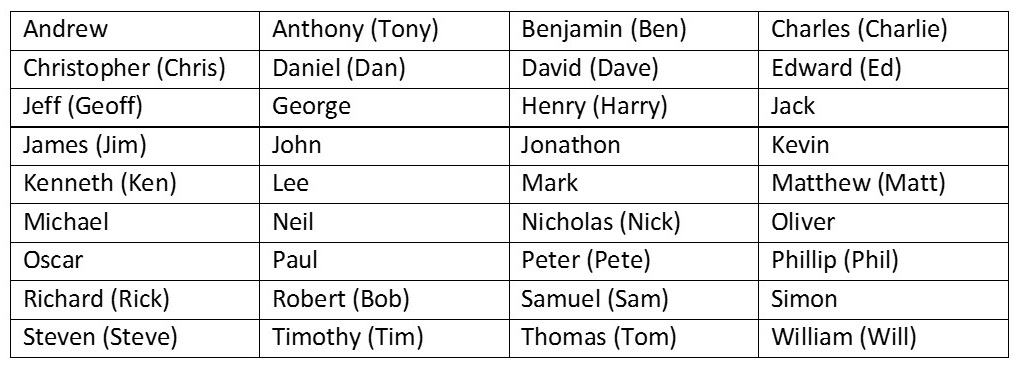
Below is a list of common English names for boys. You will also find an audio so that you can listen to the pronunciation of the names as well. For students preparing for their IELTS test, it is useful to learn common English names for your listening section 1.

Next to some names are the nicknames. These are familiar names often used instead of the real name. You can also listen to common girls’ names or watch a video with practice listening for names.

Boys Names

Get my free lessons by email

Subscribe for free to get my new IELTS lessons sent to your email inbox.


Choosing a Title IELTS Reading: Practice & Tips

Choosing a title for IELTS reading is quite a common question type. This is a practise lesson for choosing headings in IELTS. You will be given a list of possible titles for the whole passage you must choose the one that you think most appropriate.

IELTS READING CHOOSING A TITLE QUESTION

This reading question is usually the last question you might get in a reading passage. It would come after all the other questions. Why?

The answer is because this question requires you to have insight into the whole passage, not just locate answers in part of the passage. So, by giving this question as the last question, you will have had time already to look at the passage and know the contents of the passage. So, it is given last as a way to help you.

Choosing a Title: Reading Instructions

Here is an example of what that question would look like in your test:

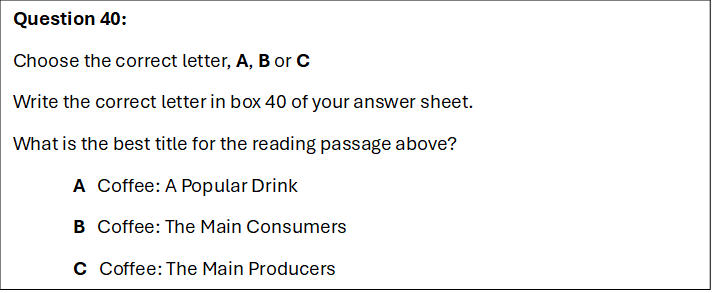
IELTS Reading Choosing a Title Question

You will be given a list of possible titles for the passage. You need to select the best one.

IELTS Reading Choosing a Title Question – Techniques

Read this list of tips to that you approach this type of question with the right techniques.

  1. Never try this type of question first. 
    • You need a depth of understanding of the whole passage to get the answer right so tackle it last.
  2. Read though the possible titles and pay attention to similarities and differences.
  3. Look at specific words that stand out.
    • For example, is the title referring to a city or an entire continent. Look at each word individually. 
    • Don’t skim read the possible titles. Analyse them carefully.
  4. Nearly all possible titles will seem appropriate at first because they will all relate to aspects of the passage.
  5. This question is NOT about matching an answer option to part of the passage or specific information found in the passage.
  6. This is about choosing a title that reflects the aims of the whole passage.
  7. This doesn’t mean that the title matches the start, middle and end – but that it is about the aims of the whole passage.
  8. You need to think carefully about what the role of a paragraph is to the whole passage. 
  9. Always look at the introduction sentence and concluding sentence of paragraphs to see if there is a similar message or whether the aim of the paragraph is different to the opening line.
  10. Your answer must be a letter, not the words. If you write the words, your answer will be marked wrong.

Choosing a Title Reading Passage

Note: to make this more realistic to an IELTS reading given in your test, I’ve added some Matching Paragraph Information Questions to this lesson.

A   Babies learn to see over a period of time, much like they learn to walk and talk. They are not born with all the visual abilities they need in life. The ability to focus their eyes, move them accurately, and use them together as a team must be learned. Also, they need to learn how to use the visual information the eyes send to their brain in order to understand the world around them and interact with it appropriately.

B   From birth, babies begin exploring the wonders of the world with their eyes. Even before they learn to reach and grab with their hands or crawl and sit-up, their eyes are providing information and stimulation important for their development. Healthy eyes and good vision play a critical role in how infants learn to see. This is why it is important that parents take this into consideration when preparing a new born baby’s room. Providing interesting visual stimulus is crucial for a baby’s visual development. This can include the use of colours, mobile toys and images.

C   Babies as young as two to three months have shown that they have some form of depth perception. One method researchers have used to study babies and depth perception is through using a “visual cliff”. A visual cliff consists of a glass platform that is raised a few feet off the floor. One half of the cliff has a shallow side, where there is a checkerboard pattern directly underneath glass. The “deep end” of the cliff shows the pattern several feet below, creating the impression of a drop-off. Researchers found that infants as young as two months showed changed in heart rate when lowered face down over the shallow and deep ends of the visual cliff. Specifically, the infants’ heart rates decreased when they were lowered over the deep end, and were changed when over the shallow end.  Note that this experiment does not show that infants this young are afraid of the deep side. Usually, a decrease in heart rate indicates interest, while fear leads to an increase in heart rate. The experimental differences in heart rate indicate the infants could perceive a difference between the deep and shallow ends of the visual cliff.

Questions 1- 4

Which paragraph contains the following information. Choose the right letter from the paragraphs above (A-C). Letters might be used more than once.

  1. Babies should have a room containing a lot of interesting things to look at.
  2. Infants have different physical responses to downward visual distances.
  3. Having moving visual stimulus and a range of hues is good for a baby’s vision development.
  4. Babies are not born with the visual ability of an adult.

Question 5

Which is the best title for the reading passage above? Choose the best title from the options below (A-D).

  • A   The importance of vision in babies
  • B   The role of vision to human development
  • C   The development of perception in babies
  • D   Research into visual cliffs

VOCABULARY AND ANSWER

Click below:

Vocabulary

  • grab (vb) = clutch / grasp / seize
  • crawl = move on their hands and knees
  • depth perception = able to see downward
  • shallow = thin / not deep
  • pattern = design
  • infant = child / pre-school toddler
Answer
  1. B
  2. C
  3. B
  4. A
  5.  C

.

RECOMMENDED FOR YOU

FREE SUBSCRIBE

Subscribe to get new lessons & tips by email.

.

Opinion Essay Introduction Feedback

Below is some feedback to an IELTS opinion essay introduction written by a student in response to the following essay question.

IELTS Essay Question

Due to the development and rapid expansion of supermarkets in some countries, many small, local business are unable to compete. Some people think that the closure of local business will bring about the death of local communities. To what extent do you agree?

Student Introduction Sample

Small business are unable to competition supermarkets, which are rapidly increasing and developing in a number of countries. It is believed that close small business will bring negative impact on local societies. In my opinion modern buildings and comfortable service are important for new societies. However, local business increased the number of job opportunity.

General Feedback

The student introduction does not give a clear answer to the statement and the main points introduced are not completely relevant. It is important to spend time:

  1. to understand the issues in the statement
  2. to find main points which answer the statement.

Below are detailed comments on both the background statement and thesis statement for the student’s introduction.

Background Statement Feedback

Small business are unable to competition supermarkets, which are rapidly increasing and developing in a number of countries. It is believed that close small business will bring negative impact on local societies.

The content of the background statement is fine. The student has paraphrased most of the statement given by IELTS. This means the student is attempting to use the correct technique for IELTS with an academic style. The student has also used a clause in the first sentence which is great to increase the band score for grammar.

Unfortunately, there are also some errors in grammar and vocabulary.

  • to competition = to compete (check the form of the word – don’t use a noun if a verb is needed)
  • to compete supermarkets = compete with supermarkets (check all verbs to see if there needs to be a preposition after them)
  • it is believed that close small business will … = it is believed that the closure of small businesses will … (check the form of the word – it should be a noun not a verb / check the use of plural nouns)
  • will bring negative impact = will have a negative impact (check the use of (a / the etc) articles / check which verb to use)

Here is a model background statement:

Many small, local business are closing, owing to a boom in large supermarkets, and, according to some, this will have dire consequences for local communities.

Thesis statement Feedback

In my opinion modern buildings and comfortable service are important for new societies. However, local business increased the number of job opportunity.

This thesis statement does not address the task or offer a clear answer to the issue. The thesis statement should provide a clear answer to the issue: Do you think the community will die because many small shops close down and people go to do their shopping in large supermarkets instead? Here are some comments on the thesis statement above:

  • The student thesis statement above does not answer this question
  • It gives information about modern buildings which is off topic
  • The thesis contains information about comfortable services which is also off topic
  • It gives information about local business offering jobs – this is also not relevant to the topic

To write the model thesis statement we must understand all aspects of this issue and think more deeply. Here are some questions to consider:

  1. Why do people shop in supermarkets rather than small businesses? Answer
    The reason is that it is more convenient to buy everything in one large shop, for example a supermarket, than have to visit different shops to buy the same things. Supermarkets reduce shopping time and people can find what they want more quickly.
  2. What is the result of people shopping in supermarkets rather than small shops? Answer
    People no long need to go into the town center and walk around the shops to buy their goods. Instead, they can drive to a large supermarket, often located on the outskirts of town, to get what they want.
  3. How does this affect the community? Answer
    Local people no long need to go into the town center. This means that the town center no longer is a place to socialise and meet other people while shopping. As small shops close, town centers become empty and local people become more distant to each other.
  4. Is this the death of the community? Answer
    It certainly means that there are negative effects for communities but communities still survive through social events, through clubs, through schools and other institutions in society. Also there are a number of shops which will not be affected by supermarkets because they are not in direct competition for example, supermarkets do not offer top quality products so high end shops will not be affected by supermarkets.

Here is a model thesis statement:

In my opinion, I agree that communities will suffer as some small, local businesses close but it is doubtful that it will cause the death of local communities.

RECOMMENDED FOR YOU:

ALL FREE IELTS WRITING TASK 2 LESSONS, TIPS & MODEL ESSAYS

…………………………………….

FREE SUBSCRIBE: Get my New Lessons & Tips by Email

.

IELTS Listening: Section 4 Practice

IELTS Listening Section 4 is an educational lecture below are tips and a practice lesson to help you prepare. All candidates take the same listening test so this is the same for Academic and GT candidates. This is the most difficult section of the listening test. The listening exercise below is based on section 4 and it focuses on short answer questions. It is possible to get any question type in section 4.

IELTS Listening Section 4 Tips

  1. Section 4 is an academic talk by one speaker, a lecture.
    • Please note, for candidates taking the General Training IELTS Test, you will be taking the same listening test and the same speaking test as the Academic candidates.
  2. Academic lectures are usually structured:
    • Introduction – what the talk main points will be
    • Middle
      • Main Points with Detailed and Examples
    • Conclusion – a summary
    • This logical organisation of information will help you.
    •  
  3. Signposts:
    • As the speaker moves from one point to another, they will say things like:
      • Looking at X
      • Moving on to Y
      • Another interesting point is …
    • You need to pay attention to these words.
  4. Linking words
    • Talks will also use linking words to add information, give an opposite point or give an example. All these words will help you understand the information and follow the points. Example words:
      • Firstly, Secondly, Thirdly
      • Also, in addition, moreover, furthermore
      • by contrast, conversely, on the other hand
      • for example, such as, like, namely
    • You can find a list of common linking words on this page: Linking WordsAlthough the page is for writing task 2, they are formal linking words used for formal talks as well.
  5. Academic talks contain vocabulary relevant to the topic. Such vocabulary often isn’t paraphrased, which can be very useful in navigating the recording.
  6. Don’t try to understand everything. Focus on listening for answers only
  7. Predict the type of answer you need to listen for.
  8. Listen out for paraphrases of common words.
  9. For the listening practice below, answers will come in order
  10. Section 4 usually has 10 questions. The lesson below is a practice lesson rather than a test. The aim is for you to get used to the language and layout of listening section 4.

When you finish your listening practice, listening again and read the transcript at the same time. Answers are given below.

Practice for IELTS Listening Section 4

Section 4 Practice Lesson

Dolphin Intelligence

Questions 1-6: Write no more than two words and/or a number.

1. The lecture will concentrate on tools, communication, sonar and what other aspect of dolphin intelligence?
2. How big is the brain of the bottle-nosed dolphin?
3. What other species use tools?
4. What can dolphins copy from other species?
5. What characteristic of their eyesight helps them see in and out of the water?
6. What does a dolphin have instead of protruding ears?

RECORDING:

.

TRANSCRIPT & ANSWERS

Click below to reveal the transcript and answers:

Transcript
Today I’m going to talk to you about dolphin intelligence and in particular their use of tools, methods of communication, sonar and also their sensory capacity.
But first let’s look at how the dolphin brain compares to the brains of other species in terms of size. The largest brain in the world belongs to the sperm whale. Weighing some 9,000 grams, it is six to seven times larger than the human brain. The second largest brain in the world is the killer whale (or orca) at 6,000 grams. The next largest brain among the marine mammals is the bottlenosed dolphin at 1,500 grams, followed by human brains at approximately 1,200 grams. Strong connections between the sensorial and motive areas of a dolphin’s brain to the body indicate that it is very much sensitive to pain and stress.
Looking at the way dolphin’s use tools, while many believe that primates, such as chimpanzees, are the only species who use tools for activities, dolphins studied in the wild have been seen using sea sponges to protect their snouts from getting scratches as they scavenge for food on the ocean floor. Dependent calves, young baby dolphins, are also provided with sponges from their mothers, as research in the wild has seen infant dolphins wearing tiny sponges on their snouts while swimming close to their mothers.
With regards to dolphin communication, dolphins utilize “signature whistles” to identify themselves to others. In other words, these whistles can be seen as representing their names. Furthermore, dolphins also mimic movements of both humans and other animals.
Another interesting point about dolphins is of course their sonar. It has been suggested by several noted scientists that dolphins may be able to create acoustical holographic images from the interlacing of their sonic output. It is well known that dolphins can see inside the bodies of their fellow dolphins, and other animals in the water. This is because dolphin sonar evolved to pass through water and does not reflect until it hits something like bone or air sacs. Since animal bodies are more than 50% water, their sonar enables them to literally “see” inside other animals.
And finally, dolphins have fantastic sensory capacity. They have the ability to focus their eyesight due to the curvy characteristics of their lenses, thus they are able to see both in and out of water. Moreover, dolphins have little more than a small hole for hearing, as having larger ears would severely affect the creature’s ability to swim. Rather, studies show that sounds are obtained through tiny bones, and then are transferred to the inner ear through the fatty material that surrounds the eardrum. Adapted from Bluevoice.org
Answers
1. sensory capacity
2. 1500 grams / 1500g
3. primates / chimpanzees
4. movements
5. curvy lenses
6. small hole

note: when you see brackets in an answer key, it means the word in brackets is optional. Your answer is right with or without it. You can’t use brackets for your own answers in your test.

Vocabulary
  • capacity = ability
  • indicate = show / point to
  • primate = monkey
  • snouts = noses (for dolphins and pigs)
  • scavenge = hunt / forage
  • infant = new born / child
  • mimic = copy

.

************************

Recommended for IELTS Listening

Click here: ALL IELTS LISTENING FREE LESSONS & TIPS

FREE SUBSCRIBE

Subscribe to get new lessons & tips by email.

.

Parts of the Face: Vocabulary for People

It is common to be asked to give a description of a person in IELTS speaking. Here is some useful vocabulary to help you describe a person in detail.

You can see that one word in the diagram is missing. Do you know that word?

face parts vocabularyListen to the recording below to complete the diagram. Words will not come in order so you will need to make notes to find which is the missing word. Answer is given below.

Answers

The missing word is “eyebrow”

Note: many of these words are often used as plurals, for example, “she has rather thick lips” or “he has high cheek bones”. Make sure you use this vocabulary accurately.


Get my free lessons by email

Subscribe for free to get my new IELTS lessons sent to your email inbox.

error: Content is protected !!