IELTS Listening Map Techniques & Practice

Maps frequently appear in the IELTS listening test. They can appear in any section, although it is more common to find them in Section 2. Below you will find useful tips and techniques to tackle a map completion question in IELTS listening with some map practice lessons as well to hone your skills.

IELTS Listening Maps: Essential Tips

Below are a few tips and techniques to help you tackle map questions in IELTS listening. Hopefully you will already have prepared language for maps because they do appear in IELTS Writing Task 1 Academic test.

  1. Maps can appear in any part of the listening test, although they appear more often in section 2. Section 2 is one speaker talking about something of general interest, such as a museum or, in the practice lesson below, a farm.
  2. Maps are visual so there is a lot to look at in a short amount of time before the recording begins. For this reason, you need to be ready to tackle this type of question.
  3. First notice the title which tells you what the map is showing.
  4. Notice next the number of buildings, facilities or rooms. Notice their names and their location.
    • Maps will nearly always have rooms and buildings labelled to help you. These words are likely to appear in the recording.
    • When you see the location of the places on the map, you’ll be able to recognise the type of language you might hear, such as:
      • beyond, next to, after that, further in, to the side, to the left, to the east, opposite, at the end of the road, by the gate etc.
  5. Then check the location of the questions. The questions will come in order in the recording, but they might be placed in different parts of the map. So, make sure you know where they are on the map and which order they are in so you can move to the next question easily.
  6. Locate north. This is often helpful if it is given on the map.
  7. See if there are any arrows or if the map shows a logical path that the speaker might take as they talk about the place. Don’t forget that the speaker will always give information in a logical order as they describe the place.
  8. Always note how many words you need for the answers. Many people forget to read the instructions properly.
  9. As you move from question to question, follow the order of information in the recording. You’ll notice which places on the map have been mentioned so that you can keep your place in the recording. Getting lost in the recording is a common reason why people miss answers.
  10. Most map recordings are similar to a guided tour which follows a logical order.
  11. Don’t be distracted by extra information. you will hear a lot of extra words. Don’t get lost in detail and focus on listening for those answers.

Now it’s time to practice listening for maps. Use this as learning curve to see where your strengths and weakness lie in tackling these questions.

Practice Lessons for IELTS Map Listening

IELTS Map Listening Practice 1

The Taj Mahal 

In this listening exercise, you will listen for questions 1 to 7 in the recording. But questions 1 and 2 are not map labelling, only questions 3-7 are map labelling. This means you need to listen carefully to know when to move from questions 1-2 to questions 3-7 about the map.

Questions 1-2: Complete the sentences below using no more than one word and/or a number.

  1. The Taj Mahal was completed in ……………..
  2. Around ………… labourers were used in its creation.

Questions 3-7

Label the map below using no more than two words and/or a number.

IELTS Map Listening Practice Lesson 1

Recording:

.

TRANSCRIPT AND ANSWERS

Click below to reveal the transcript and answers to this lesson. The transcript is given as a way to check answers. You will not get this in the test. I like to provide transcripts so that people can review their answers to see precisely why they got a question right or wrong. With map listening exercises, it’s useful to review language as well.

Transcript

Welcome to the Taj Mahal. This is one of the most famous monuments to love in the world. It was built between 1631 and 1653 in the city of Agra by the Mughal Emperor Shah as a mausoleum for his wife. The construction involved some 20,000 workers and incorporated materials from China, Tibet, Sri Lanka and Arabia.

We are here at the Outer Gate and directly in front of us is the forecourt. On the left hand side of the forecourt, you will see some subsidiary tombs and opposite that are the tomb attendants’ quarters. If you go straight ahead, you will come to the Great Gate and beyond that is the formal gardens. The gardens are divided into 4 sections by paths which represent the 4 rivers of paradise. Midway, where the paths intersect, is a marble pond, in which the mausoleum is beautifully reflected. Walking through the gardens, past the pond, you will come to the mausoleum itself which has a marble dome, 35m high. Each side of the building has archways which are framed by carefully chosen verses from the Qur’an in beautifully stylised calligraphy. To the left of this, is the mosque and to the right you can find a guesthouse. Now I’ll give you some time to wander round and see this marvel for yourself.

 Answers
  1. 1653
  2. 20,000
  3. forecourt (you must have the correct spelling)
  4. Great Gate (capital letters not important – see IELTS Exam FAQ page)
  5. pond / marble pond
  6. mausoleum
  7. guesthouse / guest house

.

*******************

IELTS Map Listening Practice 2

The Farm

Questions 1 – 4: Complete the diagram using no more than two words.
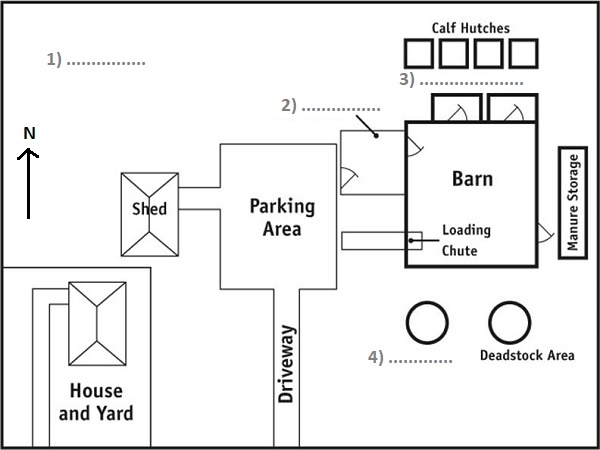
IELTS Map Listening Practice Lesson 2

RECORDING:

.

MAP ANSWERS & TRANSCRIPT

Click below to reveal the transcript, answers and a list of keywords. I suggest you use the transcript after you complete the listening lesson to listen and read, then check the answer key.

Click below:

Transcript

As you drive up the driveway you will immediately arrive in the parking area. You will see to your left the farmhouse where the farmer lives as you drive up and directly to the left of the parking area is the main shed. There are a number of smaller sheds located around the main shed which are not currently labelled on the map. In the northwest corner of the farm is a pasture area which is a wide grassy expanse. It provides rich organic grass for our cows and, along with other types of feed, gives us our organic status and key selling point.  From the parking area, you go east through the milk house, which is used daily, and then into the barn. This is where the cows are often sheltered. On the other side of the barn is the manure storage. To the north you will find the calf hutches which are located just beyond the maternity pens. Only 30% of our cows are used for breeding. In the bottom left corner of the barn is the loading chute. To the south are two circular areas, one of which is the feed storage and the other the deadstock area. We hope you will enjoy looking around our farm and learning about how we manage our cows.

Answers
  1. pasture area
  2. milk house
  3. maternity pens
  4. feed storage
Keywords

Knowing keywords for maps and building plans is essential for success in IELTS listening. Here are some words from the recording.

  • You will see to your left…
  • directly to the left of ….
  • located around
  • which are not currently labelled on the map
  • In the northwest corner
  • From the parking area, you go east
  • On the other side
  • To the north you will find
  • which are located just beyond….
  • In the bottom left corner of the barn
  • To the south are two circular areas

Adapted from royal.gov.uk

.

************************

RECOMMENDED FOR YOU

FREE SUBSCRIBE

Success! An email was just sent to confirm your subscription. Please find the email now and click 'Confirm' to start subscribing.

.

IELTS Direct Question Essay: Success of a Business

Sample essay about judging success in business. This essay question  asks two direct questions which you must answer about the way success in business can be measured. The essay below was written by a student but as one major flaw – can you find it.

Essay Question

Some people think that the only way to judge someone’s success in business is by the amount of money they make.

Is money a true indicator of the success of a business?

In what other ways could success in a business be measured?

Student’s Essay

It is argued in the statement that achievement and success in business can only be judged by the amount earned by the people. From my perspective, money is a true and most valuable criterion to mark success of a business. There are different other ways to measure business success which will be taken into account prior to reaching an informed conclusion.

Money is considered as a correct and reliable index to predict the strength of a successful business. For example, families of victorious business owners are rolling in money just because they earn a lot to fulfil the needs and demands of their dependents. It is clearly evident from the given example that the amount of money directly correlates with the huge productivity and outcome of a trade. So, it is only possible for someone to deal with all the life affairs very coherently with an ample amount of earning.

There are many other potential ways in which the peak of running business can be measured easily. Firstly, different deals and standard packages are only offered by the leading multinational companies. Secondly, a power of occupation can also be judged by the remarkable number of clients. Thirdly, an organization can also become successful with happy clerks and working staff. Finally, a success of a business can be related to the amount of taxes paid by its owners, as increased income will lead to more tax payments.

To conclude, although money is the most important way to determine the effectiveness of a business but other methods are also very important to tackle multiple problems in running a business. By following the above mentioned protocols, economy would have a bright future internationally.

Assessing the Essay Above

  1. Should the thesis statement begin with “From my prospective, …”
  2. Does the thesis statement provide answers to the questions?
  3. Does the first body paragraph answer the first question?
  4. Does the second body paragraph answer the second question?
  5. Does the topic sentence ( the first sentence) for each paragraph contain the main point?
  6. Are linking devices used well?
  7. What other comments can you make about this essay?

Answers

  1. It is better to start with “In my opinion”. See this lesson about how to give your opinion in an IELTS essay.
  2. Yes, each question should be answered in the introduction.
  3. Yes.
  4. Some of the points are off topic. Some ideas about how a company can become successful instead of how success is measured.
  5. The topic sentence for BP1 is fine and provides a clear answer. However, the topic sentence for BP2 is not clear because it doesn’t mention about measuring success of a business but about measuring the running of a business  (which is not the same thing).
  6. Yes, they are used well.
  7. More time needs to be spent planning ideas to make sure they are on topic. Here are some tips on planning an IELTS essay.


IELTS Model Essays Band Score 9, click to open


Main IELTS Pages

Develop your IELTS skills with tips, lessons, free videos and more.

Get my free lessons by email

Success! An email was just sent to confirm your subscription. Please find the email now and click 'Confirm' to start subscribing.

Clothes Vocabulary: Formal and Casual

Clothes is another common topic in IELTS speaking. Organise the following vocabulary into three different categories: Casual / Formal / Suitable for both Formal or Casual. You will see that the vocabulary below includes both clothing and accessories (bags etc).

  • tie
  • suit
  • shorts
  • t-shirt
  • trousers
  • suitcase
  • dress
  • flipflops
  • shoes
  • jacket
  • waistcoat
  • backpack
  • briefcase
  • pajamas
  • coat

Answers

Casual Clothes

  • shorts
  • t-shirt
  • flipflops
  • backpack
  • pajamas

Formal Clothes

  • tie
  • suit
  • waistcoat
  • briefcase

Either Casual or Formal

  • trousers
  • dress
  • shoes
  • jacket
  • coat
  • suitcase


Get my free lessons by email

Success! An email was just sent to confirm your subscription. Please find the email now and click 'Confirm' to start subscribing.

Single-Sex Schools Vs Mixed Schools

Learn useful ideas to talk about the advantages or single-sex and mixed sex schools. This topic can appear in IELTS writing task 2:

Some people think that children perform better in a single-sex school compared to a mixed school. To what extent do you agree or disagree?

Single-Sex and Co-educational Schools

If you don’t have youtube, try listening to a recording of the video. Audio

Recommended

Get my free lessons by email

Success! An email was just sent to confirm your subscription. Please find the email now and click 'Confirm' to start subscribing.

IELTS Speaking Part 1 Topic: Travel & Transport

It is common to get the topic of travel or transport in IELTS speaking part 1. These topics can actually be divided into subtopics which are all be asked in part 1, see the list below:

  • Holidays
    • Weekend Breaks
    • Hotels
    • Traveling Abroad & Culture
    • Public Holidays (Celebrations and Festivals)
    • Days off work
    • Trips
    • Journeys
  • Tourist Attractions
    • Historical Attractions
    • Museums and Galleries
    • Statues and Monuments
  • Private & Public Transport
    • Bicycles
    • Cars
    • Driving
    • Buses
    • Trains
    • Planes
    • Walking
  • Getting Around
  • Roads
  • Traffic

As you can see above, there are a number of subtopics for the topics of travel and transport. Make sure you prepare a range of ideas and vocabulary for all topics and subtopics.

IELTS Bar Chart: Tips for a High Score

Learn how to describe an IELTS bar chart by following the tips and techniques in this video lessons. This lesson is 100% vital for all IELTS candidates doing writing task 1 academic paper.

You must learn:

  • how to write an introduction
  • how to identify key features
  • how to write an overview (this is the key paragraph)
  • if there is a conclusion or overview
  • how to organise the body paragraphs
  • how to write complex sentences
  • tips to avoid getting a low score
  • how to get a high score
  • MODEL ANSWER FOR THIS LESSON: BAR CHART MODEL ANSWER BAND 9

IELTS Bar Chart Tips Video Tutorial

This video lesson shows you how to tackle an IELTS bar chart for writing task 1 (academic paper). To see the full model answer for this video lesson, please click on the link above. Also read the summary of tips below the video.

IELTS Bar Chart Essential Tips

Below are useful tips for an IELTS bar chart.

1. Introduction Paragraph

Keep your introduction paragraph simple. Just paraphrase the information given by IELTS. It is usually just one sentence. It is possible to also comment on the units of measurement in the chart “Units are measured in …”. You might want to add other key information such as country names, category names and dates.

2. The overview

Look at your bar chart and choose the key features. These might be highs, lows, main differences etc. Collect them together and present them in an overview. To learn more about the overview / conclusion debate, please see my IELTS Overview Video Lesson. You must remember that the examiner is looking for the overview and it is an essential part of your Task Achievement mark. That criterion is 25% of your marks.

3. Body Paragraphs

Make sure you have more than one body paragraph. The usual is two body paragraph. Decide how you will divide the information in the bar chart into difference body paragraphs. You must organise your paragraphs into a logical order.

4. Support Sentences with Data

Your body paragraphs must have numbers to support them. If you fail to have numbers with your sentences in the body paragraphs, you might get only band 5 in Task Achievement. To learn useful vocabulary for using data accurately, see my lesson: IELTS Vocabulary: Accurate Data.

5. Complex Sentences

You must write your task 1 using a range of complex sentences. You must learn these sentence structures. The best way is from model answers: IELTS Writing Task 1 Model Answers.

6. Linking devices

You should use a range of linking devices. For example, while / whereas / as opposed to / compared to / in comparison with. All these will help you get a higher score in Coherence and Cohesion which is 25% of your marks. Make sure you use them correctly.

7. Assessment Criteria

Learn more about what the examiner wants to see in your writing. You must understand the requirements for the band score you are aiming for. See this page to learn about IELTS Writing Task 1 Band Scores 5 to 8 Explained.

 Recommended

Main IELTS Pages

Develop your IELTS skills with tips, model answers, lessons, free videos and more.

FREE SUBSCRIBE to get new posts and lessons by email

Success! An email was just sent to confirm your subscription. Please find the email now and click 'Confirm' to start subscribing.

Do the advantages outweigh the disadvantages? IELTS Essay

“advantages outweigh the disadvantages?” is a common IELTS essay question in writing task 2 which many people struggle with. Below is an sample essay question to practice this type of essay and also some tips to help you.

What is an IELTS Advantages Outweigh Disadvantages Essay?

Take a look at the two essays below:

Essay 1

In recent years, more and more people are choosing to read e-books rather than paper books.

Do the advantages outweigh the disadvantages?

The essay question asks a direct question to you which is a question of choice. Whenever you are asked for choose something, you know it requires an opinion. This type of advantage disadvantage essay is very different to the normal advantage essay:

Essay 2

The development of tourism contributed to English becoming the most prominent language in the world. Some people think this will lead to English becoming the only language to be spoken globally.

What are the advantages and disadvantages to having one language in the world?

As you see, Essay 2 only asks you to present the advantages and the disadvantages rather than choose between them. This is the most typical type of essay question and you can find tips about it on this page: ADVANTAGES AND DISADVANTAGES ESSAY.

So, Essay 1 is the advantages outweigh disadvantages essay type and it is different. Read below to learn tips for tackling it.

Tips for IELTS Outweigh Essay Questions

To answer this type of IELTS essay question you must:

  1. Brainstorm ideas supporting both sides first.
  2. This question is asking for your opinion so you will need to decide your opinion.
    • do you think the advantages or the disadvantages are most important? Which one?
  3. Write your answer to the question in the thesis statement in your introduction stating your opinion clearly.
    • you can use the word “outweigh” in your introduction if you want
    • or you can simply explain if there are more advantages and less disadvantages or vice versa
    • avoid formulaic statements for your thesis statement – this means don’t use a memorised phrase.
    • don’t write “this essay will…” this isn’t how you write your own opinion. You must use words such as “In my opinion” or “I think”.
  4. Body paragraphs should cover both advantages and disadvantages whilst at the same time making it very clear which one is more important. This isn’t an advantages AND disadvantages essay – it is about presenting and arguing your opinion.
  5. Make sure your support points in the body paragraphs are 100% relevant and don’t stray off topic.
  6. Re-state your opinion in the conclusion using different language

Be Careful

  • The “outweigh” essay question is not exactly the same as the Advantages and Disadvantages essay question. Don’t turn it into a discuss without any clear opinion or you will get a low score for Task Response.

MODEL ESSAY FOR IELTS ADVS OUTWEIGH DISADVS 

In recent years, more and more people are choosing to read e-books rather than paper books.

Do the advantages outweigh the disadvantages?

An increasing number of people are using e-books as a reading tool, such as a kindle, instead of traditional paper books. I believe there are significant benefits to using e-books over paper books with only a few minor drawbacks.

E-books have enormous advantages over the paper book mainly because of the vast number of books that an e-book device, namely a kindle, can contain. Kindles are able to contain thousands of books which you can categorise and organise on a device that is lighter than a tablet. For people who are travelling or those who want easy access to multiple books, these devices are perfect. Furthermore, e-books can be purchased with the click of a button giving instant access to the book without having to wait for delivery. 

On the other hand, there is a downside to choosing an e-book over a paper book. The main issue is that it can be hard to find books on specialist subjects in electronic form. Many specialist and old books are only available as a paper book and can only be found in libraries. Another point to consider is that e-books are yet another device which people are glued to and that does have an impact on eye sight and health in general. It has long been known that people spend too much time on their devices and therefore reading a paper book might actually be preferable from time to time.

In conclusion, I think e-books have brought numerous gains to people’s lives through accessibility and convenience that truly benefit people’s lives, but there are disadvantages that should not be ignored.

Recommended for Writing Task 2

FREE SUBSCRIBE

Success! An email was just sent to confirm your subscription. Please find the email now and click 'Confirm' to start subscribing.

…………………………………………..

Advanced Lessons & E-books for IELTS Writing Task 2

Advanced Writing Lessons for Target band 7, 8 & 9

.

Tourism and The Local Community

Below are some ideas for the advantages and disadvantages which tourism brings to a community. These ideas can be used both for speaking part 3 and also writing task 2 in IELTS.

Essay Question

Over the last few decades, there has been an increase in international tourism. Some people think that tourism is beneficial for local communities and should be encouraged.

To what extent do you agree or disagree?

Speaking Part 3 Questions

  1. Do you think tourism is a good thing?
  2. Why do you think some people  believe tourism to be bad for local communities?
  3. Do you think local communities change as an effect of tourism?
  4. Do you think there are more advantages than disadvantages of tourism for local communities?

Don’t forget we are looking at the effects of tourism as an industry rather than a tourist as a person. Don’t confuse the two.

Ideas For Tourism Topic

Advantages of Tourism

  1. Tourism boosts revenue and supports the local economy.
  2. Tourism opens up new employment opportunities for local people.
  3. It stimulates local entrepreneurship.
  4. Tourism brings with it fresh perspectives on life and culture. 
  5. It fosters cross-cultural understanding.
  6. Locals usually need to learn English to talk to tourists which can have beneficial long-term effects.
  7. To boost tourism, money is often invested in improvements in local infrastructure and facilities which has lasting positive effects on the whole community.
  8. It can lead to the preservation and restoration of places of historic importance and natural beauty.

Disadvantages of Tourism

  1. Tourism can create economic dependency which can be detrimental to the community if it is not sustainable.
  2. It can cause economic strain for some individuals because employment is often seasonal.
  3. Tourism can have a negative impact on the local environment in terms of pollution.
    • noise pollution from tourist entertainment
    • air pollution from increased transportation
  4. Tourism can cause friction between locals and tourists, if local culture is not respected.
  5. Local culture can be affected by the influx of foreigners leading to cultural erosion over time.
  6. The bulk of the money brought in by tourism rarely finds its way into local hands and instead lines the pockets of the middleman (tour operators).
  7. Locals might struggle as tourism often results in a rise in housing costs and living prices in the area.

Please note that the ideas above require adapting depending on the question you are given in Writing Task 2 or Speaking Part 3. If you found this page useful, you might also be interested in my Ideas for Essay Topics E-book which covers over 150 common essay topics: IDEAS E-BOOK

RECOMMENDED FOR YOU

Click below:

FREE SUBSCRIBE

Success! An email was just sent to confirm your subscription. Please find the email now and click 'Confirm' to start subscribing.

error: Content is protected !!