Introduction Paragraph for IELTS Writing Task 1

FREE VIDEO: How to write an introduction paragraph for IELTS Writing Task 1. This is a full lesson which shows you techniques to create a high band score introduction for various kinds of tasks in Writing Task 1. This is a Must Watch video for all IELTS candidates preparing for their test.

Take your time to learn from this video. It is packed with tips, techniques and lots of advice to help you understand how your writing is marked.


This is my first video lesson for IELTS preparation in nearly a decade. I enjoyed making it for you and I hope you will enjoy and benefit from watching it.

All the best

Liz
IELTS Speaking Part 2 Topic Water Sports: Vocab & Model Answer

The IELTS cue card Water Sports is a common topic in Speaking Part 2. It appears most years and is in use at the moment. It’s not an easy topic if you haven’t prepared for it. Below you can see some useful ideas for this topic, vocabulary and a model answer.

IELTS Cue Card Water Sports

Talk about a water sport you would like to try

  • what it is
  • where and how you would do it
  • what equipment would you need
  • and why you would like to try it

Examples of Water Sports

Below are some examples of popular water sports:

  • canoeing
  • kayaking
  • surfing
  • windsurfing
  • water skiing
  • diving
  • snorkelling
  • boating
  • yachting
  • fishing
  • water volleyball
  • swimming

As you can see, some of these options might not be considered a water sport, such as swimming (for enjoyment) and fishing (for enjoyment). But that’s ok and still acceptable to use for your talk. To expand your talk, you could branch into other things people do around water or on the beach, such as building sandcastles, beach volleyball, going to a water park etc.

Water Sports Vocabulary:

  • wetsuit
  • swimming costume
  • bikini
  • sunscreen
  • sun hat
  • baseball cap
  • waves
  • choppy / gentle waves
  • waves lapping against the shore, calm water
  • crystal clear water
  • strong currents in the sea
    • weak swimmers get pulled out to sea by the current
    • they need to stay close to the shoreline
  • high tide / low tide
  • sand
  • sand dunes
  • seaweed / kelp
  • lagoon / lake / bay
  • reef  / coral
  • life jacket
  • armbands
  • water floats
  • inflatable waterbed
  • jellyfish
  • wind surfing: controlling wind, balancing on a board, adjusting the sail to control direction, gusts of wind, learn manoeuvres, take hold of the mast with both hands
  • canoeing and kayaking: sitting in a small water craft, slimline craft and easily manoeuvrable, propelling yourself through the water with a paddle, legs stretched out in front, life jacket, flat water, white water
  • diving: oxygen tanks, mask, regulator, fins, wetsuit, weights, sink neath the waves, swimming pool, open water, claustrophobia, sharks, stingray, fish, reef
  • fishing: line rod, hook, fly, weights, casting the line out, fly fishing, bait casting, spinning, angling

Feelings:

  • I hate water going up my nose, I can’t stand water going over my head.
  • I feel uncomfortable submerging my head below the surface of the water.
  • I have a a fear of drowning.
  • I love floating on the surface of the water.
  • I enjoy the the feeling of being weightless.
  • I adore diving into the waves.
  • I’m scared the current will pull me out to sea.

Model Answer: IELTS Water Sports Part 2 Speaking

Below is a model answer to the cue card above about water sports.

I’d like to talk about kayaking. It’s something I’ve never tried before but I’ve heard loads of people talking about it. In fact, my friend recently went to the Vietnam and kayaked around Ha Long Bay, which is a gorgeous bay spotted with mountains that sprout up out of the water. She showed me pictures of her and her boyfriend kayaking around the crystal blue waters. It looked magical. They were both in the same kayak, cutting through the still waters completely at peace with the world. If I had a chance to try kayaking, it would probably be in a local river where the water is calm rather than choppy. The company who offer it is really keen on safety so they provide really strong crafts and lifejackets, as well as training in necessary safety measures. From the pictures I’ve seen, you get a single kayak for one person which you sit in. You use a paddle to move the kayak in the water. You also use the paddle to break and slow down if you go too fast. One of the reasons I want to try it is because I like being around water but I don’t like being submersed in water, as you would for swimming. So, kayaking is a perfect compromise for me. Some people told me I should try diving because you don’t get wet when you wear a wetsuit. But I get claustrophobic and I think the feeling of being under the water with only a tank of oxygen would make me panic. But if you asked me what I would prefer doing if I was on a beach holiday, it would be to just stroll up and down the beach collecting shells and driftwood. I much prefer looking at the sea, than being in it. But, I’ll see how I feel on my next holiday.

Comments and Tips:

  1. You can see that it isn’t necessary to talk about only one thing , even though you are asked about only one. If you don’t know much about something, you can talk about it a little bit and then introduce other things. So, in this talk, the topic was kayaking, but the speaker also mentioned diving and general beach activities. This is a good strategy for IELTS Speaking Part 2.
  2. Create a story – you can go into detail about someone else’s experience. It’s a great way to give descriptions: crystal blue water, mountains that sprout up out of the water etc.
  3. If your talk is about a sport, always try to mention equipment even if it isn’t asked for on the cue card. It’s good vocabulary to show the examiner. If you don’t know precise words like “wetsuit”, you can just say “specialist water proof clothing for water pursuits”. Paraphrasing is always good.
  4. You can talk about things you don’t like as well as what you do like. Or things you would do as well as things you wouldn’t do. It’s a great way to expand your talk.
  5. This is a hypothetical topic “something you would do”. Make sure you use at least one conditional statement: If I had the chance, I would ….
  6. Also use at least one present perfect: I have never tried …

More Speaking Cue Cards, Model Answers and Tips

Click here: Main IELTS Speaking Page

……………………………………………………

Free Subscribe to get New Lessons & Tips by Email

Success! An email was just sent to confirm your subscription. Please find the email now and click ‘Confirm’ to start subscribing.

IELTS Liz Personal Update 2024

Hi guys,

I’ve made this video to let you know how I am and whether I’m going to make more videos. I haven’t made a video for 9 years and now it is time to tell you what happened to me. Learn about my background and my motivations behind creating this website. Click below to watch…

.

Thanks to all of you who sent me lovely, kind, supportive messages over the years as I’ve been fighting for my health. I appreciate all your support.

Wishing you all the best

Liz

IELTS Model Essay -Two Questions Essay Type

IELTS Writing Task 2 Two Questions Essay is basically a Direct Questions Essay where you are given one, two or three direct questions to answer. Instead of being given task, such as “Discuss both sides.”, you are given specific questions to answer about a given topic.

IELTS Two Question Essay Task Sample

Below you see a two question essay for IELTS Writing Task 2.

More and more adults are playing computer games.

Why is this happening? Is it a positive or negative trend?

As you see, there are two tasks:

  1. to explain what the causes are for this topic
  2. to decide whether you think this is a positive trend or negative trend

These two tasks are of equal importance. This means that for your body paragraphs, you must address each question equally and explain each with equal length. This is actually part of the Task Response marking criterion, which counts for 25% of your writing task 2 marks. Click here: WRITING T2 MARKING CRITERIA WITH TIPS

Useful Tips: IELTS Two Direct Questions Essay

The main topic in the essay question is Technology and the specific topic is Computer Games and Adults.  I’ve provided a list of tips to help you tackle this type of essay question.

  1. There is only one issue to tackle: computer games. This is lucky. It is an easy essay question. Some essay questions are more complex and have two separate issues to tackle.
  2. The issue is specific: This means it is specifically relating to adults and your essay should not discuss why children play computer based. All IELTS essays must be very focused to the precise task you are given.
  3. There are two questions to answer. I call this type of question a “Direct Question Essay”. The first question is about causes of the trend. You might have one main cause or two causes. The second question is about evaluating whether this trend is good or bad. Whenever you are asked to choose, it means you must give your opinion.
  4. Analyse & Brainstorm:
    • Think of some examples of computer games that adults play. You need to spend time on this aspect of the question. The deeper you think about this, the more relevant your main ideas will become. For example, are there any computer games that require intelligence? How have computer games changed over the years? Is this a reason why so many adults now play games? The more you think, the better your ideas for tackling this essay will be.
    • Think about what attracts adults to these computers games. What do they get out of it?
    • Then think about whether you, personally, think this is good or bad. Do adults gain anything from playing computer games or are computer games a complete waste of time for them? Are there any negative consequences of adults doing this?
  5. After you brainstorm, choose the ideas that are the most relevant and the easiest to explain well. You don’t get a high score because you have lots of ideas. You get a higher score for presenting specific ideas which are well developed and highly relevant.
  6. Body Paragraphs: f you have two questions to cover. It is logical to have two body paragraphs. Being logical in your choice of paragraphing is important.
  7. Provide a clear position in your introduction as to whether you think this is a positive or negative point. Being clear in the introduction helps the examiner follow your body paragraphs more easily and this will increase your score. If you think it is positive – make it clear. If you think it is negative – say so. If you think “it depends” – make sure you word it clearly and explain it clearly in the body paragraphs – never sit on the fence when you are asked to choose. The easiest approach is a positive or negative one (a one-sided approach). The “it depends” approach is harder and requires stronger language skills.

Model Essay for IELTS  Two Direct Questions

It seems that the current trend is for an increasing number of adults to enjoy playing computer games in their free time. With the development of game technology, it is hardly surprising that adults are playing games, but whether it is positive or negative depends on the games played and the time spent on them.

In terms of why so many adults are choosing to spend time playing computer games, it is mainly because the technology behind the games is becoming more sophisticated. Initially, when games first came out, they were very simplistic and appealed mainly to children. However, things have moved on since then and games have become visually appealing, very absorbing, require great dexterity and some also have a strategic challenge to them which adults particularly like. Such games can attract professional adults looking to hone tactics and skills to other adults wishing just to relax and switch off.

However, whether this trend in adults towards computer games is beneficial or not can be challenged. Some adults use complex, challenging games as a form of escapism which keeps their mind sharp and helps them relax at the same time. As long as the time spent on such games is balanced with other healthier pursuits, it can be constructive. Unfortunately, adults who ignore their physical health and spend too much time on mindless, repetitive games develop a sedentary lifestyle which can be detrimental to their wellbeing.

In conclusion, computer games have become more fascinating and tempting to adults. While games that help develop tactics and knowledge might be advantageous, no game, particularly senseless games, should be played to excess and certainly should not replace healthier leisure activities.

Word count = 276

RECOMMENDED FOR YOU

……………………………………………………

FREE SUBSCRIBE

Success! An email was just sent to confirm your subscription. Please find the email now and click 'Confirm' to start subscribing.

.

IELTS Bar Chart of Age Groups 2024

A Model Bar Chart of Age Groups for IELTS Writing Task 1. Use flexible language for describing age groups and don’t get too lost in lots of detail. Use the model answer below to guide you. Charts, tables and graphs showing age groups appear every year in IELTS Writing Task 1 (Academic Test).

IELTS Bar Chart Age Groups: Salt Intake (2024)

This writing task 1 bar chart has been adapted from a bar chart that was reported by an IELTS candidate in the IELTS writing task 1 test. 

IELTS Bar Chart of Age Groups

Click here to Enlarge Bar Chart Image 

IELTS Bar Chart of Age Groups: Model Answer

I’ve underlined language relating to age groups in the model below.

Your Task: Complete the model answer using these linking words: while / as opposed to / then / overall / regarding / furthermore

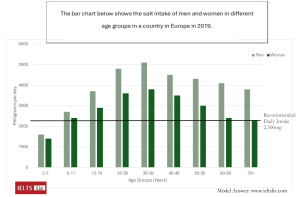
The bar chart illustrates the amount of salt an average man and woman consumed per day (divided into nine age groups) in a European country in 2019. Units are measured in milligrams.

(1)………………, men had a higher intake of salt compared to women and salt intake was above the recommended daily amount in most age groups. (2)………………….., middle aged men and women had the highest intake of salt, (3)………………….. young children who had the lowest. A greater difference in salt intake between the sexes could be seen as men and women aged.

The salt consumed by the youngest age group was just under 2000mg each day for boys but only 1500mg for girls aged five and below. Salt intake (4)…………… increased in both sexes to reach a high of over 5000mg in men and almost 4000mg in women aged 30 to 39.

(5)………………. the 40 to 49 age group, salt intake stood at about 4500mg daily for men, whereas for women it was around 3500mg. This decreased for both genders and by the age of 70 or more, consumption was still relatively high in men (just under 4000mg), (6)……………. women took the recommended daily amount of 2,300mg.

ANSWERS

Click below to reveal the answers to the exercise and the full complete model.

ANSWERS
  1. Overall
  2. Furthermore
  3. as opposed to
  4. then
  5. Regarding
  6. while
FULL MODEL & TIPS

The bar chart illustrates the amount of salt an average man and woman consumed per day (divided into nine age groups) in a European country in 2019. Units are measured in milligrams.

Overall, men had a higher intake of salt compared to women and salt intake was above the recommended daily amount in most age groups. Furthermore, middle aged men and women had the highest intake of salt, as opposed to young children who had the lowest. A greater difference in salt intake between the sexes could be seen as men and women aged.

The salt consumed by the youngest age group was just under 2000mg each day for boys but only 1500mg for girls aged five and below. Salt intake then increased in both sexes to reach a high of over 5000mg in men and almost 4000mg in women aged 30 to 39.

Regarding the 40 to 49 age group, salt intake stood at about 4500mg daily for men, whereas for women it was around 3500mg. This decreased for both genders and by the age of 70 or more, consumption was still relatively high in men (just under 4000mg), while women took the recommended daily amount of 2,300mg.

(200 words)

Tips & Comments

  1. The introduction is concise and introduces all key information about the chart, such as categories, divisions, units, country, frequency etc. Introductions are usually just one sentence in writing task 1 reports.
  2. The overview is separate and contains all key features about highs, lows and any useful comparisons that give a clear overview.
  3. The body paragraphs contain smaller detail and all sentences are supported by numbers from the chart.
  4. Rather than giving each individual age group, key points are selected and other groups are referred to as “salt intake increased over the age groups…”. This gives information about other age groups without going into too much detail.
  5. Always use flexible vocabulary about age: middle aged people/ children aged five and under / young children / as people grew older / the youngest age group / the oldest age group / over the age groups given / people aged 30 to 39 / the 40 to 49 age group / by the age of 70 or more / people between 30 and 39 years of age
  6. This chart does contain a lot of information which is why the report is 200 words in length. However, most reports will probably be between 170 and 190 words. Longer doesn’t mean better. It just depends on the chart. You do not need to write the word count under your report in your test – I do that just for your benefit.

.

FREE SUBSCRIBE

Success! An email was just sent to confirm your subscription. Please find the email now and click 'Confirm' to start subscribing.

.

IELTS Speaking Part 3 Model Answers: Sport

Here are some IELTS questions and model answers for the topic of sport in Speaking Part 3. This topic can appear in part 1 and part 2 as well.

This topic isn’t just about sport, but also about exercise in general. Make sure you don’t confuse exercise and sport – they are two different things even though they overlap. This part of the test takes 4-5 mins and it is the part when you can speak more freely, give longer answers, express your opinions and talk about the world in general. It’s also the part when the examiner can challenge your answers so be ready for that – this is the discussion part of the IELTS Speaking Test. These questions are not about you personally, but world issues.

IELTS Speaking Part 3 Questions & Answers: SPORT

Note: These questions appear each year in the test so they are definitely worth preparing for. The model answers below are only an example of the many ways the questions can be answered. You can give whatever opinion you wish, but do explain it well for a high score.

1. Do you think children get enough exercise these days?  ANSWER

No, I don’t. Personally, I think that children spend too much time sitting in front of computers or tablets instead of being outside playing and exercising. A few generations ago, children were much more active but nowadays they only do exercise at school during PE lessons. I think that’s a problem because it will really impact their health later on. It’s hardly surprising that obesity is on the rise.

  • Comment: Is it ok to give information that isn’t asked for, such as giving your opinion about the effects of lacking of exercise when it isn’t asked for? The answer – yes, it’s fine. You can take the questions in any direction you want and the examiner will direct you from there. Part 3 is the flexible part of the speaking test and you should allow the examiner to guide you through it by challenging your answers or asking for more details.

2. Do you think exercise is important? ANSWER

Yes, very much so. Of course, there are the health implications. I mean, exercise is essential to ensure that we burn off calories and encourage blood to circulate as well as all the other health benefits it brings. But it’s also important for our mental health. It’s a way to release stress and become more mindful. As technology develops, people are living more and more sedentary lifestyles so we must focus on exercise to ensure we lead a balanced life.

  • Comment: The examiner isn’t testing your knowledge. So, just try to speak naturally and give your opinions confidently. Even an answer like the one above, which contains limited ideas will still get a good band score because ideas are not marked in IELTS Speaking (ideas are marked in IELTS Writing Task 2)

3. Is there a difference between exercises or sports that boys like and those that girls usually enjoy?  ANSWER

Well, I’m not sure. Traditionally, boys tended to prefer doing more strenuous, active and competitive sports which required more strength and stamina, such as football, boxing or basketball, whereas girls often preferred more relaxing and gentle exercises, like yoga or walking. However, these days things are different. There are many female football teams now and many boys take up yoga. I don’t think sports are so gender oriented any more, which is great, and I hope sports will continue to diversify in the future.

  • Comment – it’s great not to take a black and white new of issues in the speaking test. Part 3 is a discussion and it’s great to open topics up to discussion about how things have changed or your personal views on things. It takes confidence to do this in English which is great for your band score. And as you will notice, it also means, particularly in the answer above, that you could end up using a variety of tenses.

4. How can parents encourage their children to take more exercise? ANSWER

To be honest, I don’t think it’s easy for parents to encourage their children to be more active. However, one possible way would be for parents to get involved in sports themselves and take their children along to join in. I think, if exercise is made fun for children and they can do it together with their parents, it would probably result in more children being more active.

  • Comment – you are not restricted to how many solutions you offer in your answer. But for the speaking test, it’s always best to explain what you mean in detail rather than giving a list of solutions. The more details you give, the better.

5. Do you think sports have changed much over the last few decades? ANSWER

Yes, I do. I think one of the main changes has been in sports technology which is so much more advanced now than it was years ago. For example, the speed with which tennis players can hit the ball now is so much faster mainly because rackets are made from compost materials which provide more durability and power. Also, there is a trend for more extreme sports such as such as skydiving, bungee jumping and kitesurfing, which are getting more and more popular.

6. What are the benefits of international sports events? ANSWER

That’s an interesting question. Let me see, well I guess one of the main benefits is that it encourages international cooperation. I mean, sports are a neutral, non-political activity that can bring countries together in a peaceful way. Although, they are competitive, events still promote international harmony between countries and reminds us all that we are all on one planet living together. Also, it’s a great way for people to open their eyes to cultures and countries that are different from their own. It’s a way to promote tolerance and understanding, which are seriously needed in the world today. And of course, international sporting events are just great fun for everyone. It’s a time for people to feel proud of their country and support their sports professionals. I think that can be really inspiring for young people.

7. Are there any downsides to international sports events? ANSWER

Yes, there are. I think the most obvious disadvantage is the cost. When a country offers to host an big sporting event, like the Olympics, they have to build new facilities, expand infrastructure, spend money on security and pay for labour costs. For countries that aren’t rich, this is a huge burden. Certainly, there can be financial advantages to hosting, but it the costs are still enormous. Some countries have also been known to use slave labour for sporting events which really goes against everything that international sports events represent.

8. Do sports people make good role models? ANSWER

That’s a good question. I haven’t really thought about that before. I guess I would say that on the whole, they make good role models. I mean a professional sports person is someone who has dedicated their time and energy to their discipline and that is a great lesson for all young people, particular those who lack the motivation or determination to apply themselves to something. However, not all of them are good role models. I mean, some of them have been caught taking drugs to enhance their performance, which is obviously a terrible model for young people.

.

Note: As you see, my answers are written in speaking style with expressions like “I mean” and “let me see”. The IELTS Speaking Test is informal so do get used to using a more relaxed way of speaking.

RECOMMENDED FOR YOU:

FREE SUBSCRIBE

Success! An email was just sent to confirm your subscription. Please find the email now and click 'Confirm' to start subscribing.

.

IELTS Topic: Urban Planning

The IELTS topic of Urban Planning in IELTS Speaking and Writing Task 2. This topic has appeared in the IELTS test a number of times. For this reason, it is a good topic to prepare for. Many people find this topic challenging because they don’t have many ideas about it. Below you will find:

  • What urban planning means
  • Speaking Part 3 Questions
  • Speaking Model Answers
  • Writing Task 2 Essay Questions
  • Useful Vocabulary and Ideas

This topic might also be called Urban Design.

What is Urban Planning / Urban Design

Before we look at questions and model answers, lets first understand what urban planning is.

  • Urban planning is about planning where houses and buildings are located in a city.
  • It is about ensuring there will be enough housing for the residents both now and in the future.
  • It is about planning the infrastructure of roads, bridges, overpasses etc to ensure a good flow of traffic.
  • It is also about the design of buildings and their function.
  • It’s about protecting some buildings and knocking others down.
  • It’s about how space is used in a city.
  • It helps ensure that a city can meet the needs of its citizens.
  • Before someone builds a house, it means they would require building permission which ensures their plans are acceptable.

IELTS Speaking Part 3: Urban Planning

Speaking Part Questions for Urban Planning with Model Answers. As you can see from the title of this section, this is most likely to appear in Speaking Part 3. If you had a topic in part 2 about your city, an interesting place in your country, or a crowded place, it is very possible to get this topic in part 3. Below are some questions:

  1. Is urban planning useful? (Why do we need urban planning?)
    1. I think it’s essential for any growing city. If there wasn’t any planning, people would be able to build what they want, where they want. There would be chaos, blocked traffic and unsafe buildings. I think that if any city wants to become successful in the modern world, it needs careful planning so that it remains efficient and appealing.
      1. Alternative answer: I think urban planning is really important, but too much control isn’t good. What I mean is, planning is important for big buildings, historical buildings and the infrastructure, but I think people should still be able to build the house they want for themselves without the government saying no.
      2. I’ve been to cities with good urban planning. They are really a joy to be in. There are wonderful city gardens, cycle paths, well-spaced buildings, trees and roads wide enough for the traffic, good facilities all easily accessible and much more. I think urban planning is essential if a city is to attract visitors, residents and businesses.
  2. Do you think it is interesting living in a crowded area?
    1. Personally, I’m not very keen on crowds. I mean, crowds are ok for concerts or festivals because they are exciting. But I wouldn’t want to live that way on a daily basis. I prefer cities that are more tranquil.
      1. For me, I think all modern cities with the best job opportunities are crowded. You can’t get away from that. It shows how popular the city is. Also, the more crowded it is, the more facilities and entertainments there probably are. I’d love to live in a bustling city. Such cities, feel really alive and fun.
  3. Are cities better to live in than the countryside?
    1. I suppose it depends on who you are talking to. I mean, people who have a family might prefer to live in the countryside where it’s more peaceful and also cheaper. But young people who are trying to get ahead with their careers might prefer a city because there are so many more opportunities and the salaries would be higher.
  4. Is it important for a city to have facilities for amusements?
    1. I think all cities should be designed to have amusements. I can’t imagine so many people living in a city that had nothing to offer for their free time. I mean, cities are the best places to go for nightclubs, cinemas, restaurants and concerts. Also, people come to the city to earn money and most of them probably would want to enjoy their income in their leisure time.
  5. Does urban planning make a city more boring? (Does urban planning take the character out of a city?
    1. I think it depends on the government and the aims of their urban planning. That is to say, some governments are only interested in cheap, unattractive, functional buildings which have no character and no charm. This would definitely make a city pretty boring to visit and live in. But other governments understand that a city should be appealing, with impressive buildings, historical buildings and beautiful parks. So, if urban planning is done correctly, it can make a city more attractive, not only to the residents there, but also to foreigner travellers. After all, tourism is good for the economy.

IELTS Writing Task 2 Essay Questions: Urban Planning

Below are examples of essay questions that have appeared in the IELTS test about buildings and city planning.

Some people think that cities should be designed to be beautiful rather than functional. Do you agree?

Some people think urban centres need more green spaces, while others believe more housing is needed. What do you think?

As cities have increased in size and building work has expanded in a haphazard way, there should be more careful planning. Do you agree or disagree?

Some people think it is better to pull down old buildings and replace them with modern ones. However, others believe old buildings still have value. Discuss bot sides and give your opinion.

Some cities locate shops, housing, schools and entertainment in different areas of the city. What are the advantages and disadvantages of doing so?

Useful Vocabulary for Buildings and Urban Planning Topic

  • requalify existing city buildings
  • create new urbanisations
  • improve the quality of life of the inhabitants / residents
  • ensure a logical and efficient city layout
  • plan commercial centres
  • ensure building safety
  • plan infrastructure, such as roads, airports, railways, public transport system, cycle paths etc
  • planning for the increase in traffic on roads to avoid congestion
  • make educational and health care facilities easy to access
  • without planning, future city growth might become unsustainable
  • protect heritage sites and places of historic significance
  • create national pride through buildings and layout of key buildings
  • plan parks and other green spaces for health benefits
  • ensure that housing and buildings do not encroach on natural resources, places of beauty and other protected areas
  • prohibit development that might threated wildlife and natural habitats
  • to ensure the capacity for future urban growth
  • relocating business outside urban areas
  • decentralising services, such as schools, shops and companies
  • helping with carbon emissions by developing cycle paths and efficient public transport
  • to ensure a good urban landscape
  • waste management and sanitation must be well planned for hygiene reasons
  • it makes a city more liveable / more accessible / more interesting / more appealing
  • people will feel more prosperous in a well planned city
  • it attracts investment for business
  • ensures that the city is well connected with other cities and other countries

IELTS Writing Task 2 Useful Links

Click here for: IELTS Writing Task 2 Model Essays, Tips and Lessons

Click here for: IELTS Writing Task 1: Model Answers, Tips and Lessons

FREE SUBSCRIBE

Success! An email was just sent to confirm your subscription. Please find the email now and click 'Confirm' to start subscribing.

,

IELTS Listening Transcripts: When and How To Use Them

Are you given the transcript in the IELTS Listening test? Why do IELTS put the transcript in the answer key of their IELTS Cambridge Test books? Why does Liz give the transcript to her listening lessons? Lets learn a bit about the use of transcripts for the listening test and listening exercises.

IELTS Listening Transcripts

Read through the questions and answers below to learn why you should use transcript, how to use them and how you can benefit from them.

What are transcripts in IELTS listening?

The transcript is the audio recording in written form, word for word, precisely as you hear it. 

Will you be given the transcript in the real test?

No. you will not be given the transcript. You will hear an audio recording and you must answer questions based on the recording you hear. You must listen, read the questions and answer the questions all at the same time. For the paper based test, you write your answers on the question paper and then have 10 mins to transfer your answers to the answer sheet at the end of the listening test. For the computer based test, you put your answers into the computer screen directly and are given only 2 mins at the end of the listening test to check and alter your answers. After the IELTS test is completely ended, you will not be given the transcript at that time either. The test will remain the property of IELTS. You can’t even remove the question paper from the test room. 

Will IELTS give me access to the transcript after the test?

No. IELTS do not release either the answers to your listening test or the transcript to your test.

Where can you find transcripts?

Transcripts are only given to you along with the answers in test books and on my website for my lessons. I only supply the transcript with the answers, not with the questions.

Are they useful?

Yes, transcripts are essential for you to use as part of your IELTS listening preparation which is why all my listening lessons provide the transcript with the answers.

What are transcripts used for in IELTS test preparation?

You can use transcripts in the following ways once you have finished your listening practice test or practice lesson.

  1. When you finish a listening lesson or a listening test, don’t just check the answers directly. Instead, listen again to the audio and read the transcript at the same time. This will allow you to check your answers while listening again and reading the words. You only do this after you have finished the listening lesson and you are sure if your answers. It is method of checking the answers which is more useful than just checking the answer key because it allows you to spot your mistakes which is highly beneficial for your training.
  2. When checking the list of answers, refer to the transcript. Find the location of the answer and see how the answer was presented in the recording. Read the sentences before and after each answer. This way you can see why you got the answer right or wrong.
  3. Go back to the transcript and make a note of the paraphrases used. This way you can increase your vocabulary and spot the reason why you might have missed the answer.
  4. Finally, read the transcript and listen to the audio together one last time to help your speaking skills and pronunciation. In fact, it’s a great way to improve speaking – listen, pause and repeat out loud.

As you can see, the transcripts can help you develop crucial awareness and skills needed to improve your score. Some people do practice test after practice test without improving. Now you know why. You need to analyse your mistakes, analyse why you got something wrong, note paraphrased and learn from mistakes. The transcript will help you a lot with all this.

IELTS Listening Free Tips & Practice Materials:

Click here: ALL FREE LISTENING LESSONS & TIPS 

………………………………..

Free Subscribe to get New Posts by Email

Success! An email was just sent to confirm your subscription. Please find the email now and click 'Confirm' to start subscribing.

error: Content is protected !!