IELTS Table Band Score 9 Model Answers with Tips

Below is an IELTS table with model answer for Writing task 1. The tables below are typical of what you will get in your IELTS test. The model answers help you understand how to structure your table writing and organise data into paragraphs. Getting lost in too many numbers is the biggest challenge for IELTS tables. All model answers are estimated at band 9 and are written as a safe guide to learn from for all band scores.

How to Approach IELTS Table Questions

Useful strategies for IELTS Tables in Writing Task 1: Below are useful steps to ensure that you approach your IELTS table correctly. Try not to get lost in detail and instead look for patterns, similarities and differences to group information together.

  1. Analyse the key information in each category.
    • look for key features (highs/lows/usual data/ changes)
  2. Think about grouping information and categories together
    • if numbers are all below 5%, group them together as one but avoid writing them as a list and instead refer to them collectively
        • group information together with similar trends is essential for an IELTS table because of the volume of data given.
        • you get a lower score if you give too many small details
        • you get a lower score if you miss out information
    • if a number or a category is unusually high, single it out as an individual feature
  3. Plan your paragraphs and content. Each paragraph has a unique and clear function. Use the model table answers above to review them.
    1. Introduction
    2. Overview
    3. Body Paragraph 1
    4. Body Paragraph 2
    5. Body Paragraph 3 (not usual but possible at times)
  4. The introduction should be short and factual.
    1. For a free video lesson, click here: How to Write an Introduction for Writing Task 1
  5. The overview is the most important paragraph. Make sure it contains all key features for a high score.
  6. Divide your body into paragraphs.
    1. In most tables, you will have categories along the top and the side. You must decide the best way to divide categories into body paragraphs. Always choose the most logical.
    2. The time to give data in the body paragraph. Each statement must be supported with numbers from the table given. If you don’t give numbers, you’ll get a lower score for Task Achievement which counts for 25% of your marks.
    3. You don’t have to give all details. You can group details together by giving averages or ranges.
    4. Be selective. Don’t put too many details in your report.
  7. Make sure you write over 150 words but aim for less than 200.
  8. Try to avoid being repetitive with your sentence structures.
  9. Pay attention to what type of information the table gives (static figures or changes over a period of time). This will help you decide what kind of language to use.
  10. Do not try to paraphrase all words, all the time. This leads to vocabulary mistakes. Choose wisely which words to change and which to keep the same.
  11. All information and language should be accurate for a high score

IELTS Table Model Answers

IELTS Table: Question 1

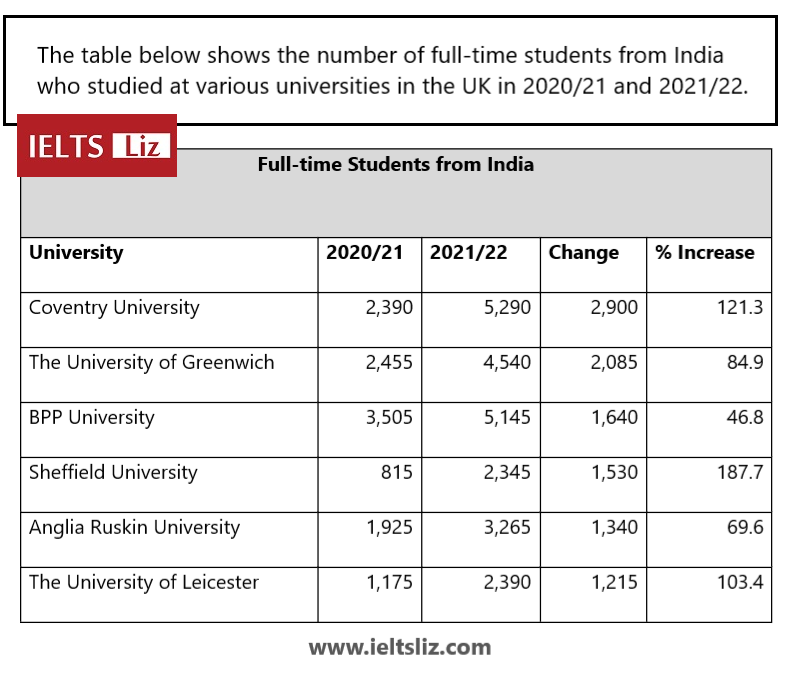
As you see, this IELTS table shows  change over two time periods with four categories in total.
IELTS Table

IELTS Table Model Answer 1

The table gives information about how many full-time students coming from India studied in six British universities in two academic years (2020/21 and 2021/22) as well as the change in numbers and percentage increase.

Overall, the greatest increase in Indian students could be seen in Sheffield University, while BBP University showed the lowest increase over the two years. The university with the most students from India was BBP University in the first year and Coventry University in the second year.

Sheffield University saw a dramatic rise of 187.7% in India students reaching 2,345 in 2021/22. Likewise, the number also climbed considerably for Coventry University by 2,900 students (121.3%) to hit 5,290 students in 2021/22. Another significant increase was seen in Leicester University from 1,175 to 2,390 students, a rise of 103.4%.

All other universities saw an increase of under 100% in the number of Indian students over from 2020/21 to 2021/22. The number of students going to University or Greenwich and Anglia Ruskin University rose by 2,085 students (84.9%) and 1,340 (69.6%) respectively. Regarding BBP University, the number of students remained high in both years at 3,505 and 5,145, which was a growth of only 46.8%.

IELTS Table: Question 2

This IELTS table is slightly easier because it contains less data. You can also see trends for each category more easily.

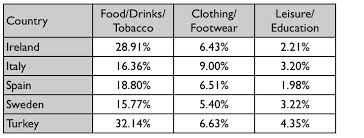
 The table below gives information about consumer spending on different items in five different countries in 2002.
IELTS Table Question Writing Task 1

(Source: IELTS Cambridge English Test Book

IELTS Table Model Answer 2

The table illustrates the proportion of consumer expenditure in Ireland, Italy, Spain, Sweden and Turkey on three types of consumer goods in 2002.

Overall, the category of consumer goods that all countries spent most on was food, drinks and tobacco, which was three times higher than on the other types of goods. The lowest spending could be seen in the category of leisure and education in all five countries. The outlay of Turkey was generally higher than the other four countries.

In terms of food, drinks and tobacco, Turkey spent the most at 32.14%. The expenditure of Ireland was also high (28.91%) compared to Sweden which spent the least (15.77%). Spain and Italy spent 18.80% and 16.36% respectively. On the other hand, the lowest expenditure was on leisure and education which accounted for under 5% in all countries. Turkey spent most on these items at just 4.35% of their national expenditure which is around double that of Spain (1.98%).

Clothing and footwear was the third category of consumer goods and outlays for those items were between 9% in Italy and 5.40% in Sweden.  The national spending in this area for the remaining countries averaged around 6.5%.

Note: in most writing task 1 reports, body paragraphs do not need to be a similar length. In report writing, it is common to very some long paragraphs and others quite short. Tables are no different to other task 1 charts.

RECOMMENDED FOR YOU IN WRITING TASK 1:

FREE SUBSCRIBE

Success! An email was just sent to confirm your subscription. Please find the email now and click 'Confirm' to start subscribing.

.

Answers to Paragraphing Options for Writing T1

I’ve posted the answers on the original page, click here: https://ieltsliz.com/writing-task-1-paragraphs-review/

All the best

Liz

Paragraphs Review for IELTS Writing Task 1?

Lets check your understanding of IELTS writing task 1 paragraphing. This is for academic writing task 1.

Below are a number of options for how to structure your writing task 1. Are all these options good for IELTS writing task 1?

Option A

  • Paragraph 1 = introduction & overview
  • Paragraph 2 = body 1 detail
  • Paragraph 3 = body 2 detail

Option B

  • Paragraph 1 = introduction
  • Paragraph 2 = overview
  • Paragraph 3 = body 1 detail
  • Paragraph 4 = body 2 detail

Option C

  • Paragraph 1 = introduction
  • Paragraph 2 = body 1 detail
  • Paragraph 3 = body 2 detail
  • Paragraph 4 = overview

Option D

  • Paragraph 1 = introduction
  • Paragraph 2 = overview
  • Paragraph 3 = body 1 detail
  • Paragraph 4 = conclusion

Questions for You

  1. Which paragraphing options are suitable for writing task 1? 
  2. Is there an option above which will get you a higher score?
  3. Which structure is not acceptable?

Paragraph Options Explained: Answers

Options A, B, & C are all possible to be used in Writing Task 1 and get a high score. Option D will not give you a good score. Read the details below to learn more:

Option A

When the introduction is very short, such as with diagrams, I sometimes put my overview statement with the introduction. I feel it gives a better balanced of paragraphs. Although the introduction and overview are in the same paragraph, they MUST be separate statements. The introduction presents the information (paraphrases the description) and the overview contains all key features.

Option B

This is my personal favourite. Writing task 1 is not an essay. It is a report. The overview contains all the key features and I prefer to present that before giving all the smaller details. I like the reader to understand the gist of the chart, before seeing small examples of data. 

Furthermore, the overview is THE MOST IMPORTANT PARAGRAPH IN WRITING TASK 1. For this reason also, I like to put it early on in the writing. The overview needs to be both clear and contain information well selected.

Option C

It is also 100% fine to put the overview at the end of the report. However, if you choose this option, make sure you manage your time well – your overview is the most important part and needs to be thought about carefully and written very very well.

Option D

There are two very serious problems with this structure.

  1. The body must be divided into a minimum of two paragraphs. You are being marked on how you take the detail and divide it into logical sections. Most writing task 2 will have two paragraphs for the body, but occasionally you might have three. 
  2. You cannot have both an overview which contains the key features and a conclusion that summarises the key features. This would mean in a short report, you would have repeated the key features twice. This will lower your score. There is no reason to repeat anything at all. Once you state the key features in the overview, your body paragraphs (plural) will present all main details. You never repeat it all again. This means you do not need a conclusion. 

I hope you have found this useful 🙂 My main writing task 1 page has lots of model answers which show both option A and B. CLICK BELOW:

IELTS Writing Task 1 Tips, Model Answers & More

If you want letter writing tips for GT writing task 1, see this page: https://ieltsliz.com/ielts-letter-writing-essential-tips/

All the best

Liz


IELTS Reading: Matching Headings

Practice and useful tips for tackling IELTS reading matching headings questions. These are one of the most challenging types of question in the reading test. They are certainly the most lengthy and time consuming. Below you will find tips for what these questions require and how to approach them. And there is a reading practice lessons as well.

IELTS Reading Matching Headings Tips

Below are a list of useful tips to tackle these types of matching questions. You definitely need a strategy and familiarity to answer these questions correctly and to do it quickly. Even if you are at native speaker English level, you need practice and develop strategy, otherwise you will waste valuable time.

  1. You can choose whether to skim read (read for gist, not detail)  the passage first or the headings. There is no right or wrong way. You decide what works for you. Most teachers will recommend you read the headings first.
  2. One advantage to the computer reading test is that the headings and passage are side by side on the screen. For the paper test, they are on different pieces of paper.
  3. Count how many headings you have and how many paragraphs. You will usually have more headings than paragraphs.
  4. There is only ever one heading that works for each paragraph.
  5. The headings are basically titles for the paragraph. This means the heading summarises the aim of the entire paragraph.
    • This isn’t about matching words or just locating information in the paragraph, it’s about the aim of the whole paragraph.
  6. Pay attention to headings that are similar in meaning or contain similar words. Some headings can appear very similar so you’ll have to pay attention to the way in which they differ.
  7. Spend time paraphrasing keywords in the possible headings. You will use keywords and key paraphrases to decide which paragraphs or headings are possible. Then you analyse deeper meaning before deciding your answer.
  8. Read the paragraphs to find the main idea – what is the direction and aim of the paragraph?
  9. Distinguish between main ideas and extra information or examples in the paragraph.
  10. There might be a heading which does match some information or one sentence in the paragraph, but that doesn’t mean it is the answer. Your aim is to find the heading that matches the aim of the whole paragraph, not just one sentence. So, look out for that when you choose your heading.
  11. Not all headings will be used.
  12. Your answer will be a roman numeral, for example, I or VI. Do not write words.
  13. Remember one correct answer is only worth one point so think about how much time you are spending on these questions. They do take time to answer.
  14. In the paper test, you’ll see the list of headings first (similar to the reading lesson below). On the computer test, the headings and passage will be side by side, which is easier. Don’t forget the paper test and computer test are not different tests. They are the same test whether you type or write your answers.

IELTS Reading Matching Headings Practice Lessons

Reading Practice 1

Try this reading passage below. 

Reading Passage: The Greenhouse Effect

Choose the correct heading (I-IX) for paragraphs A, B, C and D in the passage below.

  • I     Changing temperatures
  • II    The greenhouse
  • III   Global warming
  • IV   Use of a greenhouse
  • V    Werne’s research
  • VI    Earth’s atmosphere
  • VII   Our choices
  • VIII  Effects of carbon dioxide
  • IX     Climates around the world

A.   A greenhouse is a house made entirely of glass: both walls and roof are glass. One of the main purposes of a greenhouse is to grow tomatoes, flowers and other plants that might struggle to grow outside. A greenhouse stays warm inside, even during winter. Sunlight shines in and warms the plants and air inside. But the heat is trapped by the glass and cannot escape. So during the daylight hours, it gets warmer and warmer inside a greenhouse, and stays quite warm at night too.

  The Earth experiences a similar thing to a greenhouse. Gases in the atmosphere such as carbon dioxide do what the roof of a greenhouse does. During the day, the Sun shines through the atmosphere. Earth’s surface warms up in the sunlight. At night, Earth’s surface cools, releasing the heat back into the air. But some of the heat is trapped by the greenhouse gases in the atmosphere. That is what keeps our Earth a warm and comfortable 59 degrees Fahrenheit, on average.

C   However, gas molecules, called greenhouse gases, which absorb thermal infrared radiation, are rising and this is what is altering the climate system. Carbon dioxide (CO2) and other greenhouse gases act like a blanket, absorbing IR radiation and preventing it from escaping into outer space. The greenhouse effect, combined with increasing levels of greenhouse gases, produces climate change on a global scale, which is expected to have profound implications for all countries around the world.

D   Many scientists agree that the damage to the Earth’s atmosphere and climate is past the point of no return or that the damage is near the point of no return. Josef Werne’s, an associate professor at the department of geology & planetary science at the University of Pittsburgh, told Live Science that we have three ways to move forward. Firstly to do nothing and live with the consequences. Secondly, to adapt to the changing climate (which includes things like rising sea level and related flooding protection). Thirdly, mitigate the impact of climate change by aggressively enacting policies that actually reduce the concentration of CO2 in the atmosphere.

The above article was adapted from wiki and livescience.com

MATCHING HEADINGS ANSWERS

Click below:

ANSWERS

Paragraph A = II

  • The answer can’t be IV. The paragraph did contain information about how the greenhouse was used, such as growing vegetables. But that information was not the main aim of the paragraph, it was additional information. If the aim was about it’s uses, there would be more information about using it for various purposes – but that isn’t the aim.
  • The answer can’t be I, about Changing Temperatures. Although temperature is often mentioned, it is only to illustrate how the green house works. The aim isn’t to discuss temperatures and how they change.
  • The paragraph actually talked about what it was made of, what it was used for and how it works. The best title would be “The greenhouse” because the paragraph gives a clear overview of it.

Paragraph B = VI

  • The answer isn’t I  because the paragraph actually explains that this natural effect keeps the temperature of Earth stable.
  • The answer is VI which explains how Earth’s atmosphere works to keep our planet at a stable temperature.

Paragraph C = III

  • The answer isn’t VIII (Effects of carbon dioxide) because the paragraph isn’t aimed at explaining carbon dioxide and in fact only mentions it along side other greenhouse gases.
  • The answer isn’t  IX (Climates around the world) because although climates are affected around the world, the whole paragraph aim isn’t to discuss climates in different countries.

Paragraph D = VII

  • The answer isn’t V because the paragraph doesn’t actually discuss Werne’s research (which means how he did his studies and the problems with his studies), but rather his opinion about what options we have to deal with our changing world climate.

.

************************

Reading Practice 2

Reading Passage: The History of Pasta 

Choose the correct heading (I-VIII) for paragraphs A, B, C and D in the passage below.

  • I       A theory dismissed
  • II      Marco Polo in China
  • III     Is pasta really a popular Italian dish?
  • IV     China is the origin of pasta
  • V      The real roots
  • VI     An Arabian taste sensation
  • VII    The common belief of the origins of pasta
  • VIII   How about China?

A    Worldwide, pasta has become synonymous with Italian cuisine. Italian immigrants themselves brought pasta everywhere they went. While it is true that the most famous varieties and recipes of cooking pasta really do come from Italy, surprisingly, the actual origin of pasta lies elsewhere!

B    One of the more popular theories of the arrival of pasta in Italy was published in the ‘Macaroni Journal’ by the Association of Food Industries. It states that pasta was brought to Italy by Marco Polo via China. Polo ventured to China in the time of the Yuan Dynasty (1271-1368) and the Chinese had been consuming noodles as early as 3000 B.C. in the Qinghai province. There is even some evidence there of 4,000-year-old noodles made from foxtail and broomcorn millet.

C    Unfortunately, there are problems with this theory, least of which is that the noodles they were making in China aren’t technically considered pasta. Polo also described Chinese noodles as being like “lagana”, which implies he was possibly already familiar with a pasta-like food before going to China. Further, in 1279, there was a Italian Genoese soldier that listed in the inventory of his estate a basket of dried pasta. However, Polo did not come back from China until 1295. Furthermore, the modern pasta we know today was first described in 1154 by an Arab geographer, Idrisi, as being common in Sicily. So Marco Polo could not have brought pasta to Italy via China. It was already in Italy at that time.

D   Most food historians believe that Arabs (specifically from Libya) are to be credited for bringing pasta, along with spinach, eggplant and sugar cane, to the Mediterranean. In the Talmud, written in Aramaic in the 5th century AD, there is a reference to pasta being cooked by boiling. It is thought, then, that pasta was introduced to Italy during the Arab conquests of Sicily in the 9th century AD, which had the interesting side effect of drastically influencing the region’s cuisine. It also known that by the 12th century, the Italians had learned from the Arabs methods for drying pasta to preserve it while traveling. Further support for this theory can be found by the fact that, in many old Sicilian pasta recipes, there are Arab gastronomic introductions. One example of cross cultural recipes is Barida, which is an old Arab recipe with Roman clear roots.

Source: Passage was adapted from: todayIfoundout.com.

MATCHING HEADINGS ANSWERS

Click below:

ANSWERS
  1. A = VII
    • This paragraph is all about what we think is the origins of pasta. It opens up the topic of where pasta really comes from.
    • The answer cannot be III (Is pasta really a popular Italian dish?) because it is not about how popular pasta is as a dish within Italy.
    • The answer isn’t I (A theory dismissed) because the paragraph isn’t about a theory, but about a common belief – a common opinion or thought.
    • The answer cannot be V (The real origins of pasta) because the paragraph aim is not to talk about the real origins but instead just to introduce the idea that is isn’t Italy.
  2. B = VIII
    • This paragraph offers yet another common belief which is that pasta comes from China. For this reason, “How about China” which means is China the real origin fits with the whole aim of the paragraph.
    • The answer isn’t I (A theory dismissed) because although the paragraph does present a theory, it does not aim to dismiss it.
    • The answer isn’t II (Marco Polo in China) because although it mentions Marco Polo, the aim isn’t not to discuss his time in China.
    • The answer isn’t IV (China is the origin of pasta) because the paragraph isn’t aimed to convince us that China is the origin but rather to introduce the theory that it could be.
  3. C = I
    • This paragraph is all about dismissing the theory that was introduced in the previous paragraph – that pasta was introduced to Italy by Marco Polo when he came from China.
  4. D = keep reading:
    • There are two possible headings for this paragraph
      • V      The real roots
      • VI     An Arab taste sensation
    • We do see the word “roots” used in the paragraph.
    • We do see the paragraph is about an Arab food.
    • But which heading works? The key is meaning:
      •  – taste sensation – means a powerful, incredible, delicious experience of flavour in an ingredient or dish. This paragraph give no description of this and it certainly isn’t an aim of the paragraph to talk about something full of amazing flavour.
      •  – roots – we need to look more carefully at this word. We use the word “root” to talk about an origin of something. This paragraph really does talk about the origin of pasta. It is about the real roots of pasta. In the paragraph, the word “root” as in reference to one particular dish that had Roma roots with Arab influence. This word acted like a distractor – to confuse the reader about the real heading.
    • The answer is V (The real roots)

.

I hope you enjoyed the lessons. All the best, Liz

**********************

RECOMMENDED FOR YOU

FREE SUBSCRIBE

Success! An email was just sent to confirm your subscription. Please find the email now and click 'Confirm' to start subscribing.

.

Should I Speak Fast or Slow?

Many students ask me if they should speak fast or slow in their IELTS speaking test. Some students think that if they speak more quickly, they will get better results. Before I answer the questions of how fast to talk, lets look more at how your speaking test is assessed.

IELTS Speaking Tips: Speaking Fast or Slow

All this falls under the criterion of ‘fluency‘ which accounts for 25% of your final marks for your IELTS speaking.. Fluency relates to the flow, smoothness and coherence of your speech as well as hesitations and pauses.

FLOW –  this is about your ability to keep talking. If you are aiming for band score 6 and above, this will be important. You must show the ability to answer at length rather than just give short answers.

SMOOTHNESS – this relates to how often you break your speech with pauses, hesitations, self-corrections and silences. All of this interrupts the flow and stops the smoothness of your speech. If you are aiming for band score 6 and above, it is important  to avoid any long pauses and to avoid  repeating yourself.

COHERENCE – this is all about being understood. There is no point having a good flow with smooth speech if you are not talking in any logical order. This means organising your ideas so that the listener can understand and also using some linking devices to help the listener follow what you are saying.

How Fast Should I talk? So, how fast should you speak? As long as you keep a steady pace, you will be fine. Avoid speaking very slow because the listener can get lost in what you are trying to say if it takes you a long time to say it. Alternatively, don’t speak very fast as you may lose your coherence and the words might not be clear or easy to understand. Instead:

  1. Keep a steady, even pace when you are talking.
  2. Extend your answers.
  3. Avoid long pauses.
  4. Don’t repeat yourself too much.
  5. Avoid correcting yourself more than once or twice.
  6. Keep a logical order to what you are saying.

Free IELTS Speaking Tips & Lessons

Click the following link for more Speaking Tips: IELTS Speaking Tips & Lessons

FREE SUBSCRIBE

Success! An email was just sent to confirm your subscription. Please find the email now and click 'Confirm' to start subscribing.

.

IELTS Remarking Success Story

Can your IELTS score change after remarking? This is one persons story about remarking and the amazing results that followed.

Below is Najada’s story.

My IELTS Remarking Success Story

Hello everyone.

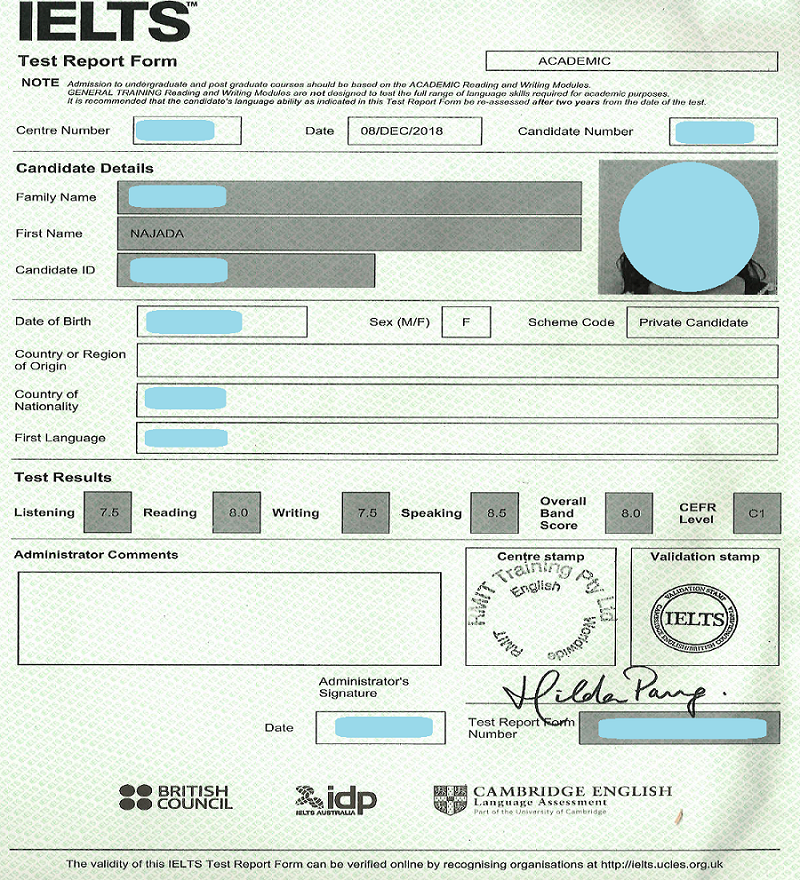
I took my IELTS Academic module on the 8th of December 2018 in Melbourne Australia. I have been living and working in Melbourne for nearly 2 and a half years, which means English has become part of my life everyday communication.


I needed to sit my IELTS in order to apply for a registration to work as a Physiotherapist in Australia. The minimum score required is 7 in each module and overall band score 7. ​I was very lucky to come across IELTS Liz website. I solely studied from Liz’s website. I did most of the lessons, read all the tips, followed all updates and of course purchased the Advanced Writing lessons. ​I strongly recommend to all students to purchase the advanced lessons as they are ABSOLUTELY fantastic. Liz’s explanation and advice are very comprehensive and clear.​I could not afford having a tutor to study so Liz’s website and affordable advanced writing lessons saved my life!!!​​

I received my IELTS score as the following:

  • Listening: 7.5
  • ​Reading: 8.0​S
  • Speaking: 8.5​
  • Writing: 6.0

​​I was absolutely disappointed with my writing score as I was pretty sure I did better than 6. In Task 1 I had two line graphs and Task 2 a problem solution essay. I did follow Liz’s advice on how to organise paragraphs and ideas, did my planning before starting writing!!!! VERY IMPORTANT​ I used a variety of complex sentences (Liz’s lessons for complex sentences are fantastic). I was as careful as possible. I felt that something was wrong with the score, so I started checking online about the remark option.​ The majority of the websites mention that there is a possibility to get a change in the score, with a 0.5 increase being the most common and in rare cases a 1.0.​ What they also mention is that if there is a major difference between each component (like my case) they will ask for a second examiner to mark it just to be sure. ​So I thought they might have done that with mine too.

But still my gut feeling said to me that something is wrong. I did better than 6.0. ​So I decided to apply for a remark. The remark fee is quite expensive, 176 AUD to be precise, so if there is not a change you lose your money, but if there is a change you get a full refund.​ I decided to take the risk because as I said before I did study very hard for my writing, which was my weakest part.​​

After 4 weeks I received an email saying that there has been a change to my writing score. And that change was……. 7.5. I COULD NOT believe it. That’s a 1.5 increase. So my final score is overall band score 8 with:

  • Listening: 7.5
  • ​Reading: 8.0​
  • Speaking: 8.5​
  • Writing: 7.5

Even the staff at the English Centre  where I took my IELTS were absolutely surprised by this remark change. ​If you have a doubt about your results, while you are confident that you have done better than this, go for the remark. You might receive your desired score.​​

I would also like to say that please do read well all Liz’s pages as they contain crucial information about the test. I literally followed her advice for each part of the test.​

What I would like to add about speaking is…. SPEAK ENGLISH AS MUCH AS YOU CAN. I was very lucky to practice my English everyday. Living and working in Australia have allowed me ​to interact with people. I was asking colleagues and friends to correct any errors I made with my speaking and, believe me, that helped me a lot.​ You can only improve if you are aware of your weak points and you are determined to study hard. Nothing comes easy without hard work.​​Unfortunately for permanent residency I need a minimum of 8 in each component, so I have to sit the IELTS again but i can finally practice my profession. I am continuing to practise my listening, speaking, writing and reading and also my spelling as I am pretty sure some of my listening errors were spelling mistakes.​

Thank you Liz for your absolutely amazing hard work and your kindness, Najada.

From Liz: Well done Najada!! And thanks for sharing your story with everyone else. It will help many people. All the best, Liz

.

Remarking Advice from Liz

Note to consider about remarking:

  1. If you are considering a remark, and have a two band score difference between your writing and speaking score (for example, speaking 8 and writing 6), your scores will already have been reviewed by a second examiner who agreed with those marks. This means the chance of your score changing after a remark by a third, senior examiner is less likely to be successful. It doesn’t mean it is impossible to change, it means it is less likely.
  2. Your scores for listening and reading are unlikely to change from a remark, because those scores are not based on examiner interpretation or assessment, but on right or wrong answers. This means it is rare the marking is wrong.
  3. Before you decide on a remark, make sure you do know and understand the band score requirements for speaking and writing. This will help you make the right choice.
  4. “Go with your gut!” Many people decide to try remarking because they feel they did better in speaking or writing (or both). If this is how you feel, make the decision that feels right for you.
  5. The remark is always done by a senior examiner. They will listen to your speaking recording and remark from that. For the writing test, they will remark your writing task 1 and task 2 again.

Share Your Remarking Story

Feel free to post your remarking story to help other people make the right choice. 

All the best

Liz

IELTS Speaking Tips: How long should my answer be?

Should your answers be long or short in IELTS Speaking? Are the answers different lengths for different parts of the speaking test? How long should my answer be? This page offers advice on the best length of your answer for each part of the IELTS speaking test. Learn how many sentences to use for IELTS speaking part 1 or how to expand your talk for IELTS speaking part 2.  Learn how long your answer should be for IELTS speaking part 3.

IELTS Speaking Part 1: Length of Answers

Some people think that they must give only short answers in speaking part 1. Other people think you should expand all answers for all questions. Take a look at the answers below and then click on the advice tab to reveal advice about what is acceptable length.

Example Question Lengths – which answers are the right length?

  • Question 1: Do you like cooking?
  • Answer 1: Yes, I do.
  • Question 2: Do you often cook?
  • Answer 2: No, not really. To be honest, I’m pretty busy most of the time so I rely on eating out or ready meals, so I only cook about once a week.
  • Question 3: What is your favourite meal?
  • Answer 3: Well, it’s really hard to choose. I actually enjoy all meals. I mean, breakfast is always great because it’s my first meal of the day and I usually aim for a big bowl of porridge. But then, I also love dinner because it’s more varied and, having a sweet tooth, I love the desserts. So, I would say it’s a toss up between breakfast and dinner.

ADVICE –  HOW LONG YOUR ANSWERS SHOULD BE

There is no right or wrong way to answer in the speaking test. And marking is not based on each question, it’s based on your overall performance, but here is the best advice for IELTS Speaking Part 1:

  1. The first answer above is too short. Don’t limit your answer to only a few words or just one sentence. It doesn’t show the examiner how good your English is. It is possible that one of your answers might be short, but it isn’t something to aim for. So, always go beyond one sentence.
  2. Part of your score for Fluency is showing you are willing to speak at length. So, very short answers are not good for your Fluency score.
  3. The second answer above is a good length on average. It’s good to answer directly and then offer a bit more. This is a typical length in part 1 when the question is very simply.
  4. However, some questions in part 1 might be more complicated so they might require a slightly longer answer. For example:
    • Q – Why should children learn to cook at school?
    • A – Well, I think that cooking is an essential skill that they will require as an adult. They should be learning not just to cook, but all about nutrition as well. Another benefit is that is helps them become more independent which is also very important.
    • Note: As you see, the question is complex and requires you to explain in more detail so your answer will be longer. Essentially, this means there is no fixed length for your answers in part 1.
  5. The third answer above is quite long for a simple question. The question doesn’t require such a long answer. Is that a problem? No, not at all. You should aim to speak until the examiner interrupts you. Let the examiner decide when to move on to the next question. So, while the answer is quite long for the third answer, it is fine to aim for that.
  6. Overall:
    • Be chatty. It’s an informal speaking test.
    • Be more natural with your answer.
    • Speaking part 1 is 4 to 5 minutes in length for 12 questions. This means there are a lot of questions in a limited time. So, your answers won’t be long, but they definitely shouldn’t be very short.
    • If you have strong fluency then don’t limit your answers – be natural, aim to give long answers, and let the examiner decide when to move on. to only two sentences. To get a high score in fluency, you must show you are able to speak at length without much effort.
    • Speaking until your are interrupted.
  7. See this page for Speaking Part 1 Topics.

IELTS Speaking Part 2 – Answer Length

What happens if you don’t speak for 2 mins? Will you get a low score for fluency? See the advice below.

Typical IELTS Speaking Cue Card:


Describe a family celebration that you remember. You should say
– what you were celebrating
– who was present
– what happened
– and why you like that celebration

Length of your Talk

Take a look at the talk below to see the average length.

I’m going to describe my sister’s wedding day, which took place a few years ago in the town where I grew up. For my sister it was the biggest and most important day of her life.

I think there were around 100 people at the marriage ceremony, which was held in a church. Even more people came to the party, or the wedding reception as we call it, after the ceremony. Of course, most members of my family were there, as well as the groom’s family and a collection of the bride and groom’s friends and colleagues. The person I remember most was John because we hadn’t seen each other in over two years so that was a really pleasant surprise. 

It was a wonderful wedding and quite lavish if I remember rightly. The wedding dress was incredible with layers of silk and lace. The cake was magnificent with detailed icing and it had about four tiers to it. It tasted amazing too, which is always the way with beautiful cakes. It was such a fun day but I can’t say anything particular happened. I mean, it was good weather, great food and the people were full of joy.

I’ve been to a number of weddings and celebrations in the past. This wedding isn’t my favourite in terms of events, but it was the most memorable because it was my sister who was getting married. To be honest, I prefer normal family get-togethers which are much more relaxed and a bit smaller so you get the chance to talk to people for longer. Next year, my cousin is getting married so I can’t wait for that.

ADVICE AND TIPS FOR IELTS SPEAKING PART 2

  1. There are no questions on the topic card. There are prompts on the card. Prompts are there to guide you – nothing more.
  2. To give a full talk, you must add much more information to your talk rather than only follow the prompts.
  3. This is your main chance in the test to show your fluency. Use this opportunity and give lots of description and information.
  4. If the prompt asks “who was present”, you can add why they were there, how close you were to those people, how they travelled to the wedding,  if there were any people you wished hadn’t gone, describe a person you clearly remember … You choose what extra information to add.
  5. Part of your preparation at home will be getting cue cards and practicing speaking for 2 mins. Always use your recording device (your phone) to record yourself so that you can play it back and work on improvement.
  6. See this page for Speaking Part 2 Topics.

IELTS Speaking Part 3: How long should my answer be?

Is the answer below the right length?

Q. Is it better to get advice from a friend or from a family member?
A. I think it depends on the kind of advice that you need. Parents and grandparents probably have more life experience than a friend, and so you might get a wiser or more sensible answer from them. But they might not think on your level or understand your life as well as a friend. Also, friends are less likely to become too worried if you go to them with a problem. For example, I probably wouldn’t want to burden my parents with a financial worry but I’m pretty sure my friends won’t mind if I go to them with a problem like that. It’s easier to talk to friends and they don’t get so stressed out about things.

ADVICE & TIPS FOR IELTS SPEAKING PART 3 – ANSWER LENGTH

  1. The answer above a good length. It’s natural – typical of spoken English.
  2. When you prepare and practice answers for your speaking test, don’t write them down. Speak your practice answers into your phone to record them. We don’t write and speak in the same way so always speak your answers at home.
  3. It’s always good in speaking part 3 to give examples.
  4. Give more examples of when you would seek advice from grandparents – what kinds of problems would prompt you to ask for their help?
  5. It is always better in speaking to give more than you need to give, than to give less..

How long should my answers be in IELTS speaking?

If you have a lower level of English with many hesitations, your answers will be shorter. If you are aiming for band score 7 and above, your answer should be longer. Use each question to showcase your English in a natural way.

Here is a link to an IELTS speaking practice test video. There is also a link in that lesson to a model speaking test. You will be able to see clearly how long my answers are: Practice Speaking Test Video

RECOMMENDED FOR YOU

ALL MODEL ANSWERS & TIPS FOR IELTS SPEAKING

FREE SUBSCRIBE

Success! An email was just sent to confirm your subscription. Please find the email now and click 'Confirm' to start subscribing.

.

IELTS Writing Maps: Model Answer, Tips & Vocabulary

Below is an IELTS Writing Task 1 Map Model Answer with Great Tips and also Vocabulary. The IELTS Map Model Answer is Band Score 9 and helps you see the structure, key features and language. The IELTS Map question is a comparison of three maps in different time periods for the academic writing task 1. 

TIPS FOR IELTS MAPS: WRITING Task 1

Below are useful tips and techniques for writing a high band score writing task 1 map.

Types of IELTS Maps

There are a variety of maps that you can get in IELTS Writing Task 1 test:

  1. Changes in Towns

These types of maps focus on the expansion and layout of towns with features such as roads, buildings, land and other features of a town or city. It is most common to be given two maps, but occasionally (like in the model below) you could get three maps.

2. Changes in a Resort

This is about a holiday area which usually has different features than a town. There might be facilities such as swimming pools, nature hikes, hotels, beaches and water features. These types of tasks often compare current resorts with a future resort. However, future maps could appear as any type of map. 

3. Places with Multiple Buildings and Features

Typical examples of this type of map is a school, university or hospital.

This type of map covers an area of ground containing different buildings that serve different functions. The layout is different to a town and the facilities relate only to the function of the company/institution.

4. Building Plans

You could be given a floor plan which means it is the layout of a building on the inside showing all the rooms. Floor plans often show a past layout with a future plan to expand and alter rooms. Unlike the above maps, this one is about rooms and the functions of rooms. For example a room might have been a study in the past but there are plans to expand it and use it as a kitchen/diner. 

Grammar Tenses for Map Writing

Always check the date on the maps.:

  1. if the map is dated in the past, you must use past tense. For example, “The hospital was located to the north side of the town”
  2. if the map shows a future plan, you must use future forms, such as “it will be extended and will no longer be used as an office, but instead used as a reception room.”. 
  3. if the map is dated as “Present” or “Now”, you would use the present tense.
  4. If there is a comparison of dates, you must be flexible with the tenses in your sentences: “the office was located on the ground floor but in the future it will be moved to the first floor.”
  5. You will also notice that the passive voice is sometimes used for map reports for writing task 1.

Map KEYS and Compass Points

Sometimes your map will have a key. This is a a box of information in the map that tells you what things are called. You should pay attention to it and use that language.

Always check if the map shows north. For towns and other areas, you can always presume that north is directly up. It is important to know: north, south, east and west. Watch the video below for map vocabulary.

Structure & Paragraphing for IELTS Map Writing

Structure of Report

  1. Introduction – paraphrasing the description given and adding more required information
  2. Overview – collecting all key features into one paragraph
  3. Body Paragraph 1 – details of the maps
  4. Body Paragraph 2 – details of the maps
  5. Body Paragraph 3 – details of the maps (optional)

Overview: Key Features

All overviews in writing task 1 are critical to your score and are the most important paragraph. They must contain all key features. So, you need to pay attention to what changes and what stays the same. This what you highlight in your overview paragraph. The biggest mistake people make is writing only one sentence for their overview because they think it isn’t important.

Body Paragraphs

Your division of information for body paragraphs will depend on what your maps show. You might divide the information into paragraphs based in different time periods. But if you do that, you won’t be comparing. Or you could divide information based on what changes and what doesn’t. Body paragraph organisation must be logical whatever your choice.

IELTS MAP WRITING TASK 1: Model Answer 

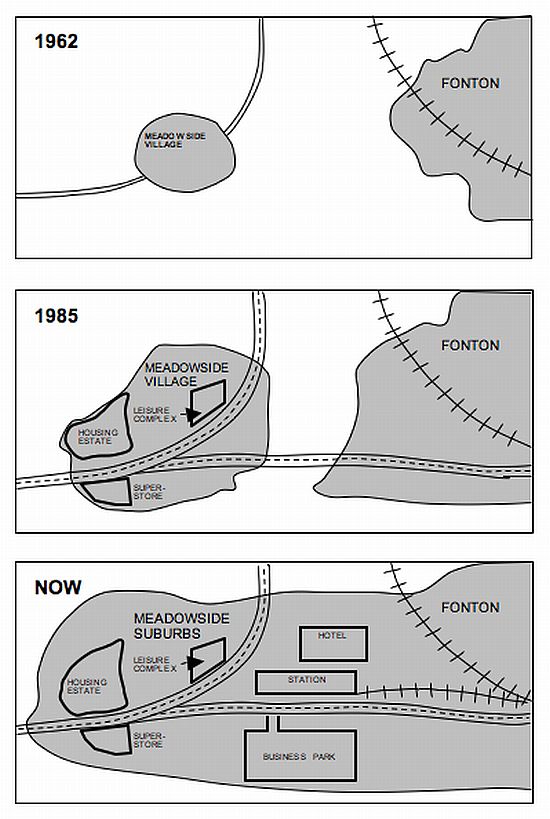
The maps below show the changes that have taken place in Meadowside village and Fonton, a neighbouring town, since 1962.

IELTS Map Comparison for Writing Task 1

Source: Map above not produced by IELTS Liz.

IELTS Map Comparison Model Answer

The three maps illustrate how Meadowside village and Fonton, which is a nearby town, have developed from 1962 to the present.

Overall, both Fonton and Meadowside village increased in size over the years until they eventually merged together, at which point Meadowside became a suburb. Furthermore, there have been significant changes to infrastructure, housing and facilities over the period given.

In 1962, both Meadowside and Fonton were completely separate with no roads or rail connecting them. While Fonton had a railway line running to the north, Meadowside, located to the west of Fonton, only had a small road from the west.

By 1985, Meadowside had expanded and the small road had become a main road. A further main road had been built to connect the village to Fonton. Within Meadowside, a superstore, leisure complex and housing estate had been developed. By this time, Fonton had also grown in size. 

Currently, Meadowside is known as Meadowside Suburbs after joining with Fonton. Between both places, a hotel, station and business park have been built on either side of the railway line.

COMMENTS about MODEL ANSWER:

  1. It isn’t often that you will have three body paragraphs for your IELTS Writing Task 1 report. But this maps has three time periods so it makes sense to have these body paragraphs.
  2. It could be possible to divide the information of body paragraphs into:
    • Body Paragraph 1 – roads and railway
    • Body Paragraph 2 – land and buildings
    • There is no right or wrong way to organise information into body paragraphs. You are being marked on being logical in how you organise information. If it lacks logic, you get a lower score. Your organisation also needs to help highlight key features which means deciding key features during your planning state is important because it will influence your paragraphing.
  3. The length of all writing task 1 should be between 170 and 190 words. A longer report will be marked down for not selecting features and getting lost in detail. A shorter report will be marked for not having enough information. To learn about the marking criteria that the examiner will assess you on, click here: Writing Task 1 Band Scores Explained

Vocabulary for Maps Video

The map shown in this lesson was designed for teaching vocabulary – it not an IELTS map task.

RECOMMENDED FOR YOU

FREE SUBSCRIBE

Success! An email was just sent to confirm your subscription. Please find the email now and click 'Confirm' to start subscribing.

.

error: Content is protected !!