Listening Practice: Big Numbers

Improve your listening skills with this listening practice with big numbers. It is common in all section of the IELTS listening test to be asked to listen and write down large numbers.

Listen to the recording below and write down the numbers you hear. There are 10 numbers to listening for.

Recording:

.

Answers

Click below for answers:

Answers
  1. 451
  2. 730
  3. 1,600
  4. 2,460
  5. 6,768
  6. 10,550
  7. 20,200
  8. 35,050
  9. 102,700
  10. 1,400,002

.

Recommended

ALL LISTENING PRACTICE LESSONS

Solving Traffic and Pollution Problems: Essay Ideas

Below are some ideas for the following IELTS writing task 2 essay question.

Increasing the price of petrol is the best way to solve growing traffic and pollution problems.

To what extent do you agree or disagree?
What other measures do you think might be effective?

There are two questions to answer:

  1. Do you think increasing the price of petrol is the best way to solve growing traffic and pollution problems?
  2. What other measures do you think might be effective to solve traffic and pollution problems?

Increasing the price of petrol:

  • if the price is increased, less people will be able to afford it
  • if less people can afford petrol, less people will drive cars
  • if less people drive cars, there will be less congestion on the roads
  • if less people drive, there will be less air pollution

Other ways to solve traffic and pollution problems:

  • traffic problems can be solved by improving public transport to encourage more people to use it rather than to use their own cars
  • public transport can be improved by having more public transport available, making it more punctual and reducing the price of tickets to make it more affordable to the average person
  • another measure is to have no traffic zones in city centers which will  reduce both congestion and pollution in urban centers.

Get my free lessons by email

Subscribe for free to get my new IELTS lessons sent to your email inbox.

Common Girl’s Names: Pronunciation

Below is a list of common girl’s name in England with an audio as well so you can hear the pronunciation of the name. It is important to learn common names in English for your IELTS listening test. IELTS frequently ask you to listen for personal information such as a name in section 1. You can also listen to boys’ names or watch a video to practice listening for names.

Mistake: Please notice that there is a mistake with the pronunciation of Scarlett in the audio. The audio actually says “Charlotte”. Sorry about that.

Girls Names


Get my free lessons by email

Subscribe for free to get my new IELTS lessons sent to your email inbox.

Advertising Vocabulary & Pronunciation

Essential vocabulary for the topic of advertising / advertisements. I have included recordings of words and meanings so that you can improve your pronunciation of this vocabulary. At the bottom of the page, is some practice exercises to learn how to use vocabulary for advertising correctly. Advertising is a common topic in both IELTS speaking and writing task 2, so you must learn all the basic vocabulary to be able to talk and write on this topic.

This lesson contains a lot of vocabulary. Take your time to learn the words and practice your pronunciation. There is an audio under each table for pronunciation practice.

Vocabulary for Advertising Topic

Forms of the word: Advertisement

  • ad (n)
  • advert (n)
  • advertise (vb)
  • advertising (v+ing)
  • advertisement (n) (there are two different pronunciation – UK and USA)

Main Types of Advertisements:

This is a list of typical commercial adverts that you are likely to come across in your everyday life.

Advertisement Vocabulary: The Main types of Ads with Meaning: TV commercials, newspaper ads, glossy magazine ads, billboards.

RECORDING: Pronunciation

.

Other Types Advertisement Vocabulary:

These types of advertisements are also common in the world today, particularly now that we have the internet and online adverts are common place.

More Vocabulary for Advertisements: direct main, radio adverts, advertising by text message sms, internet pop ups, email advertising and flyers.

RECORDING: Pronunciation Review

.

More Types of Advertising:

This list of vocabulary contains examples of advertisements that are not so well known but are effective forms of more subtle advertising.

More Examples of Advert Vocabulary:  celebrity endorsement, sponsorships, covert ads

RECORDING: Vocabulary Pronunciation

.

Practice Exercises with Advertising Vocabulary

Use the vocabulary relating to advertising given on the page above to complete the sentences. Words may be used more than once.

  1. I think I prefer …………….. because they are really good fun to watch and often have a catchy tune or song to go with them.
  2. Last night, I was just sitting down to my favourite series on TV when the phone rang. It was another …………. I find them really annoying.
  3. Personally, I think that …………………… in movies is the most effective because you aren’t even aware that you are being targeted by a company while you’re watching.
  4. I think ………………… are a great way to advertise because they are so entertaining but I guess they must be very costly to put on, particularly at peak viewing time.
  5. There’s nothing more annoying than trying to work online and getting bothered by ………………
  6. I hardly ever pay attention to adverts in the ………………….. because they aren’t usually very attractive but whenever I flick through a ……………., I’m constantly drawn towards their beautiful, glossy ads.
  7. I find telesales quite ……………….. because they call your home to sell you something. I think it’s an invasion of privacy.

Vocabulary Review & Answers

There are some interesting words used in the exercises above, such as “catchy tune” and “persuasive”. Click below to learn the meaning of some of these words and to find the answers.

Vocabulary
  • eye-catching = appealing, attractive
  • subtle = not obvious
  • flick through a magazine = look at the pages quickly
  • to target an audience = to aim for a group of people
  • catchy tune = an appealing melody
  • peak viewing time = a time when the majority of people are watching
  • glossy = shiny
  • specific market  = particular group of people
  • specific interest group = particular group of people with the same interests
  • persuasive = it convinces us to do something or think something
  • memorable = it stays in our minds for a long time
  • intrusive = causing annoyance, uninvited
  • invasion of privacy = when your privacy has been invaded (entered) without permission
  • up-to-date = current
  • customer database = list or record of customers

Listen to Recording for Pronunciation:

 Answers
  1. TV commercials
  2. cold call
  3. covert advertising
  4. TV commercials
  5. pop-ups
  6. newspaper / magazine
  7. intrusive

.

RECOMMENDED FOR YOU

FREE SUBSCRIBE

Subscribe to get new lessons & tips by email.

.

IELTS Speaking Part 2: Will I get a low score if I speak for less than 2 mins?

Are you marked down in IELTS Speaking part 2 for speaking less than 2 minutes? In speaking part 2, you will be given a topic, 1 min to prepare and then you will need to speak for between 1-2 mins. The examiner will not move on to part 3 until 1 minute has passed of your talk and the examiner will stop you at exactly 2 minutes to prevent you speaking further. So, this means you have between 1 and 2 minutes available to you for your talk.

Do you need to speak for 2 mins in IELTS Speaking Part 2?

Speaking part 2 is the only part of the test where you can show the examiner that you can speak at length. Speaking at length is important for people aiming for band score 7 and above. So, part 2 is a great chance to show this skill and impress the examiner with fluency. Speaking at length is actually part of the Fluency marking criterion. Aiming for 2 minutes should be your aim.

However, your talk should also avoid hesitations and pauses. Both of these things can impact your score.

Length of Talk for IELTS Speaking Part 2: Useful Tips

Here are some more points to consider:

  1. It is better to give a strong, fluent talk for 1.5 minutes than a weak, hesitant talk for 2 mins.
    • If you can speak for 1.5 mins without hesitations and pauses, this will be better than speaking for 2 mins with lots of hesitations and pauses.
  2. You can still get a high score if you only speak for 1.5 minutes but only if the quality of your talk is very good. This means natural, fluent speaking with great use of language.
  3. The marking criterion of Fluency accounts for 25% of your marks and is taken from your overall performance in all parts not only in part 2.
    • This means if your talk doesn’t go well, you can still showcase your fluency in part 3.
  4. If you wish to lengthen your talk,  then add more information. The prompts (the points on the topic card) are only guidelines – you can and should expand on each one.
  5. Aiming for 2 minutes is ideal.
  6. You must practice before your test what 2 minutes feels like so that you know how much to add. But don’t worry the examiner will stop you at 2 mins.
    • The examiner controls the time in the speaking test. Don’t worry about timing. The examiner will interrupt you when it’s time for the next part or the next question.
  7. Speaking for 1 minute is not ideal because it doesn’t show the examiner your fluency skills.
  8. Don’t expect the examiner to be smiling and positive. Sometimes the examiners are tired so be ready for different body language and don’t let it affect your performance in your test.

RECOMMENDED FOR YOU

ALL TIPS, TOPICS, & MODEL ANSWERS FOR IELTS SPEAKING 

FREE SUBSCRIBE

Subscribe to get new lessons & tips by email.

.

Improving a Thesis Statement

This lesson will show you how to write a clearer thesis statement for a specific question essay. This is the introduction paragraph and is applicable to both the GT and academic paper.

Many people think that job satisfaction is important in work.

Do you think young people these days should be sure of getting job satisfaction before taking a new job or should they put salary first?

What can we see from this essay question?

  1. The essay question asks for your opinion (“Do you think….?”)
  2. The essay is about what people look for when they take a new job
  3. It is often thought that people should choose a new job for job satisfaction
  4. Others think that people should choose a new job for the salary

Here’s a student’s thesis statement for their introduction. How would you improve the thesis statement? Try to write this thesis statement again before you look at the models.

While work satisfaction should be a motive for a successful employee, I do not think that salary must be a priority.”

Model Thesis Statement

Here are two possible ways that the above thesis statement could be better written to make the answer clearer for the reader.

1. In my opinion, I think that work satisfaction should be the main motive for choosing a job rather than salary.

2. In my opinion, it is better for people to put satisfaction at work as a priority for choosing a job instead of aiming for a competitive salary.

Model Introduction

Below is a model introduction with both a background and thesis statement. This offers yet another way to write the thesis statement:

People have different views as to whether job satisfaction or money is more important for a young person when choosing a new job. In my opinion, job satisfaction rather than a competitive salary should be the deciding factor and should be prioritised when accepting a new job.

Get my free lessons by email

Subscribe for free to get my new IELTS lessons sent to your email inbox.

Improving Sentences for Academic Writing

This practice exercise is about improving sentences for a higher score in IELTS writing task 2. See the essay question below.

There is a significant gap between rich and poor countries. Some people think that richer countries should be responsible for supporting poorer countries while others think it is the responsibility of the poorer countries. What is your opinion?

Below are some sentences from a student’s essay on the above topic. Read through the sentences and try to improve them yourself before you check the model answers. In other words, write the sentences again to make them accurate and also a better score.

1. Firstly, it is obvious that this is their job. Poorer countries should not wait for any organisation abroad or other governments to deal with this.

2. Secondly, depending too much on rich countries may make them weaker. For example, they will lose a part of their power  if they agree to allow developed nations to help them with critical issues.

3. Regarding to responsibility  of wealthy countries. They should support poorer countries because there are millions of people in poorer nations need their help. Many people in Africa, especially women and children die everyday because of lack of food, medical treatments.

4. However, rich countries should not be forces to help poorer ones. It should be a choice not a responsibility.

ANSWERS

Click below to reveal the answers:

Answer
  1. Firstly, poorer countries need to take immediate responsibility for developing their own country rather than wait for aid from foreign organisations or governments.
  2. Secondly, if poorer nations overly rely on aid from wealthy counties, it can create a dependency which may result in them growing weaker rather than stronger in the long run.
  3. Regarding the responsibility of the wealthier nations in the world, they should support poorer countries which are in need of fundamental help. For example, in Africa many people  die needlessly everyday, especially women and children, because of the lack of food and medical treatment which could be provided by richer countries in the form of aid.
  4. However, aid given by  richer countries should not be an obligation but, instead, a choice to take responsibility to help people in need regardless of the country in which they live.

.

RECOMMENDED FOR YOU:

ALL FREE WRITING TASK 2 LESSONS, TIPS AND MODEL ESSAYS

……………………………………………………..

FREE SUBSCRIBE: Get New Lessons & Tips by Email

.

IELTS Map Comparison Exercise

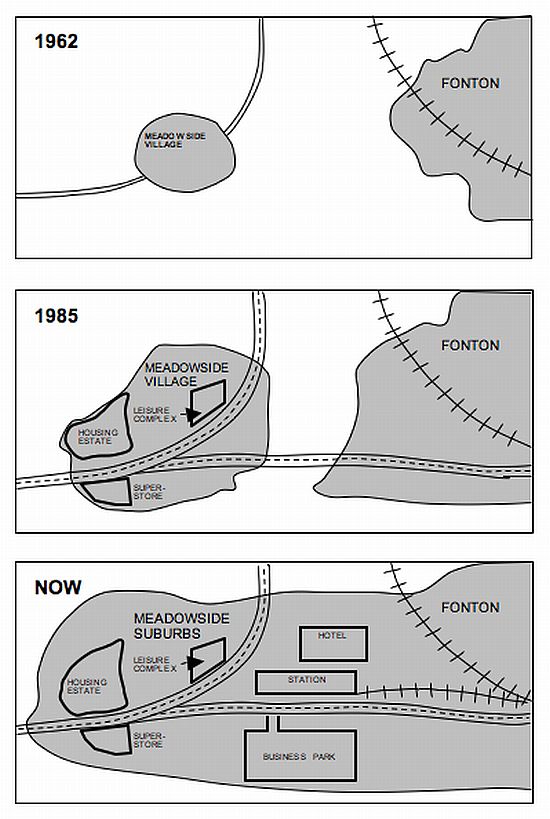
It is possible for you to be asked to compare two or three maps in IELTS writing task 1 (academic paper). IELTS map comparison tasks are not common but if you get them, you must be prepared. Below is an example of a task with three maps.

The maps below show the changes that have taken place in Meadowside village and Fonton, a neighbouring town, since 1962.

ielts map comparison 3 maps

Source: The above map was not created by IELTS Liz.

Here are some questions to help you decide how to write your task 1 map report to compare maps that show change over a period of time.

1. What tense will you use to complete this sentence:

Between 1962 and the present, there …………………… in Meadowside.

a. Present Simple:  …. is considerable development ….
b. Past Simple: ….was considerable development ….
c. Present Perfect: ……….. has been considerable development ………

2. What changes can you see in the maps? Choose the relevant features from the list below.

a. change in infrastructure
b. change in transport
c. change in entertainment
d. change in industry
e. change in buildings
f. change in size

3. Find the grammar or vocabulary mistakes in the following sentences. Each sentence may one or more mistakes.

a. In 1962, there was a small road travelling through Meadowside village which was replaced by a main road in 1985.
b. Another main road was also constructing from the southeast to southwest in 1985.
c. A superstore is building in the west, south of the main road and housing state 1985.
d. There is currently business park which is locate between Meadowside and Fonton, opposite the station.

Answers

  1. c is the correct answer. We use the present perfect when writing about something that started in the past until now.
  2. All features are shown except for d (industry).  Knowing changes in key features can help you with your overview paragraph.
  3.  
    • a) travelling = running through Meadowside… / crossing Meadowside
    • b) constructing = constructed 
    • c) is building = was built 
    • d) business park = a business park  /  is locate = is located

Recommended Lessons

Sample Task 1 Practice Charts
IELTS Video Lesson: How to structure your writing task 1

error: Content is protected !!