Using the Passive Voice for Giving Opinion in Writing Task 2

Many students ask me if it’s ok to use the passive voice to give your own opinion in an IELTS essay. And some people think that they will get a higher band score if they use a passive voice in their essay. But is this true?

For example:

Is it possible to use “it is believed …” or “it is thought …” instead of “in my opinion” or “I believe”

This lesson will

  • explain when to use passive voice
  • explain about using passive voice for opinions
  • explain what the examiner is looking for in IELTS writing task 2 opinion essay
  • provide Free Video Lessons:
    • Expressing your Opinion for IELTS Writing Task 2
    • Language for Discussion Essays
  • give useful links for IELTS

Examples of passive and active voice:

  • The road was built a long time ago = passive
  • The Romans built the road a long time ago = active

Which should we use and when?

When to Use Passive Voice

We use passive voice in the following situations and ways:

  • when the performer (the person doing the action) is unknown or irrelevant
    • More wind power is used than solar power.” In this sentence, the people using the power is irrelevant to the information so passive voice is used.
    • The information was hacked from the computer.” In this sentence, the person doing the hacking is possibly not known or the person is not important to the person speaking so passive voice was used.
  • when it refers to a group of unspecified people
    • It is thought that the government should improve the infrastructure of all major cities.” In this sentence, we do not know who the people are that think this. We only know that it refers to “some people” but not a specified group.
  • when the person doing the action is less important than the action itself
    • The decision was made by the committee.” In this sentence, “the decision” is more important than “the committee” so the decision becomes the subject and passive voice is used. The person doing the action is added after using “by ….”
  • depending on what is most important to the person speaking or the thing doing the action
    • Trees produce more oxygen.” is an active sentence and “trees” is the subject. “More oxygen is produced by trees.” is passive voice. This is used because “oxygen” is more important than “trees”.

Does using the passive voice give you a higher score?

Actually, the passive voice does not give you a higher score. No particular tense of grammar feature gives you a higher score. There are no special tenses. Each tense and each grammar feature is value simply because it shows the examiner a broader range of grammar. You should only use the passive voice when it is suitable to do so.

Using Passive Voice for Giving Opinions

From the above information, we can see that the passive voice “it is thought” does not refer to you. It refers to other people who are not specified, for example “It is thought by some people that ….” is NOT your opinion.

You use the passive voice in IELTS writing task 2 to write about other people’s opinions. For example, “It is believed by some that children should focus on sciences at school, while it is believed by others that children should spend time focusing on the arts.” Two opposite views belonging to other people – not you.

This means you could use the passive voice in a Discussion Essay or in your Background Statement when you introduce other people’s views before you give your own in the Thesis Statement.

IELTS Writing Task 2: Your Opinion

When the IELTS writing task 2 instructions ask for your opinion, you must state your opinion clearly. This means it will be an active sentence. You will need to state:

I think / I believe / In my opinion

If you use “it is believed”, this is not your opinion. It belongs to other people. The examiner give you a lower score because you didn’t give your opinion. You can’t use “it is believed” to express your own view. It is grammatically incorrect in English and it is a big mistake in IELTS writing task 2.


How to Give your Opinion: Free Video Lesson

Watch this video lessons to help tips about expressing your opinion in IELTS writing task 2. It’s an old video, but still completely relevant today.

.

More IELTS Tips

Click to open:

………………………………………..

FREE SUBSCRIBE: Get my New Lessons & Tips by Email

Success! An email was just sent to confirm your subscription. Please find the email now and click ‘Confirm’ to start subscribing.

.
Can you express your opinion using passive form in IELTS?

I have a lot of students asking me about using the passive voice in IELTS writing, particularly in writing task 2. They want to know if it is possible to use the passive form to express your own opinion.

For example:

Is it possible to use “it is believed that…” or “it is thought that …” instead of “in my opinion”.

Do you think this is possible?

Post your answers in the comments box below.

Answers

The answer is now available on this page: https://ieltsliz.com/using-the-passive-voice-for-giving-opinion-in-writing-task-2/


Model Answer for IELTS Speaking Part 2: A Service

The model answer for the IELTS speaking part 2 topic A SERVICE was produced by an ex-IELTS examiner. It shows how you can extend your ideas to showcase your English for a high band score. The topic has been repeated many times in the IELTS and will continue to be used yearly.

IELTS Speaking Part 2 Cue Card: A GOOD SERVICE

An occasion you received a good service from a company or shop

You should say:

  • where it was
  • when you received the service
  • who was with you at the time
  • and explain how you felt about receiving the service.

Model Answer: A GOOD SERVICE

I’d like to tell you about a recent purchase I made and the service I received which I thought was outstanding.

I bought a necklace from a small online shop that I found whilst surfing the net. It wasn’t a shop that I had bought things from before so I was slightly apprehensive about it. The shop didn’t have a wide range of gold jewellery but what it had was unique in style without doubt.

So, about three weeks ago, I selected a gold necklace to buy from this shop and within just three days it arrived through the post. The delivery came beautifully wrapped in fine Japanese style wrapping paper along with a gift voucher for a discount on my next order. I was truly impressed with the care that had been taken in wrapping it and the personal note that also came with it. But what impressed me the most was the free gift that arrived as well. I wasn’t expecting that at all. Along with my necklace was a matching bracelet which was also exquisitely made.

I remember the day it all arrived because my best friend was visiting me at the time. When I opened the parcel, we were amazed at both items of jewellery. My friend immediately went online and put in an order of her own. So, I suppose it goes to show that good customer service has its own rewards.

It’s hard to describe how I felt. Of course, as I said, I was amazed but it was more than that. Life can be tough sometimes and when you get such a lovely, unexpected present, it makes you feel as though anything is possible in the world. I’m pretty sure that small shop will do very well in the future. I know I will certainly order from that shop again.

Feedback:

Fluency: a full talk, delivered without unnatural pauses and without effort.

Grammar: past simple, past perfect, past prefect passive, past continuous, present simple, future form, frequent complex sentences. Error free

Vocabulary: flexible, an awareness of collocations and with a strong range of words: slightly apprehensive, unique in style, beautifully wrapped, Japanese style wrapping paper, matching bracelet, exquisitely made, put in an order, it goes to show, good customer service, its own rewards

Similar Cue Card Topics in IELTS Speaking Part 2

  1. A time you had to return something you bought
  2. A time you received poor service at a shop
  3. A successful business
  4. A time you helped someone
  5. A restaurant you frequently go to
  6. A local shop
  7. Someone with good people skills
  8. Someone who likes helping others

Tips for Speaking Part 2

  • Use your 1 mins effectively. Plan extra details to add, plan a past memory or a future plan to boost your grammar score.
  • Be natural and chatty. Talk as though you were chatting with a friend.
  • Remember that there are no questions to answer. There are guidelines of what to put in your talk which you can use or not use as you wish.
  • Following these links and prepare ideas: Common Speaking Part 2 Topics 
  • Check out another model answer for speaking part 2. Click on the link: Model Answer Speaking Part 2 Holidays
  • Learn How to Start your Part 2 Talk
  • See How your IELTS Speaking is Scored: IELTS Band Scores Explained
  • ALL FREE MODEL ANSWERS & TIPS FOR IELTS SPEAKING

……………………………………..

FREE SUBSCRIBE: to Get my New Lessons & Tips by Email

Success! An email was just sent to confirm your subscription. Please find the email now and click ‘Confirm’ to start subscribing.

.

Vocabulary for Shoes Topic in IELTS Speaking Part 1

The topic of Shoes can appear in IELTS Speaking Part 1. While many of you know the topic of Clothes, not many people realise that the topic could be a specific part of clothing such as shoes, accessories (bags) or even jewellery. You need to prepare for these topics so that you have a good range of vocabulary to offer the IELTS speaking examiner.

Below you will find vocabulary exercises with pronunciation audios to learn words for this topic and a link to questions and model answers for this topic.

Vocabulary Practice for SHOES 

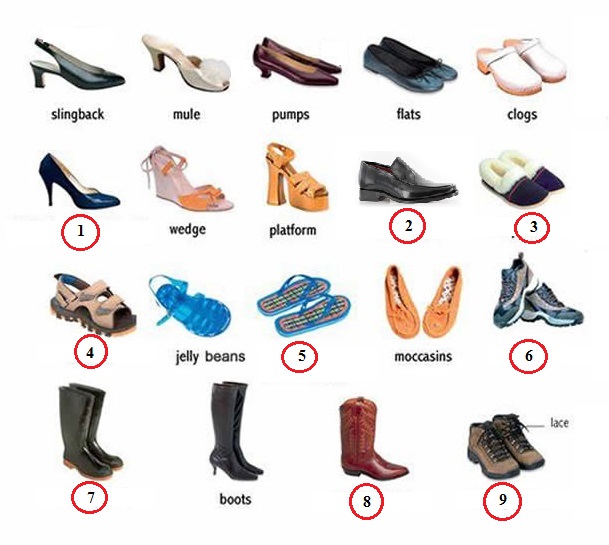
As you see there are words missing for types of shoes in the picture below. Listen to the recording and write down the missing types of shoes. Answers will not come in order. Note: words are given as singular because some images show only one shoe, but you would use plural when talking about these shoes.

Vocabulary for Shoes Clothes IELTS Topic

Listen to the recording below. Write down the missing words you hear. Listen twice if you need to – this is a vocabulary lesson more than a listening lesson.

Answers

Click below to reveal the answers to the missing words:

Answers

  1. high-heeled shoe
  2. loafer
  3. slippers
  4. walking sandal
  5. flip-flops (also knows as thongs)
  6. trainers (also known as sneakers)
  7. wellington boots (also known as wellies)
  8. cowboy boot
  9. walking boots (also known as hiking boots)

.

More SHOES Vocabulary

Learn more useful language for shoes. Listen to the recording below and practice your pronunciation.

Shoes Vocabulary - parts of a shoe

Listen to the audio  for the above vocabulary:

.

Extra Vocabulary for SHOES Topic

  • comfy
  • tight
  • slip off = come off easily
  • pointed
  • rounded
  • thick soles
  • ankle straps
  • wear out / worn out
  • sloppy (something that isn’t smart)

RECOMMENDED FOR YOU

FREE SUBSCRIBE

Success! An email was just sent to confirm your subscription. Please find the email now and click 'Confirm' to start subscribing.

.

IELTS Speaking Part 1 Topic: Shoes

“Shoes” is a commonly recycled topic in IELTS Speaking Part 1. Most people think only about the topic of Clothes, but the topic could be very focused on just Shoes. Below are some typical questions for this topic and model answers. You can also find great vocabulary to boost your score for this topic here: SHOES VOCAB LIST

IELTS Speaking Topic SHOES: Questions

  1. What kind of shoes do you usually wear?
  2. Do you have a favourite pair of shoes?
  3. How often do you buy shoes?
  4. Where do you usually buy your shoes?
  5. What do you look for in a pair of shoes?
  6. Would you ever spend a lot of money on a pair of shoes?
  7. Do you think men and women have the same attitude towards shoes?
  8. Are there any shoes in your country that shouldn’t be worn at work?
  9. Do people usually wear different types of shoes in different seasons in your country?
  10. Would you ever buy shoes online?
  11. Do you think the type of shoes someone wears reflects their character?

For IELTS Speaking Part 1, the examiner will only ask you about three or four questions per topic. So, even though the examiner has a long list of questions, you’ll only be asked a few of them.

IELTS Speaking Model Answers for SHOES Topic

  1. What kind of shoes do you normally wear?
    • Well, most days I like to wear comfy shoes that are easy to wear for the whole day, like sneakers or some other kind of flat shoes. I definitely wouldn’t choose to wear heels normally.
  2. What’s your favourite pair of shoes?
    • I love my Red high heeled shoes that match my red evening dress. But even thought they are my favourite, I rarely get a chance to wear them because they aren’t suitable for everyday events, just for fancy evenings.
  3. How often do you buy new shoes?
    • Probably not as often as I should. I guess I get a new pair about once every couple of years. I tend to stick to my favourites until they completely wear out.
  4. Do you think fashion is important to consider when buying shoes?
    • Yes and no. I mean, in some ways yes I think you do need to consider whether your shoes match the clothes you already have and if they are relatively modern. But at the same time, if I was just buying a pair of trainers I wouldn’t bother with fashion and I’d just go with comfort instead.
  5. Do you think men and women have the same attitude towards shoes?
    • Well, this is probably a gross overgeneralisation but I suppose that on the whole women are more conscious of shoes than men and tend to pay out more for their shoes. Certainly, that’s the case with most men and women I know. But I’m sure there are plenty of men and women out there to counter that.
  6. Would you buy shoes online?
    • As long as there’s an easy return policy, I don’t see buying shoes online a problem. In fact, it’s often easier to just order five pairs online and then you have time to think about whether you want to keep them before the deadline for the returns.
  7. Do you think the type of shoes someone wears reflects their character?
    • Yes, I do. People say that first impressions are important and I think that goes for shoes too. If you see a person wearing a worn out pair of shoes, it gives you the impression that they that are sloppy. On the other hand, if you see someone wearing brand name shoes that cost a fortune, you know that the person has plenty of money to splash around and doesn’t care about costs. So, shoes can tell you a lot about someone’s character.

Vocabulary Review

  • comfy = short form of comfortable (short forms are suitable for IELTS Speaking which is informal)
  • gross overgeneralisation = to assume something without really thinking deeply, for example all women do X and all men do Y
  • worn out = tatty, shabby, the worse for wear, tired
  • sloppy = not tidy, lazy, slovenly
  • cost a fortune = very expensive (cost a fortune is a much better idiom to use than cost an arm and a leg).
  • have money to splash around = have money to waste, to throw around

RECOMMENDED FOR YOU

Click to open link below:

FREE SUBSCRIBE

Success! An email was just sent to confirm your subscription. Please find the email now and click 'Confirm' to start subscribing.

.

Going Off Topic in IELTS Speaking Part 2

Is it wrong to go off topic in IELTS speaking part 2? Will you get a lower band score if you go off topic? Do you get a higher band score if you stay with the topic and follow the prompts given in IELTS speaking part 2? See the tips below to learn how your IELTS speaking is marked.

Going Off Topics for Your IELTS Cue Card Talk in Speaking Part 2

Lets look at this closely because it is something that affects everyone in their IELTS speaking test. And especially in speaking part 2 when people want to expand their talk but they are scared to take the talk in a different direction.

  1. Is it essential to follow the prompts on your cue card for speaking part 2?
    • No, it isn’t. The prompts on the cue card are guidelines and support to help you build your talk.
  2. Will you get a lower score if you don’t complete the cue card prompts?
    • No, you won’t. You can choose which prompts you want to use. You can ignore some and use others. You don’t get a lower score if you don’t complete the cue card prompts.
  3. Are there questions to answer on the cue card?
    • No. There are no questions on your cue card. There are only prompts which are suggestions that will help you give a full talk. It is your choice to use them or not.
  4. Can you add information in speaking part 2 that isn’t on the cue card?
    • Yes, you can. It is recommended that you add information to expend your talk. You will not get a lower score if you go off the topic by adding extra information that is not on your card.
  5. Is the examiner marking your ability to use the prompts on the cue card?
    • No. You are not marked on ideas at all. You are only marked on your use of English language.
  6. I heard that going off topic will reduce your score. Is that true?
    • Not for IELTS speaking. It is true for IELTS writing. In IELTS writing, you are marked on your response, ideas and being on topic. This is not the case for IELTS speaking. You can learn how band scores are marked on the links below.
  7. Should you follow the prompts on the card?
    • I recommend that you use the prompts and also add extra information. The prompts are useful and provide a structure to your talk which will help your score. Adding extra information is a useful way to showcase your English language for a higher score.

RECOMMENDED FOR YOU

Learn about how your speaking and other skills are marked: IELTS Band Score Explained

Prepare ideas for Common IELTS Speaking Part 2 Topics

ALL MODEL ANSWERS, TIPS & TOPICS FOR IELTS SPEAKING

FREE SUBSCRIBE

Success! An email was just sent to confirm your subscription. Please find the email now and click 'Confirm' to start subscribing.

.

Essay Ideas: Celebrations and Family

Happy New Year to those of you who celebrate New Year on January 1st. Here is an IELTS essay question relating to festivals and celebrations.

Most traditional festivals and celebrations are losing their meaning as they become more commercial with the emphasis on buying presents and spending money on parties. Some people think that traditional festivals are a waste of time and money.

To what extent do you agree?

Always spend time thinking about the essay title and planning your answer. You should spend a minimum of 5 minutes thinking, analysing and planning before you start writing your essay. Here are some questions to help you consider the above essay.

Questions for Analysis

1. How do most people celebrate traditional festivals?

2. Do most people who spend money not recognise the meaning behind the festival?

3. Is it possible to spend lots of money on celebrations and still recognise their meaning?

4. Are people more interested in the traditional meaning of festivals or on having a good time  celebrating?

5. How important are traditional festivals in keeping a culture alive?

6. What would happen if we get rid of all traditional festivals?

7. Do you think the money spent on festivals could be better used?

Now plan how you will use your ideas to answer the question given in the IELTS essay question. After you have decided your plan, check the ideas below. Remember that there is no right or wrong in IELTS. These ideas offer one possible options for the content of body paragraphs.

Body Paragraph Content

Below is an example of body paragraph content for a partial agree essay ( a balanced view).

  • Body Paragraph A: Many traditional festivals are becoming more commercial as people use them as an opportunity to treat themselves or others to expensive luxury goods.
  • Body Paragraph B: This money could certainly be better used as it is not necessary to spend so much money to enjoy festivals and respect traditions.
  • Body Paragraph C: Regardless of the commercial aspect that is developing around many festivals, they are still vitally important in keeping traditions alive and teaching the younger generation about their own culture.

Happy 2018 🙂

Liz


IELTS Essay Ideas: Is Art a Waste of Time?

Art is a common topic to get in IELTS writing task 2. Below is a sample essay question with ideas.

While some people think that art if an important subject for children to study, others think it is a waste of time.

Discuss both sides and give your opinion.

Ideas

Art is Useful

  • art is a means of expression
    • children need to learn to express their thoughts and feelings
    • it is often easier for young children to draw pictures than to express complex feelings in words
  • art is a creative form
    • creative thinking should be developed
    • creative thinking is beneficial later in life

Art is A Waste of Time

  • there are other more important subjects that would benefit children for their future life
    • the importance of technology, sciences and languages
  • studying art does not lead to a successful career
    • most artists struggle to make a living from selling their art

Opinion

  • art is a valuable subject but should not be a main focus on any curriculum or detract from other more important subjects
    • having a balance of subjects is the best way to help children develop a balanced character in life

Recommended

Essay Ideas: Littering in Cities

error: Content is protected !!