IELTS Reading True False Not Given: Essential Tips

IELTS True False Not Given Tips for Reading. These are the most challenging types of questions that appear in IELTS reading. You can find them in both the Academic and GT IELTS Reading tests. The more you understand about these questions, the easier they will be. Use the strategies and techniques below to help you boost your score for reading. 

Understanding IELTS Reading True False Not Given Questions

You will be given statements containing information. You must decide if the information in the statement is True, False or Not Given according to the information in the reading passage.

  1. True: You can find this information in the passage and it agrees with the statement.
  2. False: The passage and statement have different information. The passage shows that the statement is wrong – it contains a mistake which you know because the passage shows us what it should be.
  3. Not Given: This means you can’t find all the information in the passage or that the passage does not contain enough information to know if it is true or false.

Are these types of questions the same as Yes, No, Not Given Questions? They are essentially the same, but IELTS have created the two kinds of questions because of the different content of the reading passage. To learn more, click here: IELTS Yes No Not Given Reading

Difficulties with True False & Not Given

  1. Paraphrasing. You must be prepared for the words in the statement to be paraphrased in the passage. This means you really need to know your vocabulary.
  2. You are looking for meaning. Many students just try to match words but you actually need to match meaning and check the content of the information given. Some times the same words are used but the meaning is not the same – this is one common difficulty with choosing the right answer.
  3. Not Given OR False 
    1. Not Given means the entire statement is not given in the passage.  Maybe part of the statement is given but not the whole statement. Watch out for that!! Try to find the whole meaning in the passage.
    2. False means the passage contradicts the statement. This means the passages shows the statement is wrong. Don’t forget you are not just looking for an opposite meaning, you are also looking for contradicting information.

Summary of IELTS Reading True False Not Given Tips

Below is a list of the main Tips for IELTS True False Not Given Reading Questions. However, you should watch the video to understand them clearly for maximum benefit.

  1. Spend time analysing the statement in the question before you try to find the answer
  2. Many words will be paraphrased so watch out for that (for example, work = employment / changing = altering)
  3. Don’t match just key words, you are aiming to match meaning. Some of the key words might be the same in the passage but it doesn’t mean the answer is true or yes.
  4. The meaning of false or no is that the statement contradicts the claims or information in the passage. This means the statement gives one meaning but the passage gives another meaning – therefore the statement is FALSE.
  5. Not Given means that the whole meaning of the statement is not in the passage. Some key words might be found but not the full meaning of the statement.
  6. You can write T instead of True on your answer sheet but make sure your handwriting is clear.
  7. The answers follow the order of information in the passage for these questions. Other types of reading questions might not have answers that come in order.
  8. Learn common challenges or problems that you have in reading. Make a list of paraphrases you have struggled with.
  9. You can write T instead of True, but you can’t write T instead of Yes. You also can’t write True instead of Yes. So, don’t mix up TFNG answers and YNNG answer.

True False Not Given Reading Video


See below video for homework answer.

Homework Answer from TFNG Video Lesson

Is the following question statement True, False or Not Given according to the information in the passage?

  • Passage: By the second half of the 17th century coffee had found its way to Europe.
  • Question: Coffee arrived in Europe after the 17th century.

Answer 

Click below:

ANSWER

The answer is FALSE.

The passage states by the second half of the 17th century. What does this mean? Well, the first half is at the beginning of the 17th century to the middle of the 17th century. The second half is from the middle of the 17th century to the end of the 17th century. So, the second half of the 17th century is still inside the 17th century.

However, the question statement says after the 17th century which means the 18th century. So, this is wrong. If we know the statement is incorrect / opposite / contradicting, the answer is FALSE.

.

RECOMMENDED FOR YOU

FREE SUBSCRIBE

Subscribe to get new lessons & tips by email.

.

IELTS Model Bar Chart Band Score 9

The model answer below is for an IELTS bar chart in writing task 1 of the academic paper. This model answer comes from the video tutorial I made, see the following link: Free Video Tutorial:  How to Describe an IELTS bar chart

IELTS Bar Chart

Bar Chart Model

Source: Bar chart above from unknown source.

IELTS Bar Chart Sample Answer

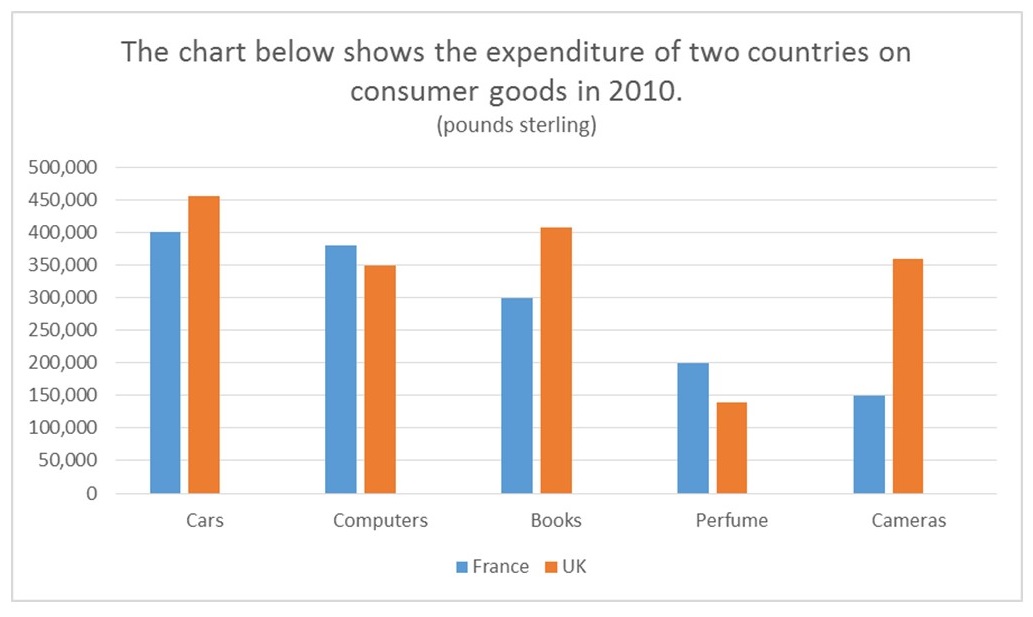
The chart illustrates the amount of money spent on five consumer goods (cars, computers, books, perfume and cameras) in France and the UK in 2010. Units are measured in pounds sterling.

Overall, the UK spent more money on consumer goods than France in the period given. Both the British and the French spent most of their money on cars whereas the least amount of money was spent on perfume in the UK compared to cameras in France. Furthermore, the most significant difference in expenditure between the two countries was on cameras.

In terms of cars, people in the UK spent about £450,000 on this as opposed to the French at £400,000. Similarly, the British expenditure was higher on books than the French (around £400,000 and £300,000 respectively). In the UK, expenditure on cameras (just over £350,000) was over double that of France, which was only £150,000.

On the other hand, the amount of money paid out on the remaining goods was higher in France. Above £350,000 was spent by the French on computers which was slightly more than the British who spent exactly £350,000. Neither of the countries spent much on perfume which accounted for £200,000 of expenditure in France but under £150,000 in the UK.

EXAMINER COMMENTS: The report has been organised into logical paragraphs with flexible use of linking. The overview is very clear with key features well highlighted. Accurate data is used to support sentences in the body paragraphs. There is a range of complex structures and vocabulary which are all flexibly used. This is an estimated band score 9 writing task 1 report for the academic paper. As you can see, the structure and information are presented in a way that is easy to understand, while the language offers complexity. 

RECOMMENDED FOR YOU FOR WRITING TASK 1:

FREE SUBSCRIBE

Subscribe to get new lessons & tips by email.

.

.

Practice Essay for Sample Materials

I am currently working on an e-book for IELTS writing task 2 grammar. I need sample writing from people preparing for IELTS for my book.

I would like you to write a model essay for the question below. Sentences from your essay might be used in my e-book. Obviously, your name will not be used, just some sentences. If you post your essay, you are giving me your consent to use sentences in your essay in my e-book.

Essay Question

Some people think that watching TV causes weight problems in children. Do you agree with this view? What solutions can you suggest to tackle children’s weight problems?

Model Essay

I have written a full model essay for this question and also a long list of tips which relate directly to many of the essays posted below.

To view the model essay and tips, click below:

Model Essay & Tips


All the best

Liz

Comments

The points below will help you when you type your essay into the comments box.

  1. Please note this is a multi-task essay. The first question asks for your opinion on the issue. The second asks for your solutions. Both questions carry equal weight.
  2. You should aim for between 270 and 290 words. It is not recommended to go over 300.
  3. You should use a range of linking devices.
  4. Do not use learned phrases. Each sentence should be uniquely created by yourself.
  5. Always divide the body into paragraphs. Choose a logical organisation of ideas.
  6. Don’t aim to impress. Always aim for accuracy.

Reading Answers Death of High Street

Below are answers for yesterday’s reading passage: Death of the High Street Lesson

If you haven’t done the lesson, please complete it before looking at the answers. Click here: Reading Lesson Death of the High Street.

Answers

  1. A = 3
  2. B = 5
  3. C = 1
  4. D = 2
  5. E = 4
  6. triggered = spurred
  7. combine = couple that
  8. expendable = disposable
  9. soar = shoot up
  10. discouraging = deterring
  11. imminent = looming
  12. boost = injection

I hope you found this lesson useful 🙂

All the best

Liz

IELTS Reading Lesson: Death of the High Street

A 2019 IELTS lesson 🙂 A reading exercise for matching headings practice about the “Death of the High Street”. This is an easy lesson to help you develop confidence. There are two exercises in this lesson.

  1. Exercise 1 = Matching Headings
  2. Exercise 2 = Synonyms (Vocabulary practice)

Death of the High Street: Reading for IELTS

Exercise 1: Matching Headings

Questions 1-5. Match the heading with the relevant paragraph below. Write a letter for each answer.

  1.  Changing Tastes
  2.  Rising Overheads
  3. Squeezed Incomes
  4. Too Much Debt
  5. E-commerce

A) A big factor has been a fall in discretionary spending, spurred by rising shop prices and weak wage growth. A near 15% fall in the pound since the Brexit vote has pushed inflation over 3% – way above the Bank of England’s 2% target. This has made imported goods more expensive, with those costs passed on to consumers. Couple that with the fact that wages have been rising at a slower pace than inflation – and shoppers have less disposable income to spend in stores and restaurants.

B) Online giants such as Amazon have had a huge impact on the high street as more consumers see online shopping as cheaper and easier than going to the shops. And while overall retail sales growth is weak, online sales continue to shoot up. If shops fail to do either “value, convenience, or experience” well, they will struggle, Mr Martin says.

C) Toy store “Toys R Us” fell short in all three areas, according to Simon Thomas of Moorfields Advisory, the toy chain’s administrators. He says it was “unlikely” the retailer can be saved because its business model “isn’t what consumers really want now”. “We’ve got very large stores which are fairly impersonal. People are looking now to have a better shopping experience, and we were unable to deliver that.”

D) Inflation is not the only cost pressure retailers face. The National Minimum Wage and new National Living Wage for over-25s go up each year, pushing up payroll costs. “Business rates are deterring investment in local communities, causing shop closures and job losses in hard-pressed communities and preventing retailers from delivering what their customers want in an efficient and cost-effective way.”

E) As a consequence of over expansion, many retailers are shouldering “high debt burdens”, says KPMG’s Mr Martin. Just before its collapse, Toys R Us UK faced a looming VAT debt payment deadline of £15m. It would have been unable to pay it without a cash injection from an outside investor.

Source: Passage from BBC News Photo sourced online.

Exercise 2: Synonyms Practice

Questions 6-12. Find the following synonyms in the passage above. The answers will come in order in the passage. No more than two words for each answer. This question type does not come in the test. I have created it to give you essential practice with synonyms.

  • 6. triggered
  • 7. combine
  • 8. expendable
  • 9. soar
  • 10. discouraging
  • 11. imminent
  • 12. boost

Answers

Click below for Answers:

Answers

Please remember that in the real IELTS test, if you are asked to write a letter, you must write the letter and not the word. Always following instructions very carefully.

  1. A = 3
  2. B = 5
  3. C = 1
  4. D = 2
  5. E = 4
  6. triggered = spurred
  7. combine = couple that
  8. expendable = disposable
  9. soar = shoot up
  10. discouraging = deterring
  11. imminent = looming
  12. boost = injection

.

Hope you find the lesson useful 🙂

All the best

Liz

Matching Headings Question: IELTS Reading Exercise

In this question you must match the correct heading to the correct section of the passage. Matching headings questions are common in IELTS reading and are one of the longest to complete. This is a practice exercise for students, not an IELTS test.

Take time to read through the headings given. Spot which ones are similar or contain similar language – they are often traps. Also check the number of headings given, usually there are more headings available than are needed.

The heading usually relates to the general aim of a section.

Antimicrobial Resistance

A) While antibiotic resistance refers specifically to the resistance to antibiotics that occurs in common bacteria that cause infections, antimicrobial resistance is a broader term, encompassing resistance to drugs to treat infections caused by other microbes. Antimicrobial resistance (AMR) is resistance of a microorganism to an antimicrobial drug that was originally effective for treatment of infections caused by it. Resistant microorganisms (including bacteria, fungi, viruses and parasites) are able to withstand attack by antimicrobial drugs, such as antibacterial drugs (e.g., antibiotics), antifungals, antivirals, and antimalarials, so that standard treatments become ineffective and infections persist, increasing the risk of spread to others. The evolution of resistant strains is a natural phenomenon that occurs when microorganisms replicate themselves erroneously or when resistant traits are exchanged between them. The use and misuse of antimicrobial drugs accelerates the emergence of drug-resistant strains. Poor infection control practices, inadequate sanitary conditions and inappropriate food-handling encourages the further spread of AMR.

B) New resistance mechanisms emerge and spread worldwide threatening our ability to treat common infectious diseases, resulting in death and disability of individuals who until recently could continue a normal course of life. Without effective anti-infective treatment, many standard medical treatments will fail or turn into very high risk procedures. This would be a financially draining situation for wealthy countries but for the poorer ones, it could have catastrophic effects.

C) Infections caused by resistant microorganisms often fail to respond to the standard treatment, resulting in prolonged illness, higher health care expenditures, and a greater risk of death. As an example, the death rate for patients with serious infections caused by common bacteria treated in hospitals can be about twice that of patients with infections caused by the same non-resistant bacteria. For example, people with MRSA (another common source of severe infections in the community and in hospitals) are estimated to be 64% more likely to die than people with a non-resistant form of the infection.

D) WHO’s report on global surveillance of antimicrobial resistance reveals that antibiotic resistance is no longer a prediction for the future; it is happening right now, across the world, and is putting at risk the ability to treat common infections in the community and hospitals. Without urgent, coordinated action, the world is heading towards a post-antibiotic era, in which common infections and minor injuries, which have been treatable for decades, can once again kill.

Questions 1-4

Choose the correct heading from the list below (i-x)

Choose the correct heading for sections A-D from the list of headings below.

i. A fatal threat

ii. A global concern.

iii. The evolution of resistance

iv. MRSA in hospitals

v. The present situation

vi. What is antimicrobial resistance?

vii. Protecting future generations

  1. Section A =
  2. Section B =
  3. Section C =
  4. Section D =

Answers

  1. vi
  2. ii
  3. i
  4. v

(passage adapted from WHO)

All reading exercises on ieltsliz.com have been written by myself to help you prepare for your IELTS test.   

Liz

Vocabulary

  • broader term = a more general term
  • encompassing = including
  • persist = continue
  • phenomenon = occurrence
  • replicate = copy / reproduce
  • erroneously = mistakenly
  • sanitary = hygienic  / clean
  • catastrophic = disastrous / terrible / devastating
  • prolonged = lengthy (prolonged illness = chronic illness)

Recommended

Matching Heading Practice: Medium Level

Finding Ideas for IELTS Writing Task 2

Before your test for your preparation, you need to find and develop ideas for IELTS writing task 2 topics. Your ideas and the way you present ideas make up 25% of your marks in writing task 2. So, you need to prepare ideas for common topics.

Follow the links to find a list of common topics for writing task 2 and also to get a list of over 100 IELTS essay questions. You can also follow the next link to see recent IELTS topics and questions posted by students after their IELTS test. Use these questions and topics as a starting point to develop ideas.

Developing Ideas For IELTS Essays?

There are two ways you can find ideas for topics before your test. Below are your two options:

1.  Using the Internet for Ideas

Take an essay question or topic and type it into google. Then start researching. There are always plenty of model essays, which although not always safe to use as models for IELTS, are good for gaining ideas and vocabulary. You can also visit debate websites which show you pros and cons of different topics or different world issues. 

2. Ideas for Essay Topics E-book

You can purchase an e-book which contains ideas and vocabulary for over 150 IELTS essay topics. 

The ideas in the e-book are presented as exercises to help you remember the ideas and learn the vocabulary. Don’t forget that vocabulary counts for 25% of your writing task 2 marks so you will need to review or develop your word knowledge. Click here: Sample Chapter. Click here: E-book in Liz’s Store

The method you choose for developing ideas will largely depend on the time you have before your test. If you like convenience, get the e-book. If you have lots of time, do your own research.

Planning Ideas During Your Test

It is important that you take time to analyse the essay question and plan your ideas properly. You are being marked not using relevant ideas, presenting them clearly and explaining them fully. Use at least 5 mins to make plans before you start writing. Remember – you control the time during the writing test. You have 1 hour for task 1 and task 2. It is your choice how long you spend on each one and which order you do them in. Click here: IELTS essay planning tips.


Subscribe to get New Posts by Email

IELTS Writing Task 2 Sample Answer Band 9

The IELTS writing task 2 sample answer below has examiner comments and is band score 9. The topic of social media is common and this IELTS essay question was reported in the IELTS test. Check the model essay and then read the comments.

Target Band 7, 8 and 9 in IELTS Essays

Many people think that the techniques used to get a band score 7 vary from those to get a band score 9. This is not the case. The techniques for a band score 9 essay are the techniques for all essays regardless of what score you are aiming for. The result of your band score will be decided by how well you apply those techniques, how well you address the task, and the level of your English language. So, the essay below is one that all IELTS candidates can learn from.

IELTS BAND 9 MODEL ESSAY

Many people believe that social networking sites (such as Facebook) have had a huge negative impact on both individuals and society.

To what extent do you agree?

Social networking sites, for instance Facebook, are thought by some to have had a detrimental effect on individual people as well as society and local communities. However, while I believe that such sites are mainly beneficial to the individual, I agree that they have had a damaging effect on local communities.

With regards to individuals, the impact that online social media has had on each individual person has clear advantages. Firstly, people from different countries are brought together through such sites as Facebook whereas before the development of technology and social networking sites, people rarely had the chance to meet or communicate with anyone outside of their immediate circle or community. Secondly, Facebook also has social groups which offer individuals a chance to meet and participate in discussions with people who share common interests.

On the other hand, the effect that Facebook and other social networking sites have had on societies and local communities can only be seen as negative. Rather than individual people taking part in their local community, they are instead choosing to take more interest in people online. Consequently, the people within local communities are no longer forming close or supportive relationships. Furthermore, society as a whole is becoming increasingly disjointed and fragmented as people spend more time online with people they have never met face to face and who they are unlikely to ever meet in the future.

To conclude, although social networking sites have brought individuals closer together, they have not had the same effect on society or local communities. Local communities should do more to try and involve local people in local activities  in order to promote the future of community life.

Examiner Comments: This essay was about how social media impacts two aspects: 1) individuals, which means people  2) society, which also means communities. This essay did address both of these aspects of social media and developed them both sufficiently for a high score. The writer presented a clear opinion and retained this opinion throughout the essay. Organisation of ideas into paragraphs was logical. Signposting and linking were also flexible. Furthermore, the word length of this essay is typical for anyone aiming for band score 7 and above. Words 280 = this is a sufficient length for a high score. A long essay (well over 300 words) is not helpful for a high score in Task Response, particular as IELTS essays are designed to be highly focused and quite short.

Useful Links – IELTS Writing Task 2

FREE SUBSCRIBE

Subscribe to get new lessons & tips by email.

error: Content is protected !!